Giving up your “right” to be offended can be one of the most freeing, healthy, simplifying, relaxing, refreshing, stress-relieving, encouraging things you can do. Being “unoffendable” helps lift religious burdens from our backs and allows us to experience the joy of gratitude, perhaps for the first time, every single day of our lives—flourishing the way God intended.HarperCollins/Zondervan/Thomas Nelson
Day 1
Scripture: Proverbs 19:11
Being Unoffendable: The Ridiculous Idea
Becoming Unoffendable
I actually heard a guy say, “You can choose to be ‘unoffendable,’” at a business meeting. I looked up the definition of offended, and all the dictionaries say something about anger and resentment. When I’m writing about the word here, then, that’s what I mean.
There’s another definition, about having your senses affronted, or offended, but that’s not the definition we’re dealing with here. We just made some homemade barbecue sauce the other day, and we unanimously and immediately agreed, right then and there, that it was highly offensive. That happens.
It’s the taking of offense, and the very presumption that I’m somehow entitled to be angry with someone, that I’m talking about. Surely there’s got to be a place for “righteous anger” against someone, right? Surely there are times we are justified in our anger . . .
But what that guy said at the business meeting did get me thinking, because he was so obviously wrong. And besides, since I call myself a Christian person, wasn’t I supposed to be angry at people for certain things? Isn’t being offended part of being a Christian?
So I did what any rational, fair-minded, spiritually mature person would do: I scoured the Bible for verses I could pull out to destroy his argument, logically pummel him into submission, and—you know—win.
Problem: I now think he’s right. Not only can we choose to be unoffendable; we should choose that.
We should forfeit our right to be offended. That means forfeiting our right to hold on to anger. When we do this, we’ll be making a sacrifice that’s very pleasing to God. It strikes at our very pride. It forces us not only to think about humility, but to actually be humble.
I used to think it was incumbent upon a Christian to take offense. I now think we should be the most refreshingly unoffendable people on a planet that seems to spin on an axis of offense.
Forfeiting our right to anger makes us deny ourselves, and makes us others-centered. When we start living this way, it changes everything.
Actually, it’s not even “forfeiting” a right, because the right doesn’t exist. We’re told to forgive, and that means anger has to go, whether we’ve decided our own anger is “righteous” or not.
We won’t often admit this, but we like being angry. We don’t like what caused the anger, to be sure; we just like thinking we’ve “got” something on someone. So-and-so did something wrong, sometimes horribly wrong, and anger offers us a sense of moral superiority.
That’s why we call it “righteous anger,” after all. It’s moral and good, we want to think.
But inconveniently, there’s this proverb that says, “You may believe you are doing right, but the Lord will judge your reasons” (Prov. 16:2 NCV).
So it’s not just me. We all, apparently, find ourselves pretty darn convincing. Of course my anger is righteous. It’s righteous because, clearly, I’m right and they’re wrong. My ways seem pure to me. Always.
In the moment, everyone’s anger always seems righteous. Anger is a feeling, after all, and it sweeps over us and tells us we’re being denied something we should have. It provides its own justification. But an emotion is just an emotion. It’s not critical thinking. Anger doesn’t pause. We have to stop, and we have to question it.
We humans are experts at casting ourselves as victims and rewriting narratives that put us in the center of injustices. And we can repaint our anger or hatred of someone—say, anyone who threatens us—into a righteous-looking work of art. And yet, remarkably, in Jesus’ teaching, there is no allowance for “Okay, well, if someone really is a jerk, then yeah—you need to be offended.” We’re flat-out told to forgive, even—especially!—the very stuff that’s understandably maddening and legitimately offensive.
That’s the whole point: The thing that you think makes your anger “righteous” is the very thing you are called to forgive. Grace isn’t for the deserving. Forgiving means surrendering your claim to resentment and letting go of anger.
The apostle James said point-blank that anger does not produce the kind of righteousness God wants in us: “The anger of man does not produce the righteousness of God” (James 1:20 ESV).
In Colossians 3:8 Paul writes, “But now also put these things out of your life: anger, bad temper, doing or saying things to hurt others, and using evil words when you talk” (NCV).
We don’t like the “anger” part. We think that when he said to put anger “out of your life,” he really meant “except when it’s constructive.” I’ve yet to hear us apply that logic to the rest of his teaching in that verse: “Get rid of your evil words—except when it makes sense,” or “Rid yourself of evil words—except when they really had it coming.”
Let’s admit it: we like anger—our own anger, that is—at some level. We’re just so . . . justified.
Seek justice; love mercy. You don’t have to be angry to do that. People say we have to get angry to fight injustice, but I’ve noticed that the best police officers don’t do their jobs in anger. The best soldiers don’t function out of anger.
Anger does not enhance judgment.
Yes, God is quite capable of being both just and angry, but if I’m on trial in front of a human judge, I’m sure hoping his reasoning is anger-free.
Some people think I’m nuts when I talk about this, when I say we’re not entitled to our anger. And maybe I am. At first, I hated this idea too. The thing is, now I’m hoping I’m right, because life has become so much better this way, and I think I can understand Jesus more.
Respond
Describe a time when you chose to be “unoffendable.”
What impact did that choice have on you and your relationship with the Lord?
Prayer
Heavenly Father, help me to focus on You and put anger out of my life.
Day 2
Scripture: Ephesians 4:26
Anger’s Fun—Except for the Boiling, Blazing, and Burning Part
The Myth of Righteous Anger
So, overall, how does Scripture, which is well acquainted with injustice, describe anger? Take a look at some verses from the New Living Translation.
Anger is described as “fierce” and “cruel” in Genesis 49:7. It’s “burning” in Exodus 11:8. In the same book, it’s also described as a “blazing fury,” and if you’re not careful, it can “blaze against you” (Ex. 15:7; 22:24).
In Leviticus 26, anger is something given “full vent” and equated with “hostility” (v. 28). In Deuteronomy 7, it is associated with the words “burn” and “destroy” (v. 4). In 1 Samuel 20, we see an anger that “boil[s] with rage” (v. 30). Anger “will not be quenched,” according to 2 Kings 22:17. In 2 Samuel 6, it “bursts out” (v. 8); in Job 4, it “blasts” (v. 9); and in Job 16, God Himself, in anger, “tears” and “pierces” (v. 9).
Anger is terrifying and fierce in Psalm 2:5. It’s burning and consuming in Psalm 69:24, then smoldering intensely in Psalm 74.
In Isaiah 9:12, it’s associated with a fist poised to strike. In chapter 30, it’s demonstrated with flames, cloudbursts, thunderstorms, and hailstones (v. 30). In Isaiah 63:3, it tramples.
It doesn’t exactly chill out in Lamentations. The words “engulfed” and “slaughtered” are used in chapter 3 (v. 43).
We’re also told we should be aroused to anger when we see one of God’s commands being broken. Really? Then we’re going to be busy . . . really, really busy. We’re also going to be really, really angry, all the time—and that’s just at ourselves, for starters.
If this is, in fact, what we’re supposed to do—experience “righteous anger” whenever we’re made aware of one of God’s commands being broken—we’ll be precisely what the world doesn’t need and largely believes we already are: a bunch of uptight, seething hypocrites.
The Bible directs us to get rid of anger (Eph. 4:31; Col. 3:8), but our idea of “righteous anger” turns that directive on its head: we can actually pat ourselves on the back for being offended and embracing anger.
And all that boiling, piercing, corrosive power becomes part of our lives—and destroys us.
We cling to our self-righteousness and can’t possibly imagine giving it up. We think it’s how we’re supposed to live.
But our Father is holding out another way of living, entirely. He’s saying it’s far more valuable. He knows. He made us. He knows we can live better this way. We’ll be under less stress. We’ll be able to live in the moment. We won’t be constantly offended, perpetually nursing hurts. He’s telling us to hand over the idea that we know things we don’t about ourselves and others, and simply be humble.
I’ve found myself thinking—even if I don’t say it out loud—that part of my job as a Christian is assessing where people stand. Therefore, if I didn’t try to make this assessment about others, I wasn’t taking Christianity seriously enough, or something. I don’t know what I was thinking.
What a sweet, sweet relief to not have to do this.
Jesus had to point out to seemingly upstanding religious leaders that some prostitutes were closer to the kingdom of God than they were. Would you or I have known that?
Last night, I talked with a new friend of mine who shared that he’s always seemingly been angry. “I spend half of my life with anger,” he said. “I’ve always lost a tremendous amount of sleep because of it.”
As I sat at his kitchen table, with his two adorable toddler daughters running around us, he told me that because he’s now in recovery from drug addiction, he’s had to make amends with people with whom he’s been angry. So he called a guy who once beat him up and told him he was forgiving him.
“The guy was amazed, but it really wasn’t for him. It was for me,” he said.
“And did you sleep soundly that night?”
He laughed. “Yes! Finally! It’s amazing how that happens. And you know what? I’ve found that when I’m not angry, I can finally be in the moment with my wife and kids. Finally. I can just be here. I’m not thinking about what other people did to me.”
God knows how we’re wired. He tells us to forgive and to get rid of anger. People made in His image would do well to listen. It means everything, not just for us, but for those around us.
Like two sweet little girls, who can now have their daddy in full.
Life is better this way. It’s better when we admit what we don’t know, realize our own moral status before God, and give up our made-up Right to Be Offended.
We think we want a right to “righteous anger.” It takes a tremendous amount of humility, an extraordinary “dying to self” to hand over this desire, this job, this obsession, to God. But He made us, and He knows how we operate best. He says to hand it over.
And He’s promising something of value that no one else—and literally no other religion— promises. He’s promising a release from the constant evaluation, never-ending striving, and relentless assessment of where we, and everyone else, stand.
He’s promising a better way of life. He’s holding it out to us, saying, “Hand over the garbage;” and He means it, because He loves us, and He has something better to offer.
He’s offering peace. He’s offering rest.
Respond
Share a time when you were forgiven.
Describe a circumstance when you have shown forgiveness to another.
Prayer
Beloved Jesus, lead me to someone today who needs to hear Your story of love and forgiveness.
Day 3
Scripture: Psalms 106:3
The Big Question: What About Injustice?
We Do Better Without Anger
It’s fair if you are presently thinking, wait! Are we not supposed to be angry at injustice? Are you crazy?
We’re not. But this does not make me crazy. The fact that I enjoy puppetry when no one else is looking? That makes me crazy. My daily habit of eating an entire loaf of burnt toast every morning for ten years? Yes, that qualifies me. Sure. You got me.
But this? No. It’s not as insane sounding as you think.
Yes, it’s unnatural, completely against our instincts, exceedingly radical, certainly unfashionable, counterintuitive, and in violation of conventional wisdom.
Yes to all that.
But so is “Love your enemy.”
Let’s dispense with one idea at the very start: that anger and action are synonymous. Often, we confuse the two, thinking that if we’re not angry about an unjust situation, we’re simply accepting it. That’s completely false.
Anger and action are two very different things, and confusing the two actually hurts our efforts to set things right.
Check out Twitter sometime. You can see anger all over the place. People upset about this, and “taking a stand” on that. This isn’t surprising.
Of course, we’re all thankful for the right to speak our minds. But here’s what’s odd about this confusion when it comes to injustice, anger, and action: a recent study found that people who join causes online are not more apt to actually do something—they’re less likely to take action.
Let’s face it: we’re positively in love with “taking stands” that cost us absolutely nothing. We even get to be fashionable in the process.
We get to think we’re involved, doing something; and if we’re angry, we get to say, “My anger is righteous anger.” And since it’s “righteous” anger, it stands to reason that we’re actually more righteous than the people who aren’t angry like we are!
The myth of “righteous anger” actually impedes the taking of action, because it lets us congratulate ourselves for a feeling, rather than for doing something.
So often it’s true: one person is angry—but it’s someone else who takes action.
Another unfortunate result, in my experience, of the confusion of anger and action is this: Men, in particular, learn to see anger as masculine. They tend to think being angry, and acting out angrily, is very much part of what it means to be a man. (I could cite a million academic sources on this, but I’m just going to assume you agree with me. Plus, if I get back on the internet right now, I’m going to wind up looking at cat memes again, and I really need to focus.)
When talking about this with people, this idea that the Bible doesn’t ever endorse human anger as a solution for injustice, I get this reaction, particularly from men: “But we’ve got to do something!”
Yes, agreed: Do something. Take action.
“But if we don’t get angry, we won’t do anything.”
Really? Why?
So you can’t just do the right thing, because it’s the right thing?
The Bible gives us ample commands to act, and never, ever, says to do it out of anger. Instead, we’re to be motivated by something very different: love, and obedience born of love.
In fact, Paul wrote in 1 Corinthians, it’s the defining motivation. If we do something good, even, without love, we’re just a bunch of noise (13:1).
Acting out of love, to show mercy, to correct injustices, to set things right . . . is beautiful.
Love should be motivation enough to do the right thing. And not “love” as a fuzzy abstraction, but love as a gutsy, willful decision to seek the best for others.
What the world needs, I think you’ll agree, is not a group of people patting themselves on the back for being angry. We need people who actually act to set things right.
Someone might be motivated by anger to do something that is otherwise good. But a relationship with God is like other relationships; it’s not a moral “Did you do that?” checklist. The condition of our hearts is not a side issue. Why we do what we do matters infinitely.
Again, in 1 Corinthians, Paul said, “Though I bestow all my goods to feed the poor . . . but have not love, it profits me nothing” (13:3 NKJV).
You can recognize injustice, stand up to it, even sacrifice your life fighting it. And you can do it without anger. In fact, you’ll do it better. You won’t be remembered as angry, but as convicted of what’s right, and loving to the very end. This kind of love leaves an impression on one’s enemies that anger simply never will.
The early church dealt with injustice daily and was aware of widespread injustices affecting others. So why were they not told to get angry about it, if human anger toward true injustice is actually righteous?
Why isn’t righteous anger ever listed among the things that a Spirit-filled life will bring us? If it’s righteous, why is it not akin to the “fruit of the Spirit,” like love, joy, peace, and gentleness? Why is anger in Scripture so consistently lumped in the other lists with things like, say, slander and malice, with no exclusions for the “righteous” variety? (See, for example, Colossians 3:8.)
We aren’t to just pretend anger away or feel guilty for the initial emotion of anger. But we are to deal with it, with the goal of eradicating it within us. This, of course, is not easy to do, but it’s not complex to understand, either.
Respond
How do you deal with injustice?
Describe a circumstance where you chose to set things right by acting out of love.
Prayer
Precious Lord, fill me with Your love and help me show it to others in every situation.
Day 4
Scripture: Colossians 3:13
On Winning—and by “Winning” I Mean, of Course, Losing
Embracing Forgiveness Instead of Anger
I’m just really good at arguments. I can argue about God, and I almost always win!
And by “win,” of course, I mean “lose.”
Sure, in my fantasy world, I get to out-argue everybody and pin them to the logical mat, and they are so humbled, they turn to me, in tears, and ask what they must do to be saved. They are so in awe of the truth of my premises, validity of my argument, and soundness of my conclusions that they have no choice but to begin their relationship with God.
Yeah, it doesn’t work that way. Ever.
Without love, I’m just a bunch of noise. And even when well-intentioned, my arguments are abstractions. People have heard so many words. They want to see the love of God. We quote Scripture, saying, “God is love,” and “Love covers a multitude of sins” (1 John 4:8; 1 Peter 4:8 NLT), but if we don’t demonstrate this, our words are just more useless racket.
I’m convinced that this—the battleground of anger and offense, of forgiveness and letting go—is where it all matters. Jesus said our defining characteristic should be: love for one another.
And it’s not just love for those who are culturally similar to us.
This is why we can, and should, overlook offenses. This is why we give up our “right” to anger, however justified we feel in it. If I’m to love people the way God loves me, I have to love them faults and all.
Letting go of offense and anger means forgiving, and forgiveness means sacrifice. This is what’s so striking to me, as I get older, about Jesus: I’m simultaneously dumbfounded that I’m “off the hook” because of what He’s done for me, but still stopped in my tracks by what’s being asked of me.
It’s both. I know God has already forgiven me. And yet this very truth obligates me. It means if someone has done something to wound me, I have to endure a second hurt, one that feels like another wound. My sense of justice says the person who hurt me should pay; but with forgiveness, it’s the forgiver—the victim—who must pay again.
This will probably seem like a silly story, but I’ll share it anyway. I live in South Florida and I had a surfboard. (This makes little sense, given that I can barely balance myself on dry land, but that’s not important now.) My wife loaned it to some friends. They destroyed it and didn’t offer to pay for it.
At that moment, I had a choice: forgive them, and I, and my sense of justice, take the hit or refuse to forgive them and try to make them pay for it. In either scenario, someone pays.
I’m actually not going to tell you the end of the story, because it doesn’t matter. Whenever there’s an injury to a relationship, a hurt, a broken heart, or even a broken thing, and you are willing to forgive, you are saying, “I got this. I’m going to pick up the bill for this.”
This is, of course, precisely what God has done for us.
The cross simultaneously stands as a constant reminder of His willingness to “pay the bill” and as an indictment on us when we are unwilling to do the same for others.
There’s a story in Luke, where an apparently “good,” religious, and rich young man approached Jesus, wondering what he must do to inherit eternal life. Ultimately, Jesus placed a demand on him—sell everything and give to the poor—and we’re told the young man heard that and walked away, sad.
I think for many of us who live in this society that is so riven with anger, even addicted to it, Jesus is giving us a similar demand: “Give up your anger. Because of what I’ve done for you, give it up, and forgive.” Sadly, our response is, “That’s not fair.” And we walk away too.
One thing that strikes me about the rich young man story: Jesus doesn’t leave him with room to wriggle. The man will either do what Jesus says or walk away. There’s no splitting the difference, paying lip service, or trying to split theological hairs.
But we love to do this with forgiveness. Jesus tells His followers to forgive as we have been forgiven, yet we find reasons why this doesn’t quite apply in our situation.
Once, I inadvertently got into an argument on Twitter. I responded to a well-known actor/comedian who’d tweeted that whenever he talked about his atheism, people told him he shouldn’t, because it offends people. I replied that it’s too bad, because even though I disagree with him about God, I still love his perspective and his wit.
And that, for some of his followers, was “fightin’ words.” I have no idea why. But as we went back and forth, I was reminded again of how God is helping me grow up. I didn’t need to, or even want to, “win” an exchange. I know there’s nothing to win. I knew the people attacking me weren’t really attacking me. I don’t know what they’ve been through.
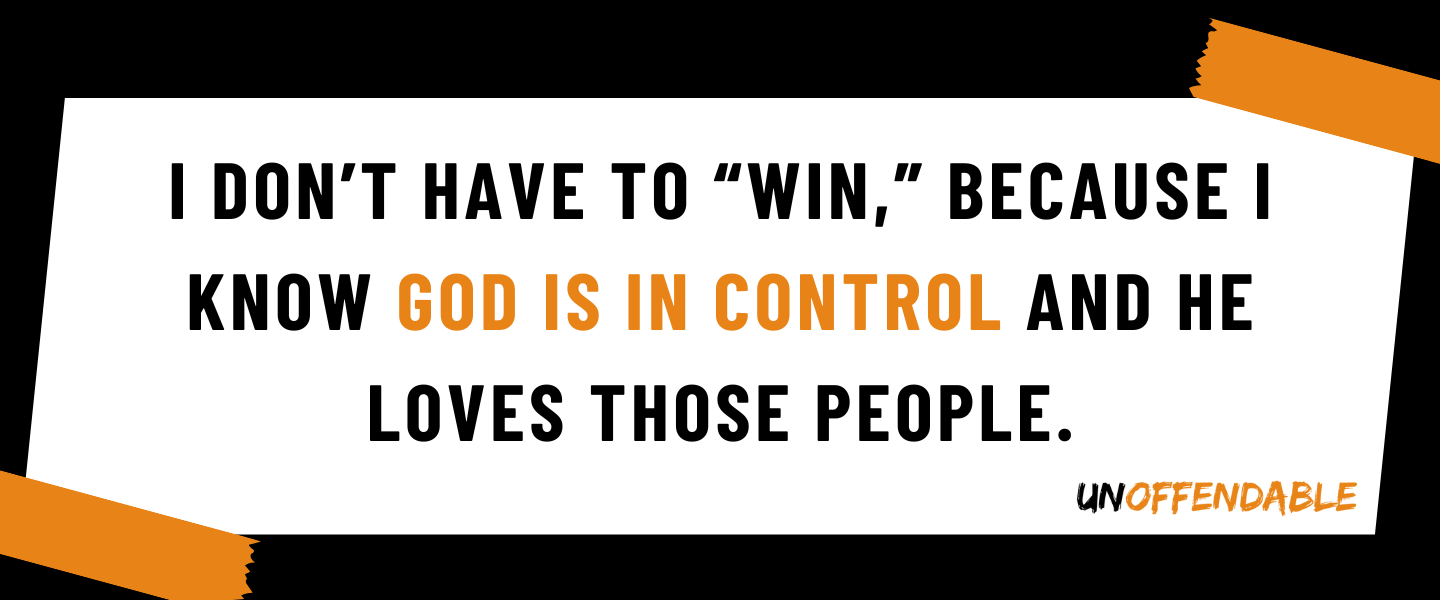
I don’t have to “win,” because I know God is in control and He loves those people. And I don’t have to “win,” because there’s no status at stake. When people make assertions about me, I can actually think them over and occasionally say, “You know what? That’s a good point.”
I’m not “winning” or “losing,” because I’m not even playing that game anymore. I’m off the board. Jesus is giving us a completely different way to live, and it’s one that sets us free from anger, free from ever-present guilt, free to really love people, free to forgive as Jesus forgives.
Respond
Are you struggling with choosing forgiveness over anger? Explain.
Write a brief prayer asking for the Lord’s help.
Prayer
Lord Jesus, thank You that I can choose to forgive as You have forgiven me.
Day 5
Scripture: Psalms 16:11

And Lo, the Kingdom of God Is Like a Terrible Football Team
How-To
We signed my son up for a flag-football league when he was in sixth grade. My wife told me the league needed someone to coach my son’s team, the Rams, and I told her, point blank, I would not be doing it.
The park district called me before the first practice and told me about the Rams, and how they needed a coach, and would I do it? I told them no. “I’m sorry; I just can’t do that; it’s out of the question. I will not be coaching the Rams.”
At the first practice, all the teams went to different parts of the practice fields. They all had coaches. The Rams assembled, and everyone’s parents had dropped them off, and I towered over all the kids. They asked me if I was their coach. I told them no. “I’m sorry, I will play catch right now, but I will not be coaching the Rams.”
The smallest kid, a little scraggly-blonde kid named Jared, threw the ball back and forth with me. He asked me again if I would coach. I told him, again, no. They’d have to find someone else to coach the Rams.
He caught the ball, stopped, and looked at me. He said, “Okay, but for today, can I please call you ‘Coach’?”
When I got home, I had to tell my wife why I was carrying a big bag of footballs, pylons, and flags. I was now coaching the Rams.
I was clueless. Over the first eight games, we not only didn’t win, but we also didn’t score any points. We were shut out, every game. We’d all look over during our practices and see the Yellow Shirt Team Over There. They had six football dads, coaching positions, fancy drills, and football-y things I didn’t know about. They were amazing, a well-oiled machine.
And we played that team, the Yellow Shirt Team Over There, the very last game of the season.
We were 0-11. They were 11-0. Sounds like we had no chance, right? They laughed at us before the game.
Something incredible happened. Our best player, a little guy named Christian, returned the opening kickoff for a touchdown. We were ahead 6-0!
So the team that supposedly “didn’t have a chance,” the one that was mocked, derided, considered the worst-coached team in the league, now led the game over the mighty Yellow Team! There were gasps from the crowd.
Then the Yellow Team scored 77 unanswered points, and we lost 77-6.
As our dejected, winless kids left the field, the kids who went 0-12 and just got humiliated again, something wonderful happened, something you usually don’t see in football.
A white stretch limousine pulled up along the field, a limo with flags. Rams flags.
Everyone stopped and stared: the Rams, the playoff-bound Yellow Team, everybody. And a mom said, “Guys, it’s time for your end-of-season party!”
The Rams went from dejected losers to royalty. Just like that.
The Yellow Team, coaches and all, were in awe.
This is how the kingdom of God works. The last are first, the first are last, and in the end, as much as we want to think our performance is all that matters, the victory has exactly nothing to do with us.
We’re human, so we’re going to occasionally feel threatened. It happens. Anger happens too. So do jealousy and bitterness and resentment. But if you want to be a citizen of this other kingdom, the one in which God promises things will be set right in the end, you may as well remind yourself of it all the time.
Choosing to be unoffendable means choosing to be humble. Not only that, the practice teaches humility. Once you’ve decided you can’t control other people; once you’ve reconciled yourself to the fact that the world, and its people, are broken; once you’ve realized your own moral failure before God; once you’ve abandoned the idea that your significance comes from anything other than God, you’re growing in humility, and that’s exactly where God wants us all.
It’s contrary to seemingly everything in our culture, but the more we divest ourselves of ourselves, the better our lives get. Jesus told us as much. He said if we’d give up our lives, for His sake, we’d find real life.
When we surrender our perceived “rights,” when we let go of our attempts to manipulate, we find—surprise!—joy.
I’ve seen it happen in my own life, in little bits. I’m still learning. But I’m so glad someone told me to choose to be unoffendable, because something clicked in my understanding of what it means to follow Jesus. It turns out that life is not only more joy-filled for me but more attractive to others.
I have to die to myself. What I’m finding is it doesn’t happen all at once, and it’s simultaneously simple to understand and arduous to actually do. But little by little, I think I’m seeing what God is up to.
He wants to be in control. And you know what? I want Him to be. This hasn’t always been the case. I think I can trust Him. I don’t need to control things anymore. There’s so much less at stake when I let go, so much less of me to defend, so much less of “my way” to get in the way and feed my anger.
What a relief. God tells us to die to ourselves, and get rid of anger, for a reason: He loves us.
And I guess I always knew that, that He loves us. But I’m now less prone to anger, and more prone to forgive, because I’m finally really believing, a bit more, day by day, that He actually loves me.
God is my Defender. He’s in control. I don’t know where I’m going, but I know He loves me.
Respond
Have you experienced the joy of giving your life to Jesus?
Describe your salvation experience.
Prayer
Compassionate Savior, thank You for loving me, saving me, and bringing joy to my life.