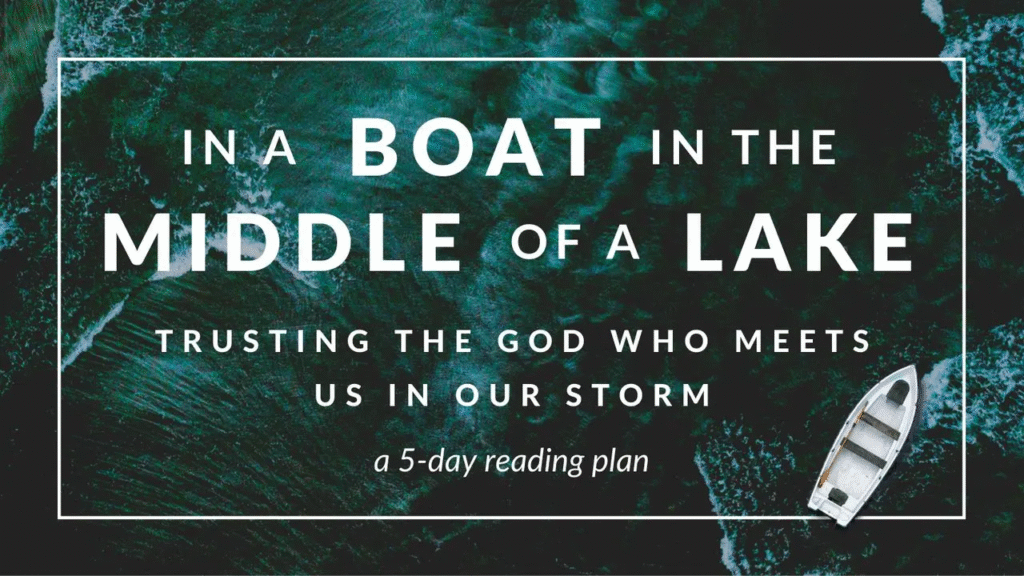
At some point in our lives, we all find ourselves in a boat in the middle of a lake. We might be there due to a job loss or the death of a loved one. Maybe disability, divorce, or financial insecurity has stranded us. And that’s when our transformation begins. Jesus is still Lord over the water, and this flood might just be a path to abundance.
HarperCollins/Zondervan/Thomas Nelson
Day 1
Scriptures: Mark 4:35-41, Hebrews 11:1, Isaiah 41:10, 1 Peter 5:6-7, Psalms 23:4
The word “cancer” rattled around my brain like a pinball bouncing back and forth, looking for a place to land. A place to register. And then it dropped. Sinking into my heart. Shredding everything in its path.
As much as comfort can be our friend, it can also be our enemy. Have you ever been just fine where you are? Your health is good. You have plenty of money in the bank. Your job is secure. All of your kids are healthy. Life makes sense. God is behaving like he should, or at least like you think he should. And then Jesus says, “Follow me. You’ve learned enough by the lake. Let’s go in the lake.”
This is exactly what Mark records Jesus doing with his first disciples. Jesus shifts his location as he shifts his lesson.
The disciples found themselves in water instead of by water. It was getting dark. Evening was coming. And where there is water, there are also waves. Before long, these waves were threatening the very lives of these young followers of Jesus.
But if not for the storm, they would never discover the goodness and power and faithfulness of the God who was with them. Without fear, they would never know faith. Without hurt, they would never know hope.
It’s no wonder Mark records that Jesus was the only one unmoved by the storm. The chaos of the water and storm were no threat to Jesus. In fact, he was in the stern of the boat, sleeping on a cushion. At rest. This was going to be a lesson not for Jesus but for the disciples. And for us.
We need water to grow. And some lessons we can learn only in the midst of chaos, not in a classroom. And no matter how we get there, we can trust the God who meets us in our storm.
Day 2
Scriptures: Lamentations 3:21-26, Psalms 69:13-15, Psalms 42:1-11, Romans 12:12, Romans 15:13
There is one thing we don’t want you to miss. We want to encourage you that our deepest hurt is also where our greatest hope emerges. While we experience pain and loss, those circumstances are also the fertile soil for new beginnings. For new life. For a new day.
Accepting hurt never means you are over the hurt. It means you’ve come to grips that this reality really is yours. It’s your boat. Your lake. You’re coming to terms with the fact that, with every death, there is new life.
This is one of the things that is so beautiful about this short and sad book of Lamentations. Right in the middle of the hurt and pain there is the promise of new life. Like a protest to the pain, there is this proclamation of God’s goodness and the newness of life in him.
We know it might seem impossible to envision right now. We know there may be things we’ve lost that we’ll never get back. But biblical hope enables us to see differently. To see our pain, feel it, but not be consumed by it. To see through it and see God’s purpose for it.
Hope reminds us that our current reality is not our final reality.
“Yet this I call to mind and therefore I have hope,” the writer of Lamentations says. This reality, this season, these circumstances, this hurt will not last forever. It doesn’t have to last forever. God wants to give you hope. His hope.
Here’s the good news. Even Jesus experienced pain; he entered pain for us and felt the weight of our pain in a way that we will never know. He lamented, cried, questioned, and even asked God to change the plan.
“Abba Father,” he said, “everything is possible for you. Take this cup from me. Yet not what I will, but what you will” (Mark 14:36).
Jesus accepted the pain and endured it. He was crucified for us. But he was also raised to new life for us. There was glory in the pain and glory on the other side of the pain.
There can be the same for you. Today. Right here, right now. It’s okay to not be okay.
Day 3
Scriptures: Luke 5:1-11, Romans 5:3-5, 1 Peter 5:10, Philippians 2:12-13
When Jesus first called some of the disciples, they were casting their fishing nets into the water. They were mending nets on the shore. Dry ground was underneath their feet. When Jesus said, “Come follow me,” they followed. “I will make you fishers of men,” he told them. We would imagine following Jesus sounded fun. Exciting and full of adventure. It probably seemed like a great work, a work of God, they were signing up for. A lot like when we first believed. We gladly received God’s love. We felt his presence. He gave us new identities as sons and daughters. We could see his goodness and faithfulness. Like those first disciples, early in the journey we, too, were excited.
Or maybe Jesus calling the disciples was like when God first called you to a new ministry, a new job, or a new season in life. And yet this journey of following Jesus is full of surprises, isn’t it? The path is not always straight. The terrain is not always smooth. Sometimes there is water. And storms. Interruptions, we might say.
But we discover Jesus not only wants to work through us but needs to work in us. And this is no secondary work of lesser importance. He doesn’t just want to get us from one side of the lake to the other. He uses the “middle.”
The storm we are facing is never a threat to God’s work; it is often a tool for God’s work. Suffering might feel like an interruption to us, but it is instrumental to Jesus.
Undoubtedly, suffering was not God’s plan. He hates evil. All of the sickness, pain, disease, loss, and death we experience is the result of Adam and Eve’s first sin (Gen. 3). Things are not the way they once were in God’s original creation. And they are not what they will one day be when Jesus renews all things and does away with the messiness and brokenness and sin we are all living with. But God can and does use suffering in this life for his redemptive purposes.
Day 4
Scriptures: Proverbs 3:5-6, Psalms 9:10, Luke 22:42, Psalms 56:3-4, Isaiah 26:4
Trust is not giving up; trust is opening up. Opening our hearts to the possibility that maybe God really does know best. Maybe his wisdom and care and love are what we need most. And so, reluctantly at first, we open our hearts to trust in the middle of what we don’t always like or understand. But we open our hearts to a Father who knows best and has our best interests in mind, even if we can’t fully comprehend it. . . .
The struggle to trust and obey is real. But it’s also a necessary step toward growth and transformation.
Learning to trust God with what we don’t know is essential for being filled with God. If we are to increasingly experience the good life of following Jesus, we have to learn to trust like he did, often with what we can’t see or get our minds around.
This is one of the hardest parts of growing and being transformed in trials. Learning to surrender to what Jesus wants—his purposes, his plans, and his wisdom.
The Bible talks a lot about obedience. But the obedience God is after is not just an external conformity to what he says. It’s an inward alignment of our heart with his, even when we don’t understand what he is doing or why he is doing it.
Trust requires humility.
Trust requires saying, “I don’t understand, God, but you do.”
Trust requires admitting our powerlessness.
Trust requires giving up control.
When Jesus took the disciples out on the water and they found themselves surrounded by the storm, they realized they weren’t in control. They were helpless. They lacked the resources, the power, the wisdom to fix the situation. They were discovering what we all soon discover, that belief is not just faith in something, belief is faith in Someone. God is at the center. We follow him. He doesn’t follow us.
Their first response was fear. They had obeyed him before. But out on the water, in the world of the unknown, they were learning to trust him.
If we don’t trust God, inevitably, we will try to be God. And we’ll try to control what only he can control. What God is really interested in is our trust.
Day 5
Scriptures: Psalms 23:6, Hebrews 10:23, 2 Corinthians 4:16-18, Colossians 3:1-4
God wired us for home. And to a certain degree, our earthly homes are supposed to be miniature Edens. For many of us, home is where we first experience what it means to be loved. It’s where we discover the security of belonging. Homes don’t just define where we live, but in many ways, they define who we are. Which is why leaving home can be so hard. But even these homes we have to eventually leave.
So it’s no surprise that we all experience homesickness in different ways and in different seasons. Eventually we leave our home, but our longing for home, the one God made us for, never leaves us. We all live with that “memory.” We never outgrow homesickness.
We were not born in Eden but outside of it. And as beautiful as this life is, it’s not enough. It’s temporary. A prelude of sorts, of what is to come. It’s why the New Testament describes us as “exiles” and “foreigners” (1 Peter 2:11).
God has made us to hunger and thirst, long and wait, for a new home. A greater home. A restoration of what went wrong in the Garden of Delight. The road to this home is bumpy. It’s full of suffering and weakness and pain. But the weeping is meant to be like a welcome mat. Instead of feeling homesick for the place behind us, we begin to long for a home that is ahead of us.
You might be in a boat in the middle of a lake. But you are not alone. And that lake has another side. One Jesus has promised to get you to. “Let us go over to the other side,” Jesus said. There will be many storms. Some smaller. And maybe some bigger. But there is a shore. We’ll say it again: there is a shore.
The promise of safe arrival.
Rest.
Renewal.
Victory.
Home.
God’s presence. . . .
So let us press on in the storm. Let’s continue to trust the God who meets us in our storm.
Your chaos will cease. It will not last. You have a future. We have a future. And it’s a future filled with God’s goodness and love and beauty. It’s a future filled with God himself.