Ever notice that spiritual growth often triggers unexpected resistance? This six-day plan explores an ancient word—”acedia”—and why following Jesus faithfully can suddenly feel difficult, empty, or pointless. Discover biblical strategies to overcome spiritual resistance, remember your true identity, and keep moving forward when faith feels hard. You’re not crazy. You’re not alone. And there’s hope ahead!
Scott Savage
Day 1
Scriptures: 2 Corinthians 1:8-9, Hebrews 12:1-2
Have you ever noticed that when you decide to take a spiritual step forward, things suddenly become more challenging?
Perhaps you committed to reading your Bible daily, and immediately your schedule became overwhelmed with busyness. You may have decided to join a community group, only to find yourself doubting whether it’s worth the effort to get to know people and open up. Or perhaps you finally took a courageous step of obedience, and life seemed to throw every obstacle your way.
There’s a reason for this, and your enemy has ancient names: acedia or sloth.
Approximately 1700 years ago, a group of Jesus followers living in Egypt identified acedia, also known as sloth, as one of the seven deadly sins. Author and pastor Jon Tyson defines acedia (pronounced uh-SEE-dee-uh) as “spiritual resistance to spiritual progress.” (A message Tyson gave on acedia had a profound impact on me and significantly shaped this plan.)
While I doubt acedia is a word you commonly use today, the experience it describes is something many of us face. Author Steven Pressfield captured a universal truth when he wrote, “the more important a call or action is to our soul’s evolution, the more resistance we will feel toward pursuing it.”
Whenever I take a step of spiritual obedience, I am surprised by how challenging simple spiritual practices can be. Reading my Bible, which I had been doing regularly for years, suddenly felt like an impossible task. Prayer becomes awkward and dry. Attending church services feels more like a chore than a joy. I used to think I was being lazy. Now, I know the truth – this is an attack!
The Apostle Paul understood this struggle. In 2 Corinthians 1:8-9, he describes the plight of his missionary team. “We were completely overwhelmed—beyond our strength—so that we even despaired of life itself.” Paul wasn’t weak-willed or uncommitted. He was experiencing spiritual resistance.
When acedia attacks us, we often misdiagnose it. We assume we’re just tired, distracted, or unmotivated. We don’t recognize it as resistance to the spiritual progress we’re making. As a result, we either push ourselves harder, leading to burnout, or, worse, we give up entirely.
Here’s the truth: spiritual resistance begins when we make spiritual progress. When you start taking steps that align with God’s purposes for your life, resistance will appear. In military terms, “the flak is strongest above the target.” Our enemy, Satan, doesn’t waste ammunition on targets that pose no threat.
If you’re feeling an unusual amount of resistance to spiritual growth right now, it might be a sign that you’re on the right path, not the wrong one. The resistance is evidence that your spiritual steps matter.
In this plan, we will explore what spiritual resistance feels like in daily life. You might be surprised to discover you’re not alone in experiencing these symptoms. Many faithful followers of Jesus throughout history have battled acedia, and understanding what it does to us is the first step toward overcoming it.
However, before moving on to the dangers of acedia on Day 2 of this plan, I would like to offer you a simple practice. When you feel resistance to something spiritually good, pause and say, “This resistance may be a sign that I’m moving in the right direction.” Then take even a small step forward in faith.
Remember, resistance doesn’t mean you’re doing something wrong – it often means you’re doing something right. I’ll see you on Day 2!
Day 2
Scriptures: Psalms 13:1-2, 1 Peter 5:8-9
Several years ago, I read an article that described my spiritual state so perfectly that it felt like the author had been reading my journal. “It wasn’t burnout – I still had energy. It wasn’t depression – I didn’t feel hopeless…Languishing felt somewhat joyless and aimless, like I was muddling through my days looking at life through a foggy windshield.”
The article called this state “languishing” – a sense of stagnation and emptiness. And I realized that this perfectly describes what spiritual resistance (acedia) often feels like in our lives.
When acedia strikes, several symptoms typically appear.
Often, we feel an unusual sadness, not the temporary kind that comes from life’s disappointments, but a pervasive sadness that seems unattached to specific circumstances. A sense of despair often accompanies this despair about your future with God. You struggle to see hope or possibility ahead.
Over time, we develop a strange disgust with the things of God. Activities that once gave you life and purpose – worship, prayer, serving others, studying Scripture – now feel empty or even repulsive. You find reasons to avoid them rather than engage with them.
Finally, many people battling acedia experience a profound loss of meaning. The big questions surface: “What’s the point of all this? Why does any of this matter?” These are not thoughtful philosophical inquiries, but expressions of spiritual weariness.
Do any of these symptoms sound familiar? If so, you’re not alone. Throughout church history, Christians have recognized and battled these exact feelings.
The Desert Fathers and Mothers – those early Christians who pursued God in the Egyptian desert – called acedia “the noonday demon” because it would attack them in the middle of the day as they prayed and fasted. They would suddenly find themselves distracted, unfocused, and struggling to focus on the very spiritual practices they had dedicated their lives to pursuing.
Acedia threatens our spiritual progress in several key ways.
First, acedia sabotages our sanctification—the ongoing process of becoming more like Jesus. Since Satan can’t undo our salvation, he seeks to stall our spiritual growth and effectiveness.
Second, acedia attacks our identity and spiritual memories. Like spiritual amnesia, it causes us to forget who we are in Christ and what God has done for us. We begin to act like spiritual orphans rather than children of the King.
I’ve experienced this myself. During a challenging season in pastoral ministry, I began to forget all the ways God had proven faithful in the past. This memory loss twisted my perspective until I viewed God as distant rather than present, harsh rather than loving. I wondered what I had done wrong and considered quitting my job as a pastor. I didn’t end up quitting, but I learned how powerful these attacks can genuinely be.
Third, acedia induces a feeling of languishing. As the opening quote about it indicated, we feel aimless, joyless, and stuck.
Please take a moment to reflect: Which of these symptoms of acedia do you recognize in your own life right now? Simply naming them can begin to diminish their power. Remember, what you’re experiencing isn’t unique to you – it’s a common struggle for those pursuing Christ.
The good news is that recognizing these symptoms is the first step toward fighting back. On Day 3, we will begin exploring practical ways to combat acedia, starting with the most foundational truth of spiritual warfare.
Day 3
Scriptures: 2 Peter 1:3-4, 2 Corinthians 12:9-10
My first instinct when facing spiritual resistance is to try harder. I make new commitments, create ambitious Bible reading plans, set prayer timers, and essentially attempt to discipline myself back to spiritual vitality. You may have tried the same approach.
However, here’s what I’ve learned through years of struggling with this strategy: We cannot overcome acedia through willpower alone.
Our battle against spiritual resistance isn’t fought through discipline only. It’s a spiritual conflict that requires spiritual power! The Apostle Peter makes this abundantly clear in 2 Peter 1:3-4: “His divine power has given us everything required for life and godliness through the knowledge of him who called us by his own glory and goodness.”
Notice Peter doesn’t say, “Your determination and spiritual disciplines will give you everything required for life and godliness.” Instead, he points to “His divine power” as the source of our spiritual vitality.
Some view this reliance on God’s power as a weakness. I’ve had people tell me, “Your faith is just a crutch.” To which I now readily respond, “Yes! I am weaker than you think. I am less competent than you imagine. I am more vulnerable than I appear.”
The Desert Fathers and Mothers were unable to overcome acedia through their strength, despite their extraordinary commitment. What makes me think I can?
The truth is, Satan is stronger than you and me. He’s been in this battle longer. He’s more cunning, and he’s relentlessly focused on derailing our spiritual progress. But – and this is crucial – while Satan is stronger than us, he is not stronger than Jesus.
Consider what happened to Paul. After pleading with God three times to remove his “thorn in the flesh,” God said no. “My grace is sufficient for you, for my power is perfected in weakness” (2 Corinthians 12:9). God’s power isn’t a nice supplement to our spiritual efforts; it’s the essential source of our spiritual life.
In practical terms, this means that our first response to acedia should be surrender rather than striving. When you feel that spiritual resistance rising – the lack of motivation to pray, the emptiness when reading Scripture, the hesitation to serve – your initial move should be to acknowledge your weakness and invite God’s power.
Try praying something like this: “God, I can’t do this on my own. I need your power. Fill me with your Spirit and help me to keep going.”
This prayer doesn’t mean we have no part to play in the battle against acedia. In fact, on Day 4, we will examine the specific effort that Peter calls us to make. But that effort must flow from a place of reliance on God’s power, not our own.
Before we end today, take a moment to identify where you’ve been trying to fight spiritual battles in your strength. Surrender those areas to God and invite His power to work through your weakness.
Remember, the path forward isn’t found in trying harder but in trusting deeper. I’ll see you tomorrow as we learn how God’s grace and our effort work together.
Day 4
Scriptures: 2 Peter 1:5-8, Galatians 5:22-23, 1 Corinthians 15:10
As a new believer, I had a misconception about spiritual growth. I thought it was entirely passive – I would naturally become more like Jesus simply by believing in Him. While God’s grace is indeed the foundation of our transformation, I have since come to understand that I also have an active role to play.
After emphasizing God’s power in 2 Peter 1:3-4, Peter makes a significant shift in verse 5: “For this very reason, make every effort to supplement your faith…” He then lists seven character qualities we should actively pursue: goodness, knowledge, self-control, endurance, godliness, brotherly affection, and love.
Notice the phrase “make every effort.” The gospel is absolutely one of grace – we cannot earn our salvation. However, the pursuit of a Christlike character requires our active participation.
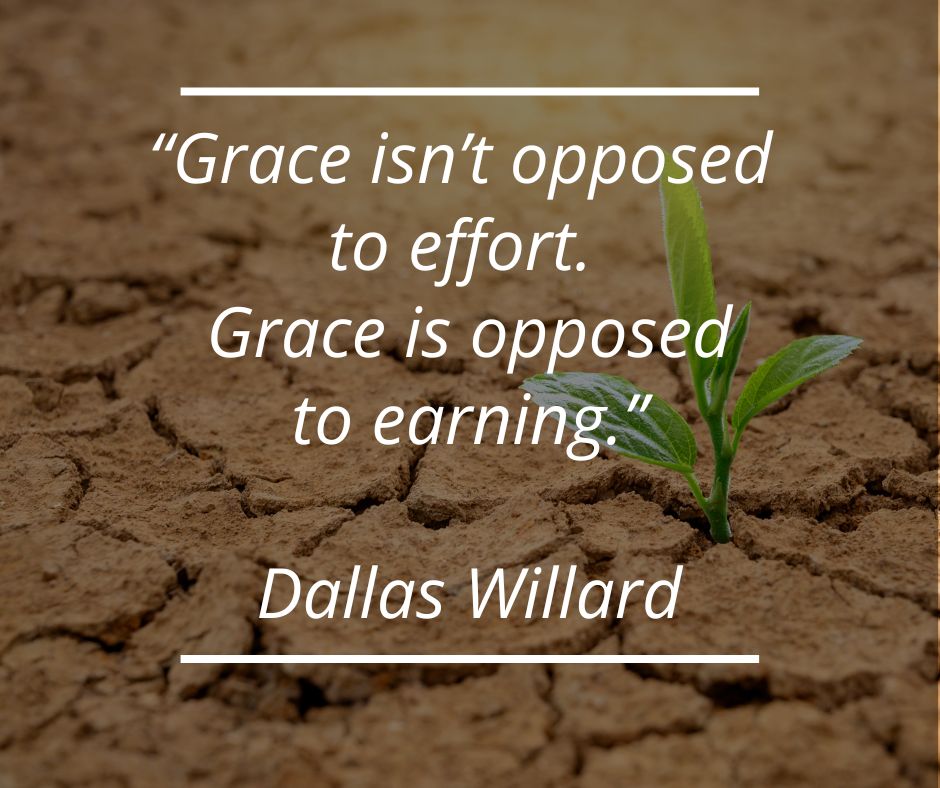
I love how Dallas Willard, a brilliant author, described this dynamic. “Grace isn’t opposed to effort; grace is opposed to earning.” Grace isn’t about earning God’s favor; grace invites you to cooperate with the work God’s already doing in you.
William Carey, often referred to as the father of modern missions, understood this balance. In the late 1700s, he left England for India despite tremendous obstacles. During his ministry, Carey was married and widowed three times. He buried his 5-year-old son, who died of dysentery. He translated the Bible into 44 languages. When a fire destroyed years of his work, he started again the next day.
When asked about his remarkable perseverance, Carey simply said, “If anyone should think it worth his while to write my life, if he can give me credit for being a plodder, anything else will be too much.” Day after day, year after year, Carey pursued his calling through consistent, faithful action.
We overcome acedia not through dramatic spiritual experiences, but through the steady pursuit of Christlike character. There is power in perseverance. When you don’t feel like praying, keep praying. When Scripture seems dry, read it faithfully. When serving others feels burdensome, serve them as if you are serving Jesus. Keep trusting in God’s power and allow Him to bear His fruit in your life, in the same way a tree bears fruit in the appropriate season.
The beauty of Peter’s teaching is found in verse 8: “For if you possess these qualities in increasing measure, they will keep you from being useless or unfruitful in the knowledge of our Lord Jesus Christ.” As we cultivate these character qualities, they become a protective barrier against the effects of acedia.
I’ve found this to be true in my own life. During seasons when I have intentionally pursued these qualities (especially self-control and endurance), I have been much more resistant to spiritual drifting. The habits of character create momentum that carries me through periods of resistance.
On Day 5, we’ll explore how a larger vision of work and rest can equip us to overcome acedia.
Day 5
Scriptures: Genesis 2:1-3, Mark 2:27-28, Matthew 11:28-29
My culture has some peculiar views about work and rest. Some wear exhaustion as a badge of honor, boasting about 80-hour workweeks and surviving on minimal sleep. Others elevate “self-care” to an idol, seeking endless comfort and ease.
Both extremes can be manifestations of acedia – spiritual resistance to spiritual progress.
As a millennial pastor, I’ve observed how my generation has elevated the concept of “self-care” to unprecedented heights, partly in response to our parents’ workaholic tendencies. While there is wisdom in caring for ourselves, we have sometimes overcorrected to the point where rest becomes our ultimate goal.
However, Jesus reminds us in Mark 2:27-28, “The Sabbath was made for man and not man for the Sabbath.” Rest is a gift from God, but it’s not our ultimate purpose.
At the same time, work isn’t our ultimate purpose either. In Genesis 2, we discover something remarkable about God’s design. Adam wasn’t created and immediately put to work; he was created on the sixth day, and his first full day was the Sabbath – a day of rest. As many have pointed out, this reality teaches us that “we don’t work for rest; we work from rest.”
The pattern God established wasn’t “work hard so you can eventually rest,” nor “live every day planning your next vacation or spa visit.” God’s pattern is “rest in my provision so you can work from a place of fullness.”
This mindset gives us a completely different vision of both work and rest. Rest isn’t merely recovery from exhaustion; it’s receiving God’s provision and presence. And work isn’t simply productivity; it’s participating in God’s purposes.
When acedia strikes, it can manifest as either laziness or a form of workaholism. The lazy person lacks the spiritual energy to engage with God’s purposes. The workaholic lacks the spiritual trust to rest in God’s provision. Both are forms of resistance to true spiritual progress.
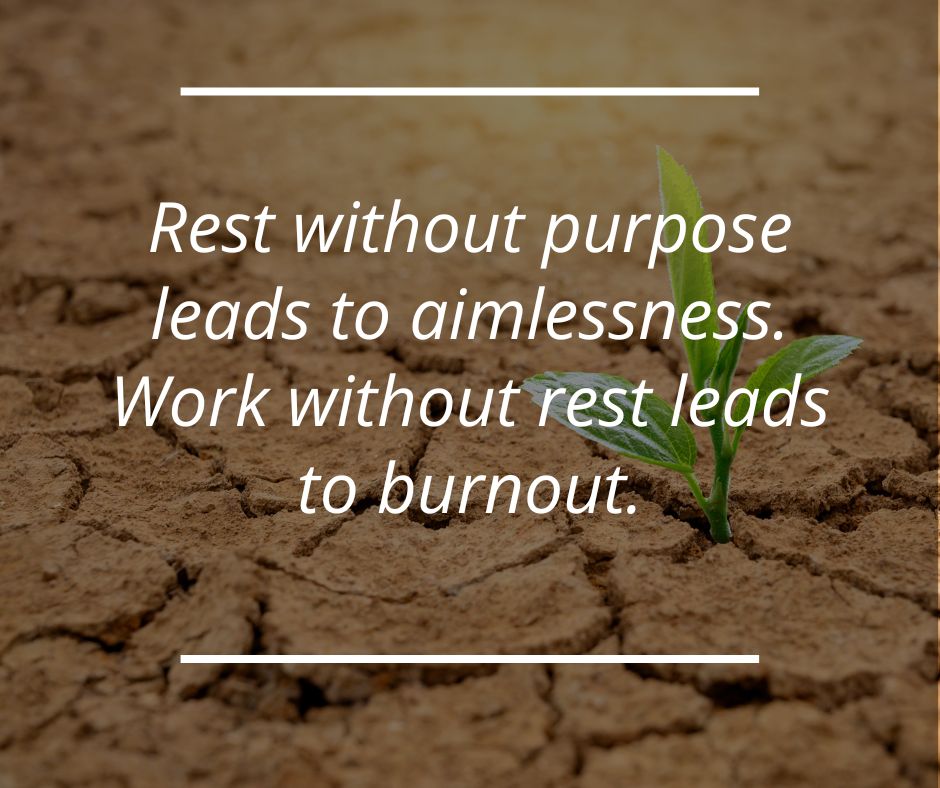
A biblical vision understands that we rest to refuel as we sustain our pursuit of purpose. Rest without purpose leads to aimlessness. Work without rest leads to burnout.
I’ve experienced both extremes. There have been seasons where I’ve worked frantically, believing the success of God’s kingdom somehow depended on my efforts. My grandfather worked until he was 91, and my father and I have battled the tendency towards a no-boundaries approach to work. At other times, I disengage in destructive ways, using “self-care” as an excuse to avoid the challenging work God is calling me to do.
Neither extreme led me to spiritual flourishing. I found a healthy path forward as I embraced both rhythms as God designed them: purposeful work flowing from restful trust.
In practical terms, this means creating rhythms that incorporate both engagement and withdrawal, as well as productivity and peace. It means working diligently without anxiety and resting fully without guilt.
For example, I now schedule times of complete rest – no emails, no sermon preparation, no ministry responsibilities. During these times, I focus on receiving God’s love and renewing my soul. Then, from that place of fullness, I return to my work with fresh energy and clear purpose.
Reflect on how your perspective on work and rest may be contributing to spiritual resistance. Are you working frantically without proper rest? Or are you resting endlessly without true purpose? Ask God to show you what a healthy rhythm would look like in your current season.
I’m excited for the final day of this plan, where we’ll explore our final strategy for overcoming acedia. This strategy is tied to one of my most vivid childhood memories – a special afternoon at the movies.
Day 6
Scriptures: 2 Peter 1:9, Philippians 1:6, Revelation 12:11
One of my favorite childhood movies was The Lion King. Young Simba, the rightful heir to Pride Rock, flees his home after his uncle Scar convinces him he’s responsible for his father’s death. For years, Simba lives in exile, adopting a carefree “Hakuna Matata” lifestyle, forgetting his true identity.
The turning point comes when his childhood friend Nala finds him and the wise baboon Rafiki helps Simba remember who he truly is – not just any lion, but the son of King Mufasa and the rightful heir to the throne. With his identity restored, Simba returns home to reclaim his throne.
This storyline powerfully illustrates Peter’s final insight about overcoming acedia. In 2 Peter 1:9, he explains that the person who lacks the qualities he’s been describing is “blind and shortsighted and has forgotten the cleansing from his past sins.”
Spiritual stagnation often results from forgetting what God has done for us and who He has made us to be. Like Simba, we forget our true identity and settle for less than what we’re called to be.
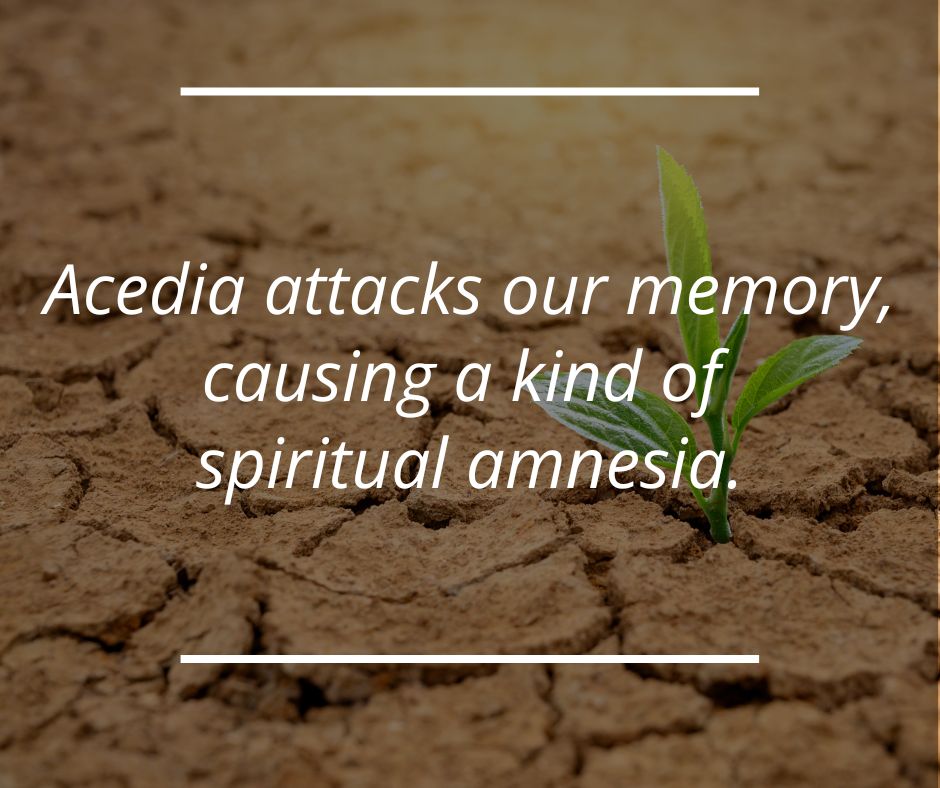
Acedia attacks our memory, causing a kind of spiritual amnesia. We forget that we’re children of God, co-heirs with Christ, forgiven and beloved. When this amnesia takes hold, our spiritual motivation evaporates.
During a particularly difficult season of ministry, I found myself questioning everything – my calling, my purpose, my worth. Prayers felt hollow. Scripture seemed lifeless. Serving others became a burden rather than a joy.
What had changed? Not God’s love for me. Not my position in Christ. What changed was my memory – I had forgotten who I was and whose I was.
Recovery began when I started intentionally remembering what God had done in my life. I returned to a list of “identity statements” based on Scripture – truths about who God says I am. Each morning, I would read these statements aloud:
- I am created in God’s image (Genesis 1:27)
- I am adopted as God’s child (Romans 8:15)
- I am a new creation (2 Corinthians 5:17)
- I am loved unconditionally (Romans 8:38-39)
- I am a God’s masterpiece (Ephesians 2:10)
As I remembered these truths, the fog of acedia began to lift slowly. My spiritual motivation didn’t return all at once, but gradually, as my identity was repeatedly reaffirmed, my desire to pursue God was rekindled.
This practice of remembering is central to the Christian faith. As Revelation 12 reminds us, we overcome our Enemy “by the blood of the lamb and the word of our testimony.”
When spiritual resistance feels overwhelming, when progress seems impossible, when acedia has drained your motivation – remember who you are! You are loved not because of what you’ve done, but because of what Christ has done for you.
As we conclude this devotional plan, I encourage you to allow God’s truth to overcome spiritual amnesia. You are a child of God, and you have not been abandoned. He will finish what He started in you!