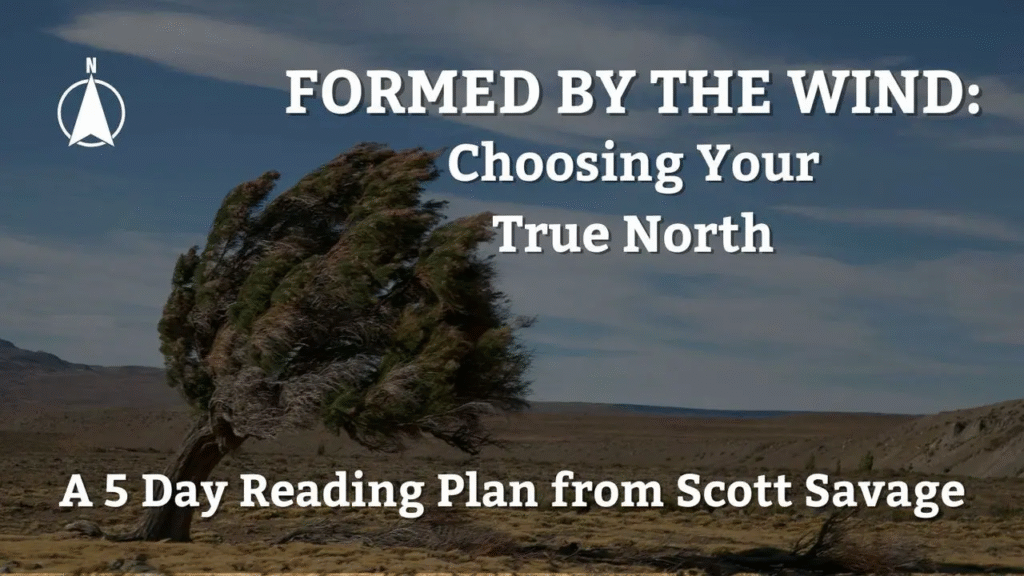
Like trees that grow stronger through wind resistance, your struggles aren’t meaningless—they’re forming your character and pointing you toward your true purpose. In this 5-day plan, discover how God uses challenges to shape you into Christ’s image. Learn how Jesus’ wilderness temptations empowered him to reject cultural pressures and how you can embrace the spiritual practices that will anchor your identity in God’s unshakeable truth.
Scott Savage
Day 1
Scriptures: Mark 1:12-13, James 1:2-4
My wife and I met in the middle of a crisis. We became friends as we were both serving in the same ministry at our church. But to be frank, neither of us was looking for a romantic relationship then.
One Monday morning, right before I walked into a meeting, she texted me asking for prayer because her boss was missing. She was working as a civil attorney at the time. He wasn’t responding to phone calls and had missed a court appearance that morning.
The day before, her boss had flown a colleague from Phoenix to Sedona in his single-engine plane. The plane went below the radar 4 miles from the airport and disappeared. The crashed plane and two bodies were ultimately discovered two and a half years later.
She closed down the firm with the help of her boss’s father, a well-known attorney. She received 3 months’ severance, but she had a problem. With only one year’s experience after passing the bar—all office work, no litigation—finding a new job would be a struggle. The financial stress was immense, compounded by student loans.
We formed a bond of trust, vulnerability, and support during this period. We came together as friends, with me offering emotional support. That foundation for friendship ultimately led to our dating and marriage.
The marriage we enjoy today was formed and strengthened by adversity, not ease.
The truth is that easy things don’t change us. Adversity teaches us things success cannot. We spend most of our lives living from crisis to crisis. As my father often preached during his 41-year tenure at a single church, “We’re all either headed into, in the middle of, or heading out of a crisis.”
Crisis becomes the ground in which we bury our roots. We will never be well-rooted without struggle, difficulty, and adversity.
The big idea I want to share with you in this plan is simple but profound: God uses adversity to make us more like Jesus.
After his Father declares his identity over him at his baptism, the Father begins step two of Jesus’ formation. Mark tells us: “At once the Spirit sent him out into the wilderness, and he was in the wilderness forty days, being tempted by Satan. He was with the wild animals, and angels attended him” (Mark 1:12-13 NIV).
What does this short passage tell us? The Spirit “drove him out”—the exact phrase to describe exorcising a demon. Jesus ended up in a barren area with few natural resources. Satan tempted him. The kingdom of God that Jesus would advance would oppose and ultimately defeat Satan, and that war began there. Jesus was with wild animals in a dangerous place. Angels ministered to him—he was alone, with no people around.
In summary, Mark paints a picture of adverse conditions, challenging experiences, and isolation for Jesus.
I’ve noticed something interesting in my life and the Bible: a crisis often follows a decisive moment of clarity with God, as we are challenged to put what we learned in the light into practice as we walk through darkness.
Tomorrow, we’ll look at the specific temptations Jesus faced in the wilderness and how they mirror our struggles when facing adversity.
Day 2
Scripture: Matthew 4:3-4
I want to explore with you three temptations Jesus faced during his time in the wilderness. Each reveals something profound about the trials we face in our lives.
After Jesus had fasted for forty days, Matthew tells us that the tempter came to him and said, “If you are the Son of God, tell these stones to become bread” (Matthew 4:3 NIV).
Henri Nouwen states that the first temptation Jesus faced was to be relevant.
“Turn the stones to bread,” Satan suggested. Show the world you have something to offer. Do something that proves your worth and value.
Satan tempted Jesus to do something to show the world he was relevant, but at the cost of being disobedient to his Father. We must choose between obedience and popularity—a crossroads of sorts. While these aren’t always at odds, we must acknowledge that we can’t always have both.
Satan tempts us to put our value and worth into what we can offer the world. Our gifts, talents, abilities—what we can do and produce. We are tempted to prove ourselves to the world through achievement or performance. Someone recently said, “You’re only as good as your last performance.” How exhausting to prove our worth this way!
Suffering tests us to determine where we’re putting our worth and value. When adversity strikes, we quickly discover whether our identity is rooted in what we do or who we are in Christ.
When I face difficult circumstances, I often try to “fix” things by leveraging my strengths. If I’m honest, a voice inside says, “You need to prove you’re still valuable, worthy of respect, still relevant.” In a similar way, Satan tempted Jesus to use his divine power to prove himself.
But Jesus’ response is remarkable. He doesn’t argue about whether he could turn stones into bread. Instead, he points to something more fundamental: dependence on God. “Man shall not live on bread alone, but on every word that comes from the mouth of God.”
The answer to the temptation of relevance isn’t to try harder to be relevant. Remember that our true worth comes from being children of God, not from what we produce or accomplish.
When adversity strips away our ability to “perform” or “achieve,” we’re left with a crucial question: Is God’s love enough? Can we find our identity in being loved by God rather than being helpful to others?
Tomorrow, we’ll explore the second temptation Jesus faced. But today, I invite you to reflect on where you might be trying to prove your relevance instead of resting in God’s love and provision.
Day 3
Scripture: Matthew 4:5-7
The second temptation Jesus faced in the wilderness was to be spectacular.
“Then the devil took him to the holy city and had him stand on the highest point of the temple. ‘If you are the Son of God,’ he said, ‘throw yourself down’” (Matt. 4:5-6 NIV).
Satan essentially told Jesus, “Grab their attention and admiration. Turn your divinity into a sideshow. Become a circus animal.” Jesus knew this wasn’t his Father’s will, and he knew that to go outside of God’s will was to test God.
I face this temptation regularly in ministry. Say something worth writing down. Do something people will talk about. Attract more people.
Can I share something with you? I believe one of our greatest fears is that we are ordinary. Many young people dream of being famous. In a recent survey, young people’s primary career aspiration was to be a social media influencer or YouTube star.
On social media, our ordinary lives can feel unspectacular as we scroll through an endless highlight reel of other people’s seemingly extraordinary experiences. Author Jon Acuff wisely observed, “We compare our behind-the-scenes footage with everyone else’s highlight reel.”
How many times have you diminished your worth by saying, “I’m just a ____________”? Just a mom. Just a teacher. Just an office worker. Just a student.
When facing adversity, we often feel pressured to do something dramatic to escape our circumstances or to prove God’s presence in our lives. We want God to show up in spectacular ways that everyone can see, validating our faith and making our suffering worthwhile in the eyes of others.
But what if God calls us to faithful endurance rather than spectacular deliverance?
I remember going through a challenging season when everything seemed to fall apart. I prayed for a dramatic intervention—for God to show up in ways that amazed everyone around me. Instead, God provided daily strength to get through each day. No dramatic testimony. No viral story of God’s miraculous provision. Just quiet faithfulness.
Sometimes, we are tempted to choose between being spectacular and faithful. Jesus chose faithfulness to his Father over the spectacular display Satan suggested.
Most spiritual formation happens in ordinary moments of faithfulness that no one else sees. The decision to trust God when you’re afraid. The choice to forgive when you’re bitter. The commitment to integrity, even when no one would notice the difference.
God’s work in our lives often resembles the slow growth of fruit more than the sudden flash of lightning.
Tomorrow, we’ll explore the third temptation Jesus faced. But first, I challenge you to embrace the ordinary path of faithfulness that God has set before you, trusting that He is working even when no one else can see it. What’s one ordinary way you can be faithful to Jesus today?
Day 4
Scripture: Matthew 4:8-10
The third temptation Jesus faced was to be powerful.
Satan tempted Jesus to get power without the cross. It was as if he said, “Just bow before me and save the pain. The agony. The exposure.” If Jesus had compromised, he could have gained control instead of surrendering to His Father in the garden.
We love being in control. As Henri Nouwen has observed, “If I’m being honest, I find it easier to control God than to love God, to control people than to love them, to control life than to receive it.” Nouwen also noted, “The temptation to power is greatest when intimacy is perceived as a threat.”
Have you heard of “Impostor Syndrome”? It’s that feeling that you don’t belong where you are. Imposter Syndrome says you’re faking it, and someday everyone will figure out you don’t have it all together. We try to control the perception of others instead of trusting God and being vulnerable.
When adversity strikes, our instinct is to seize control. We make detailed plans. We manipulate circumstances. We refuse to accept help because it makes us feel vulnerable.
When I went through burnout at age 28, I had to make a choice: Would I keep struggling for control, or would I surrender to God and accept my limitations? Would I allow others to see my weakness, or would I keep trying to project strength?
The path to healing began when I chose vulnerability over the illusion of control. When I admitted to a team I was leading that I was not okay and was desperate for God’s help, something beautiful happened. People stepped up. Relationships deepened. And God worked in ways I never would have experienced if I had not let go of my grip on control.
Jesus rejected Satan’s offer of power and control because he knew God’s path led through surrender, vulnerability, and sacrifice. The way of the cross always looks like weakness to the world, but it’s where God’s power is perfected.
Jesus teaches that we gain by giving up, living by dying to self, and finding freedom through surrender. As Jesus later told his disciples, “Whoever wants to be my disciple must deny themselves and take up their cross and follow me.”
Tomorrow, we’ll explore the spiritual practices that formed Jesus during his testing and how we can practice them in our own lives. But today, I invite you to consider where you might be grasping for control instead of surrendering to God’s path.
Day 5
Scriptures: Psalms 1:1-3, Proverbs 3:5-6, 2 Corinthians 12:8-10
We’ve seen that God uses adversity to make us more like Jesus. So, how do we cooperate with this process? How do we avoid the temptations to be relevant, spectacular, and powerful when facing difficulties?
Jesus shows us three spiritual disciplines that formed him during his time in the wilderness and can form us during our trials.
1. Meditate on Scripture
The goal isn’t just to check off boxes on a schedule; it’s to allow God’s word to transform us.
We read Scripture to know God, not just to learn about God. To become like Jesus, not just to know all about Jesus. When theology and maturity become about how much you know instead of how much you look like Jesus, something has gone wrong.
Jesus responded to each temptation with scripture. He didn’t just read and forget it; he meditated on it, internalized it, and allowed God to sustain him through His word.
2. Trust the Character of God
Jesus chose surrender over the spectacular. He didn’t test God; he trusted Him.
I just wanted to ask you a question: Where did you plan to be by this point? If you’re like me, the answer is “not even close to here!” Few people see their lives unfold exactly as they planned. When our plans and God’s plans are visibly different, we can choose to control life or trust God and what He has planned for us,
You can try to control or love God, but you cannot do both.
3. Embrace Adversity
There’s a fascinating story about Biosphere 2 in Tucson near the University of Arizona. Scientists created a miniature version of our planet to study how the planet’s living systems work. In the biosphere, trees grew faster than they would in the wild but wouldn’t completely mature. Before the trees could mature, they would collapse.
Later, scientists discovered the reason for the tree collapse—the lack of wind in the biosphere. Wind plays a significant role in a tree’s life. The presence of wind makes a tree stronger, enabling it to mature and withstand its weight.
When plants and trees grow in the wild, the wind keeps them moving. This wind causes stress in the wooden load-bearing structure of the tree. To compensate, the tree grows something called “reaction wood” or “stress wood.” This stress wood has a different structure and can position the tree where it will get the best light or other optimum resources. Without the wind, the trees die!
Similarly, the adversity we face strengthens us in ways comfort never could.
Pastor John Ortberg once wrote: “If you ask people who do not believe in God why they do not, the number one reason will be suffering. If you ask people who believe in God when they grew the most spiritually, the number one answer will be suffering.”
I’ve shared that quote with thousands of people as a pastor, author, and speaker. Whenever I share it, people tell me how close to God they felt amid their worst moments. “My relationship with God was never stronger than when I was going through that difficult time.”
What if the very thing you’re asking God to remove from your life is what He’s using to make you more like Jesus? What if the wind of adversity is strengthening you for what lies ahead?
I pray that you will surrender to the forming God wants to do in the wind and prepare for God to use adversity as you choose and pursue true north.