Whether you’re on the verge of a breakdown, in the middle of one, or wondering if you’re headed toward one—this 10 day plan will show you how a breakdown can lead to a breakthrough. We have wasted enough time living in fear, let’s start living in freedom!
Fearless Unite
Day 1
Scriptures: John 8:32, John 14:6, Proverbs 28:26, Proverbs 16:9
I believe control is an illusion that leads you down a dead-end street. My dead-end started when my primary care physician looked at me and said, “Christy, you have severe panic and anxiety disorder.” Nothing stops you faster than a diagnosis that slows you down. With anxiety disorders on the rise, many are experiencing these slowdowns. Regularly, the world tells us to believe we can control our destiny, manifest success, create opportunities, and control our circumstances. Those big ideas contain some truth, along with some significant lies. The lies packed into these truths are poisonous, and even if the truths outweigh the lies, just a little bit of poison can still kill you.
I believe that the ultimate source of truth is the Word of God, the Bible. God’s Word is right, good, authentic, genuine, and true. John 8:32 declares that the Word is truth and that walking in the truth will set you free.
With the journey I have endured, I sincerely believe in the truth. We are not the heroes of our stories; Jesus is. He is the ultimate source of truth. I have lived the life of thinking I’m the hero. Plus, I tried the “there is no truth, live your truth” approach, and it got me nowhere but a nervous breakdown. The truth found in John 14:6 says, “[Jesus is] the way, the truth, and the life” (NLT).
Many self-help books, even those referred to as Christian, present lies as truths that contradict the Bible. For example, Proverbs 28:26 is crystal clear on self-help: “Those who trust in themselves are fools, but those who walk in wisdom are kept safe” (NIV). Let’s be honest: a “surrendered-life-to-Jesus-help” isn’t as popular as self-help. In fact, there isn’t even a sale category for it. The point is: self-help is no help at all.
There is a big difference between healthy planning and the disorder of manifesting control in your life. Planning is biblical. In fact, a popular verse that gets quoted regarding planning is, “In their hearts humans plan their course, but the Lord establishes their steps” (Prov. 16:9 NIV). There is nothing wrong with a good solid plan, but do you hold that plan loosely? Are you willing to lay that plan down if the Lord leads you in a new direction? The world so influences our lives that it is rare to study or practice living a life submitted to God. Making my own plans led to destructive and alarming results. I controlled my circumstances to help manage the deep fears and anxieties I had inside. Control is exhausting, and it comes with a high price.
Tomorrow we will dig deeper into understanding your controlling ways.
Day 2
Scripture: Isaiah 9:6
According to WebMD, “People with anxiety disorders feel a need to control everything around them in order to feel at peace.” The writer of this article indicates that control and anxiety disorders go hand in hand. Let’s do some digging to make sense of what WebMD is trying to teach us. What is at the root of control? When I control, I’m trying to protect my peace. How does one “feel” at peace? By taking control. I liked to control things by dominating every situation. It’s evident by the diagnosis I received, severe panic and anxiety disorder. Peace did not result from that control. What are your controlling ways?
- Do you always have to be right?
- Do you try to determine outcomes in advance to move things in your favor?
- Do you rarely take the blame?
- Do you like being the center of attention?
- Do you rarely seek advice from others?
- Do you like the way you do things best and therefore seldom rely on others for help?
- Do you like to micromanage people?
- Do you constantly check your bank statements and stock performances?
- Do you speak white lies from time to time to make your situation look better?
Is something else coming to your mind that you do to take control of a situation? Let’s stop right here. Part of overcoming a problem is acknowledging a problem.
Now it’s time to evaluate. Does the outcome of those statements you just identified bring peace? Hopefully, I have got your thoughts flowing and you are processing the question, What is peace? To answer that clearly, I think we must define or perhaps redefine peace. Is peace a feeling or a state of being? For example, can you feel peace when the circumstances around you are crumbling? “Absolutely not” is how I would have answered that question pre-nervous breakdown. I assumed that peace is something you achieve, something that manifests when you follow all the proper steps and manage yourself in a way that is free of disturbances.
The world seems to preach that peace is possible when no fear or violence is present. Interestingly, there is no shortage of fear and violence among us. The increasing number of conflicts and amount of hatred toward one another and rising fear and anxiety disorders don’t seem to highlight a peaceful world. This leads me to the question at hand: Can peace be achieved by checking all the right boxes and doing the right yoga moves? Is it possible to enter a state of tranquility or Zen managed by you? Do we have the power to cultivate peace from within? What if the world has got it wrong, and peace is a person?
What if the solution to control is surrender, and surrender leads to peace? The world teaches us to never wave the white flag. Always keep going. Don’t you dare show weakness. Keep on keeping on. Hustle harder. The world offers no accolades to surrender; it frowns upon it. Surrender paints signs of weakness. What if surrender is a strength? Please follow me closely: I’m not proposing surrendering to the world, but I’m asking you to ponder what it would look like to surrender to Jesus, the person who is the Prince of Peace. What if peace is a state of being that starts with surrendering to the Prince of Peace?
Stop and process what peace is to you.
Day 3
Scriptures: 2 Timothy 1:7, 1 John 4:18, Isaiah 41:10, Psalms 23:4, Deuteronomy 31:6
I believe it is impossible to overcome anxiety without building your faith. As I like to put it, the Bible is a prescription that cannot be overdosed. The Bible contains hundreds of passages that urge us not to walk in fear. The spirit of fear is not from God. Peace is from God, and we walk in the peace of God by knowing the Word of God. To help you build your faith muscles, today I’m going to include my top five favorite passages on not being afraid. Memorize these scriptures. Meditating on what God says about fear will bring peace to your life.
Jesus, seeing a doctor, and Christian therapy are the top three things I credit that helped me overcome severe panic and anxiety disorder. It took eighteen months to get to a point when I felt like a normal, functioning, productive adult. It took me years to get into that mess; I’m grateful it only took me eighteen months to get out of it. The point is to have grace with your healing process. Don’t rush it, and don’t delay it either, but while you are healing, don’t stop opening and memorizing God’s word.
Day 4
Scriptures: Jeremiah 1:5, Psalms 139:14, Jeremiah 29:11, Luke 12:7, Romans 5:8, Ephesians 3:17-19
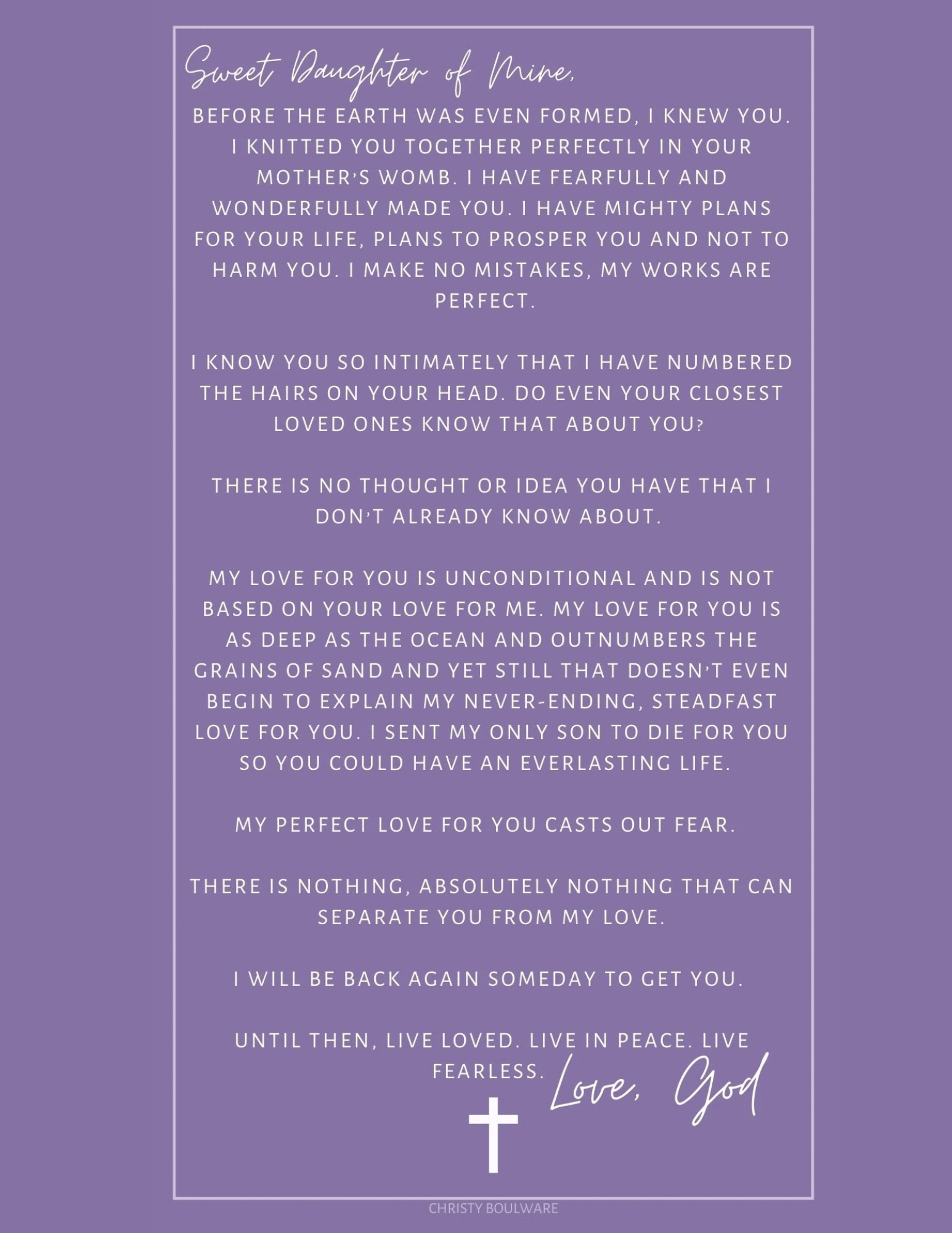
In the most extraordinary love story ever written, God sacrificed his one and only son so we could gain eternal life. Can such unconditional love truly exist—a perfect heaven-born love, not an imperfect earthbound love? Our human minds have a hard time grasping this kind of love. We only know human love. But the love of God? It’s far more remarkable. Take a moment to read this love letter written for you:
Sweet child of mine. Before the earth was even formed, I knew you. I knitted you together perfectly in your mother’s womb. I have fearfully and wonderfully made you. I have mighty plans for your life, plans to prosper you and not harm you. I make no mistakes; my works are perfect. I know you so intimately that I have numbered the hairs on your head. Do your most intimate loved ones know that about you? You have no thought or idea that I don’t already know about. My love for you is unconditional and is not based on your love for me. My love for you is as deep as the ocean and outnumbers the grains of sand, and yet still, that doesn’t even begin to explain my never-ending, steadfast love for you. I sent my only son to die for you so you could have everlasting life. My perfect love for you casts out fear. There is nothing, absolutely nothing, that can separate you from my love. I will be back again someday to get you. Until then, live loved. Live in peace. Live fearlessly.
Love,
God
Although this letter was my human attempt to capture the heart of God, I hope you read every word carefully and soaked in its meaning. The sentences woven together are promises from his Word. You can take this letter at face value and believe it. Take a picture of it, and make it your screen saver. Text it to a friend, post it on social media, tell the world that God loves you, and remind somebody else that he loves them too.
What does God’s love have to do with fear? A lot. Until I truly learned to rest in God’s love, I continued to struggle significantly with fear and anxiety, which leads me to ask: Can understanding his love be a method we’ve overlooked in overcoming anxiety? I believe strongly that our world has massively overlooked understanding God’s love as a method of overcoming anxiety.
Now, dig into some of the scriptures written in this love letter and process how much God loves you.
Day 5
Scriptures: 1 John 4:18, Philippians 4:6
Now that we are settling into understanding God’s love, we need to understand a big point. Fear is a counterfeit love, and, if left unchecked, it can make you do some crazy things. Where fear is operating, love cannot freely flow. God’s word says that His perfect love casts out fear (1 John 4:18) Failing to recognize that we are operating out of fear means losing our footing fast. Fear loves to mask itself as a concern. It says things like, “You better get that lump checked out. You know Grandma Joyce died of cancer, which will probably happen to you.” Sure, getting a lump checked out is wise, but do you see the trickery baked into that fear thought? There is a difference between concern and worry. Concern moves you to action and worry stops the action. Concern says, I have a genuine problem, and I need a plan to solve it. Worry says, I have a real problem, and the action I’m going to take is to be anxious. Fear makes you feel like it cares by raising concerns, but it tricks you into believing untrue things. On the other hand, love cares and gives you solutions for your worries that calm anxiety and bring about peace.
Now determine whether you are concerned or worried. Take those concerns to prayer now, and lay down your fears and worries at the feet of Jesus.
Day 6
Scriptures: Proverbs 14:27, Hebrews 4:12
There is a healthy fear. The fight-or-flight kind of fear protects you from danger and tells you not to jump into the deep end when you can’t swim. When the hairs stand up on the back of your neck when you find yourself in a dangerous situation, you know you need to get out now. Protective fear is a suitable type of fear, and we need to thank God for it. We welcome and are grateful for it. The fight-or-flight response is a beautiful gift from the Lord that needs to be activated on purpose when danger arises, not because our lifestyles are such that we are always running at supersonic jet speed.
Then there is fear of the Lord. Fearing the Lord is commanded in the Bible. One example is found in Proverbs 14:27 (NIV): “The Fear of the Lord is the fountain of life, turning a person from the snares of death.” Why would God ask his people to fear him when repeatedly he tells us not to fear? Fear, in this sense, is defined as awe or reverence. Fearing our heavenly Father means respecting, honoring, revering, and walking in wonder and delight before him. We should all have this healthy fear for our deep and great God.
The best way to fear God is to know his word by spending daily time in the Bible. A study by Barna Group in 2021 showed that only 16 percent of US adults read their Bibles regularly. Clearly, the benefits of knowing God’s word are undervalued in our world today. It’s no wonder that Americans are stressed out and anxious. We are unresponsive to the most important tool that can bring us peace. God’s Word is not dead and dull. In fact, it is quite the opposite. “For the word of God is alive and active. Sharper than any double-edged sword, it penetrates even to dividing soul and spirit, joints and marrow; it judges the thoughts and attitudes of the heart” (Heb. 4:12 NIV). I want something sharper than a double-edged sword judging my thoughts and attitudes; I’m sure you do, too!
What type of fear are you operating in currently? If it’s a harmful kind of fear, what changes can you make today?
Day 7
Scriptures: Matthew 6:33, Matthew 6:9-13
I boarded a ski lift ride called the Chondola that would take my family up the Smoky Mountains for spectacular sightseeing and incredible family fun. Our feet dangled as the single bar came over our heads to protect us from falling out of the seat. My youngest daughter seemed like she could easily slip through the space where the seat and the bar came together. I looked up, and there was an iron piece that clasped the seat to a steely rope that pulled us up the mountain. Then, fear set in. The thoughts came rushing in. What if the rope breaks? What if that iron clasp comes detached and we fall to our death? I white-knuckled that safety bar the whole way up the mountain as if it could save me, and I barely took time to breathe. I had no control over my circumstances, and I panicked. More fear rose with every inch we climbed.
That’s how our world is, too. Unless we are grounded in the firm foundation of Jesus, we wind up striving for something that’s not godly. We try to make it to the top of something, and with every inch we climb, fear rises. Globally, the pandemic of fear and anxiety is at an all-time high. I’m willing to put my neck out on the line and say something bold. Fear is rising because faith is dying. The need for control has us white-knuckling something, and it isn’t God. We are not living our lives surrendered fully. God is often our last resort instead of our first response. Lack of surrender is how we open the door for fear and anxiety to take root.
Here is my definition: true surrender yields to who is in authority. It puts aside your agenda and elevates the plan of the one in authority. Our ultimate authority is the one and only Jesus Christ. True surrender asks daily, What do you want me to do, Lord?We continually seek his direction in the Word and in prayer; we genuinely want what he wants for our lives.
Read the following scriptures in the Bible plan and then ask yourself, are you yielded to the authority of Jesus Christ in full surrender?
Day 8
Scripture: 2 Corinthians 1:4-6
I remember the moment I felt called to share my anxiety journey like it was yesterday. It was warm and sunny on Mother’s Day weekend in 2011—my family was outside enjoying a barbecue. I was dealing with anxiety considerably well and was in a great spot—body, soul, and spirit. Then suddenly, I felt a strong prompting while lounging on my chair on the driveway: It’s time to write about your experience with panic and anxiety. Initially, I laughed it off. Who would want to hear all about my panic attacks? Nobody cares about that.
I was obedient and posted my story on a blog. Laying myself bare, I didn’t hold back. I was shocked by the responses. One by one, I was receiving feedback. Overwhelmingly, the reactions were, “Me too.”
I needed to process; what did they mean, me too? Was I not the only one who struggled with panic attacks? How could this be, and why was no one talking about their struggles? Let’s pause to read a scripture: “He comforts us in all our troubles so that we can comfort others. When they are troubled, we will be able to give them the same comfort God has given us. For the more we suffer for Christ, the more God will shower us with his comfort through Christ. Even when we are weighed down with troubles, it is for your comfort and salvation!” (2 Cor. 1:4–6 NLT)
Second Corinthians 1 directly confirms what I heard on that beautiful sunny day on the driveway. Sharing my story means I get to share the comfort God has given me. We should spread comfort like confetti. Talking openly about my pain and the comfort I have received from God is like pressing a pay-it-forward button. The person on the other side receives comfort for their pain, comfort that could ultimately lead to salvation.
Have you thought about sharing your anxiety story and how God has helped you?
Day 9
Scriptures: Galatians 6:2, John 15:12, Matthew 5:16, Proverbs 3:27, Acts 20:35
What you focus on grows. If all you do is sit around and think about your fears, you will become more anxious and depressed. Working hard with the tools I have provided in this Bible plan can prevent fear and anxiety from consuming you. Another step you can take to avoid anxiety flare-ups is to help others deal with fear. Most people think they must be worry-free and exempt from panic attacks before they can help someone dealing with anxiety. That could not be further from the truth. Your struggle with anxiety is what qualifies you to help. There is nothing worse than asking for help with anxiety from someone who doesn’t understand it. You are more equipped to help others if you struggle with anxiety because you will likely have a greater sense of empathy.
Interestingly, helping others can improve mental health, lower stress, increase happiness, and boost confidence. Scripture also backs helping others. We addressed 2 Corinthians 1:4–6, yesterday, but are there any other scriptures to support helping others? There sure are! Those will be the scriptures you will focus on today.
What if you are the person God will use to help someone overcome anxiety and walk in a more surrendered life? If you are bold and brave with how anxiety has impacted your life, it might cause a ripple effect of healing in their life. Sharing is caring, and it feels great to do it!
Day 10
Scriptures: Psalms 46:10, Psalms 46:5, Psalms 91:2, Luke 12:7, Psalms 103:10-12, Matthew 22:37
I clearly remember the day when I blocked a panic attack for the first time instead of dodging it. It felt remarkable to stop the fear before it stopped me. What did I do? I stopped trying to control the situation and let God be God. Psalm 46:10 famously says, “Be still, and know that I am God” (NIV). This scripture calls us to stop striving and let God fight on our behalf, to rest in him and surrender. Being still is not a passive approach; it’s the best approach possible. Too often, we strive to solve a problem with our strength when God already has the answers. Being still and knowing means to admit that you are not God and to submit to and trust in the God of the universe who is all-knowing, powerful, and ever-present in times of trouble. Realizing that I need to fully trust God has been one of the most important factors in overcoming my fear and anxiety.
Learning to stop panic and anxiety has taken years of practice and discipline, but now I know it is possible. I’m living proof of it. I’m happy to report my panic attacks are few and far between. The label of severe panic and anxiety disorder is now in the past.
I want that for you too, friend. Here are five ready statements to proclaim loud and proud. Get up and fight: you are learning to fear less.
- I will not fail; God is within me. (Adapted from Psalm 46:5)
- I declare this about the Lord: he alone is my refuge, my place of safety; he is my God, and I trust him. (Adapted from Psalm 91:2)
- I am valuable. (Adapted from Luke 12:7)
- I am forgiven. (Adapted from Psalm 103:10–12)
- I will love you, Lord, with all my heart, soul, and mind. (Adapted from Matthew 22:37)
God has a clear destiny for you, and it’s not a life disrupted by continual fear and annoying anxiety. I declare that the fullness of God’s love is activated in your life—the pressure is lifted. You are no longer a slave to fear. As a child of the holy king, God has called you to be unafraid. The cross makes you fearless. Now walk in that freedom.