This devotional reading plan invites you to walk through the depths of grief and hope alongside the biblical story and the hauntingly honest art of Rembrandt. Through the lens of his personal losses—including two daughters (both named Cornelia) and a son (unnamed) who died in infancy, and the complicated joy of a third daughter Cornelia, who survived into adulthood—we explore how faith, scripture, and creativity can speak into our sorrow. Let Rembrandt’s journey and the truth of God’s Word guide you through lament, healing, and the quiet strength of enduring love.
Eric Targe
Day 1
Scripture: Psalms 42
Self-Portrait with Two Circles (c. 1665–1669)
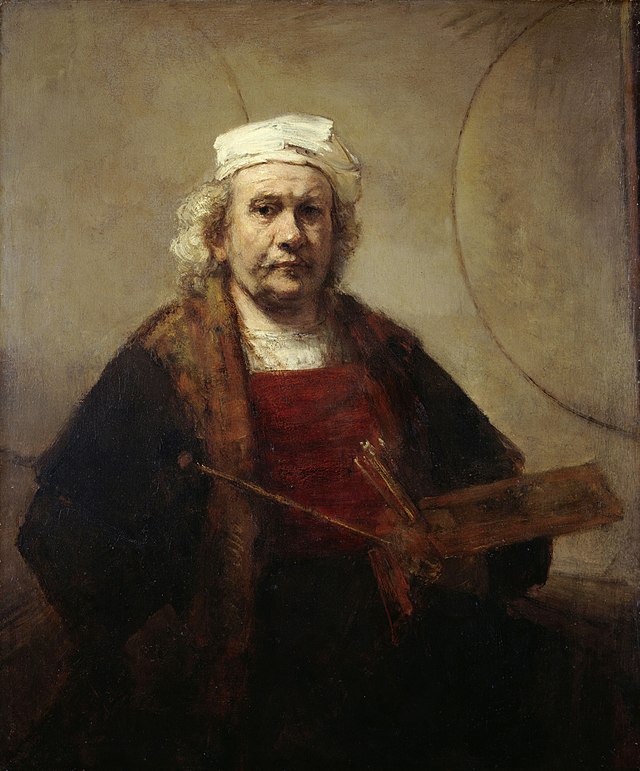
“Rembrandt” Harmenszoon van Rijn was born on July 15, 1606, in Leiden, in what was then the Dutch Republic. Rembrandt has regularly been regarded as one of the greatest visual artists in history who influenced countless artists in the centuries since he last took brush to canvas. But in one of his final works, Self-Portrait with Two Circles (c.1669), we do not see a man posing for legacy. We see a face marked by sorrow and candor. His expression is steady, weary, and unapologetically human. There is no pretense. No performance. Just presence. And in that rawness, there is something almost sacred. As we look into the eyes of Rembrandt, we see a man who tasted wealth, lived extravagantly, and still knew deep abiding sorrow and loss.
Perhaps you started this devotional today because you are navigating a loss of your own, the loss of a loved one, a spouse, a parent, a future, or maybe the loss of your marriage. I finished reading a biography of Rembrandt the day before my wife and I experienced our third miscarriage. In the weeks that followed, we felt loss even more acutely in a variety of ways in our church family, which made me grateful for the new friend I had in Rembrandt, a man who knew loss intimately. By age 32, Rembrandt had buried three of his children, and at 36, only a year after the birth of his surviving son Titus, he buried his wife, Saskia. This is a man who knew despair.
Like the psalmist, Rembrandt could have said, “My soul is cast down within me.” (Psalm 42:6, ESV). But please note, Rembrandt’s is not the blueprint of a virtuous life. This is not a “things all work out in the end” story. After Saskia’s death, Rembrandt entered a complicated and scandalous relationship with a woman he never intended to marry, whom he later had institutionalized to avoid paying alimony. Financial ruin followed. He declared bankruptcy, was blacklisted, and prohibited from selling work under his own name.
In 1669, Rembrandt died in obscurity, buried in an unmarked grave. And yet, the sorrow in Rembrandt’s life is not the final word. Especially in his late self-portraits, we glimpse a longing for something beyond the grief and disgrace—a thirst that mirrors the cry of Psalm 42:
As a deer pants for flowing streams, so pants my soul for you, O God.” (ESV)
His paintings, especially in his later years, are drenched in humility, depth, and a brutal kind of beauty. They are the visual equivalent of that desperate plea:
Why are you cast down, O my soul, and why are you in turmoil within me?” (Psalm 42:11, ESV)
Rembrandt’s story reminds us that even those who reach worldly heights can find themselves in the valley of shadows. His life was a mixture of brilliance and brokenness, of artistic mastery and personal failure. And yet, like the sons of Korah, he gives voice to a sorrow that seeks God in the silence,
Deep calls to deep at the roar of your waterfalls; all your breakers and your waves have gone over me.” (Psalm 42:7, ESV)
Rembrandt eventually buried a wife, a son, a daughter-in-law and two infant daughters, both named Cornelia. Eventually, he began a relationship with his former maid, Hendrickje, with whom he had a third daughter who he again named “Cornelia.” Even in that naming choice, there seems to be a seed of hope, ‘perhaps this one, perhaps a third Cornelia.” Rembrandt’s naming of his daughter is not so much a resolution but a defiance against despair: ‘I will have Cornelia.’
The psalmist clings to hope similarly—not because his circumstances have changed, but because he knows God has not.
“Hope in God, for I will again praise Him, my Salvation and my God” (Psalm 42:11, ESV).
This is the hope we are invited into—not the promise that everything will work with three Cornelias, but the deeper assurance that even in the darkest seasons, God is near. That He sees. That He remembers. That He is not done.
Day 2
Scripture: Lamentations 1
Jeremiah Lamenting the Destruction of Jerusalem (1630)
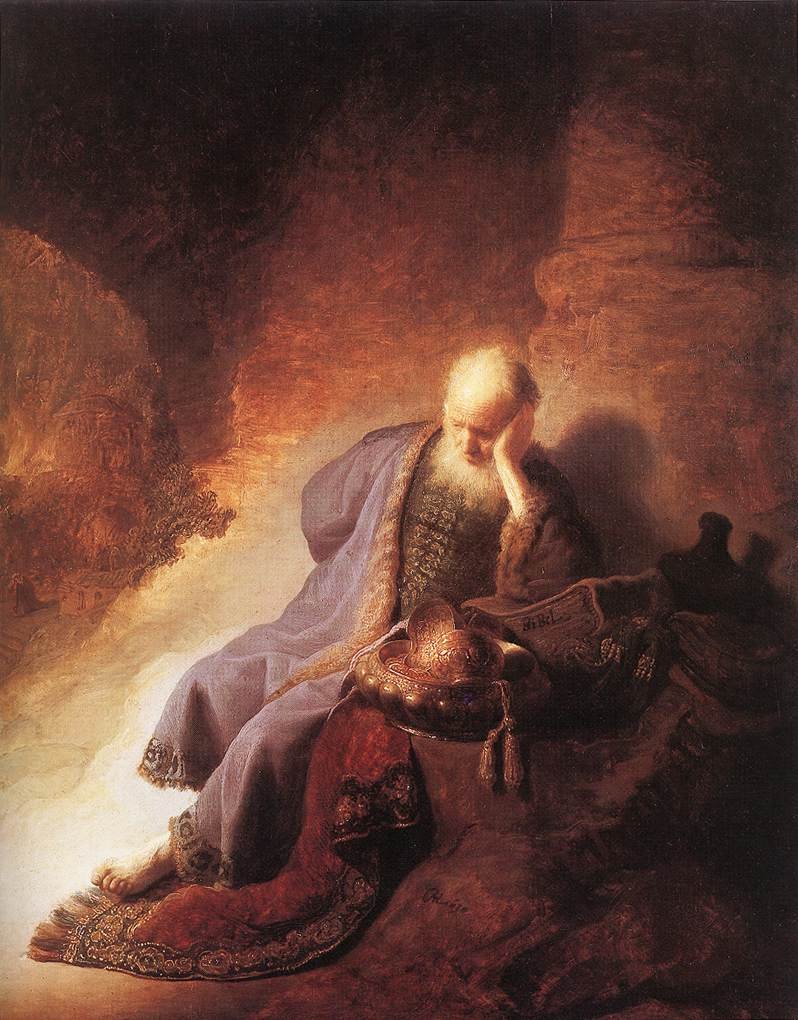
Rembrandt’s Jeremiah Lamenting the Destruction of Jerusalem captures more than just a moment in history—it captures the silence of grief, the kind that settles into your bones when everything you knew is shattered. The prophet Jeremiah sits, hunched and defeated, his eyes are heavy and his hand pressed to his forehead as if the weight of his sorrow is simply too much to bear. You can feel the ache. Jerusalem, the city of God, lies in ruins, and Jeremiah, with no words left to say, simply weeps.
At just 24 years old, Rembrandt already understood that kind of sorrow, having buried his mother four years prior, when he was only 20. Grief, like this, is overwhelming. It drags you down, leaves you breathless, and there’s no escape. Rembrandt’s painting captures that moment—a man broken by loss, caught between the weight of the past and the hopelessness of the future.
In Lamentations 1, we find the words of a people who are similarly undone:
“How lonely sits the city that was full of people!
She has become like a widow…” (Lamentations 1:1, ESV)
Perhaps you’ve felt this way—once full of hope, full of life, full of dreams—and now, it seems like all the people have left, leaving you alone in the rubble. Maybe you’ve lost something or someone that has left you feeling desolate. A relationship. Your health. Your sense of purpose. And like the people of Jerusalem, there’s a deep, quiet ache that refuses to go away.
“Her gates are desolate…
all her people groan as they search for bread” (Lamentations 1:4, 11, ESV)
It’s easy to read these verses and think of the destruction of a city, but I wonder if you’ve ever felt that deep hunger in your own life—the hunger that comes from losing something precious and not knowing how to heal. Maybe it’s a hunger that feels like a physical ache, a yearning for something to make sense, a desperate search for something that can’t be found in the rubble.
Jeremiah’s lament, captured by Rembrandt’s brush, reminds us that grief doesn’t have to be tidy or eloquent. There’s no right way to grieve. Sometimes, all you can do is sit in the silence, broken, and allow the sorrow to wash over you. Jeremiah doesn’t try to fix things; he doesn’t rush to a resolution. He simply grieves, and in his grief, he is deeply human. He shows us that lament is not a sign of weakness, but of honesty with God.
Maybe you’ve been trying to find the right words to pray, the right way to grieve, the right way to make sense of your pain. But like Jeremiah, you might find that the words aren’t there. And that’s okay. You don’t have to have all the answers. Sometimes, the only thing you can do is sit with God, just as Jeremiah did, and say, “I don’t know why this is happening, but I’m here, and I need You.”
Day 3
Scripture: Genesis 22
The Sacrifice of Isaac (1635)
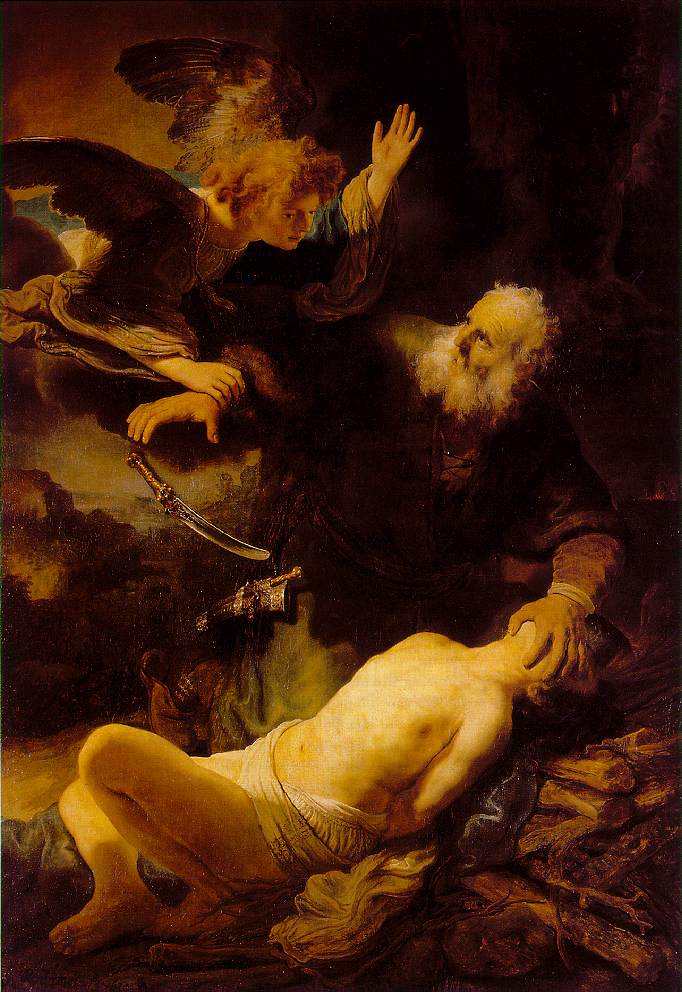
InThe Sacrifice of Isaac Rembrandt seems to capture the moments where everything seems hold its breath. Abraham’s left hand holds Isaac’s face away—an act of both violence and mercy, as if shielding his son from the terror of what’s about to happen. Abraham’s right hand is in the powerful grip of a delicate angel, his face is contorted in bewilderment, and the knife he was holding just a moment ago is now falling through midair.
Rembrandt painted this in 1635. He was still in the early years of success, still rising in fame and fortune. He had not yet buried his wife. He had not yet wept over the graves of three of his children. He had not yet been blacklisted, bankrupted, or buried in an unmarked grave.
And yet, even then, he understood something about the tension between surrender and love. About what it costs to trust God.
God tested Abraham and said to him, ‘Abraham!’
And he said, ‘Here I am.’
He said, ‘Take your son, your only son Isaac, whom you love,
and go to the land of Moriah, and offer him there as a burnt offering
on one of the mountains of which I shall tell you.’” (Genesis 22:1–2 ESV)
There are few words more crushing than these. We often read this story knowing how it ends. But Abraham didn’t. He walked those three days with Isaac, carrying only wood and faith, faith that somehow, God would provide—even when nothing made sense.
“On the third day Abraham lifted up his eyes and saw the place from afar.” (v. 4 ESV)
Maybe you’ve been on a journey like that. Maybe God has called you to surrender something—someone—you love deeply. A relationship. A future. A dream. And maybe, like Abraham, you’ve walked that path not knowing how it ends. Maybe you’re still walking it.
Rembrandt’s painting captures the very moment God intervenes. An angel breaks through the tension, grabbing Abraham’s wrist, and we’re reminded that God is not distant from our pain. He enters it. He stops the knife and provides the ram.
It’s worth noticing that God never wanted Isaac’s death—He wanted Abraham’s heart. The test was never about sacrifice for the sake of suffering. It was about trust. Would Abraham trust God even when obedience looked like loss?
What Rembrandt so powerfully communicates is this tension between surrender and mercy, between obedience and intervention. In Abraham’s grief-stricken face, we see a man who was willing to let go, not because he understood, but because he believed in the One who called him.
“So Abraham called the name of that place, ‘The Lord will provide’;
as it is said to this day, ‘On the mount of the Lord it shall be provided.’” (v. 14 ESV)
Is there something God is asking you to surrender—something you’re gripping tightly out of fear or love? What would it look like to trust that the Lord will provide, even when the outcome is unclear?
Day 4
Scripture: Luke 15:11-32
The Return of the Prodigal Son (c. 1669)
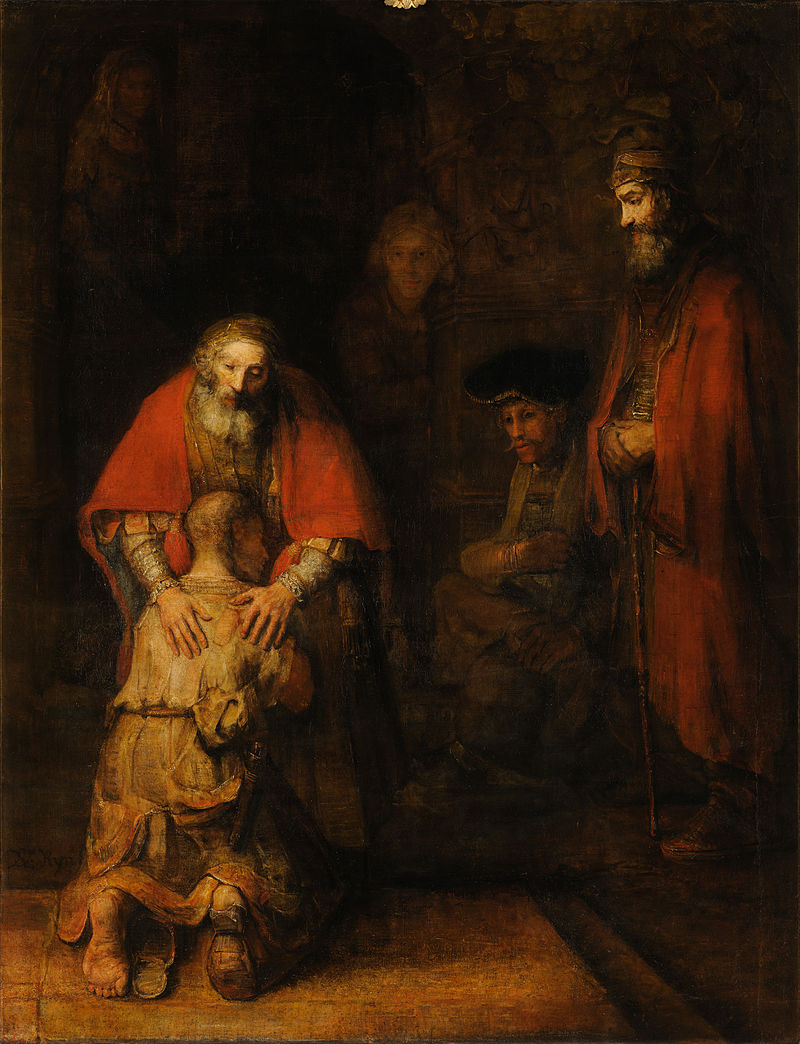
By the time Rembrandt painted The Return of the Prodigal Son, he was a man who had lived long in the shadow of grief. His fame had faded. His wealth had vanished. His reputation had been marred. This was not the work of a young man chasing greatness. This was the work of a man trying to find his way home.
The painting is quiet. No movement, no spectacle. Just a father and a son—and grief thick in the atmosphere. The younger son kneels, bones pressing through his clothes, head shaved, foot worn and cracked. His arms cling weakly to his father’s waist, but it is the father’s arms—broad, weathered, steady—that hold the son in place.
Rembrandt knew what it meant to be that son. To return empty. To be undone by loss. To have nothing left but need.
“But while he was still a long way off,
his father saw him and felt compassion,
and ran and embraced him and kissed him.” (Luke 15:20 ESV)
When you are grieving, the return feels impossible. You don’t feel worthy of joy. You don’t feel capable of celebration. All you know is what you’ve lost—and maybe who you’ve become in the losing.
That’s why this story matters. That’s why this painting is so powerful. The father doesn’t wait with conditions. He doesn’t ask for explanations. He simply sees his child, with both his soul and his sole (of his foot) exposed as impoverished.
In The Return of the Prodigal Son, we see the shape of Rembrandt’s hope—not in resurrection from pain, but in the embrace of the Father within it.
But then, off to the side, stands the elder brother. His hands are clasped. His face is stiff. His clothes are clean. He is the picture of control, of dignity—and of distance. He, too, is grieving, though he doesn’t name it. His bitterness is a mask for pain. The story doesn’t say what he’s lost—but something has hardened him.
“But he was angry and refused to go in…
‘All these years I’ve served you…’” (Luke 15:28–29 ESV)
How often do we let grief make us guarded, resentful, alone? We ache quietly, while pretending to be okay—hoping duty will earn back what love alone can restore.
But the Father comes outside for him too.
Grief leaves us ragged. We may not have the words. We may not even have the strength to ask for healing. But the Father still sees. Still runs. Still welcomes.
Like Rembrandt near the end of his life, we can bring our sorrow home—not for answers, but for embrace.
“My son, you are always with me, and all that is mine is yours.” (Luke 15:31 ESV)
Day 5
Scripture: Luke 2:22-38
Simeon In The Temple (c.1669)
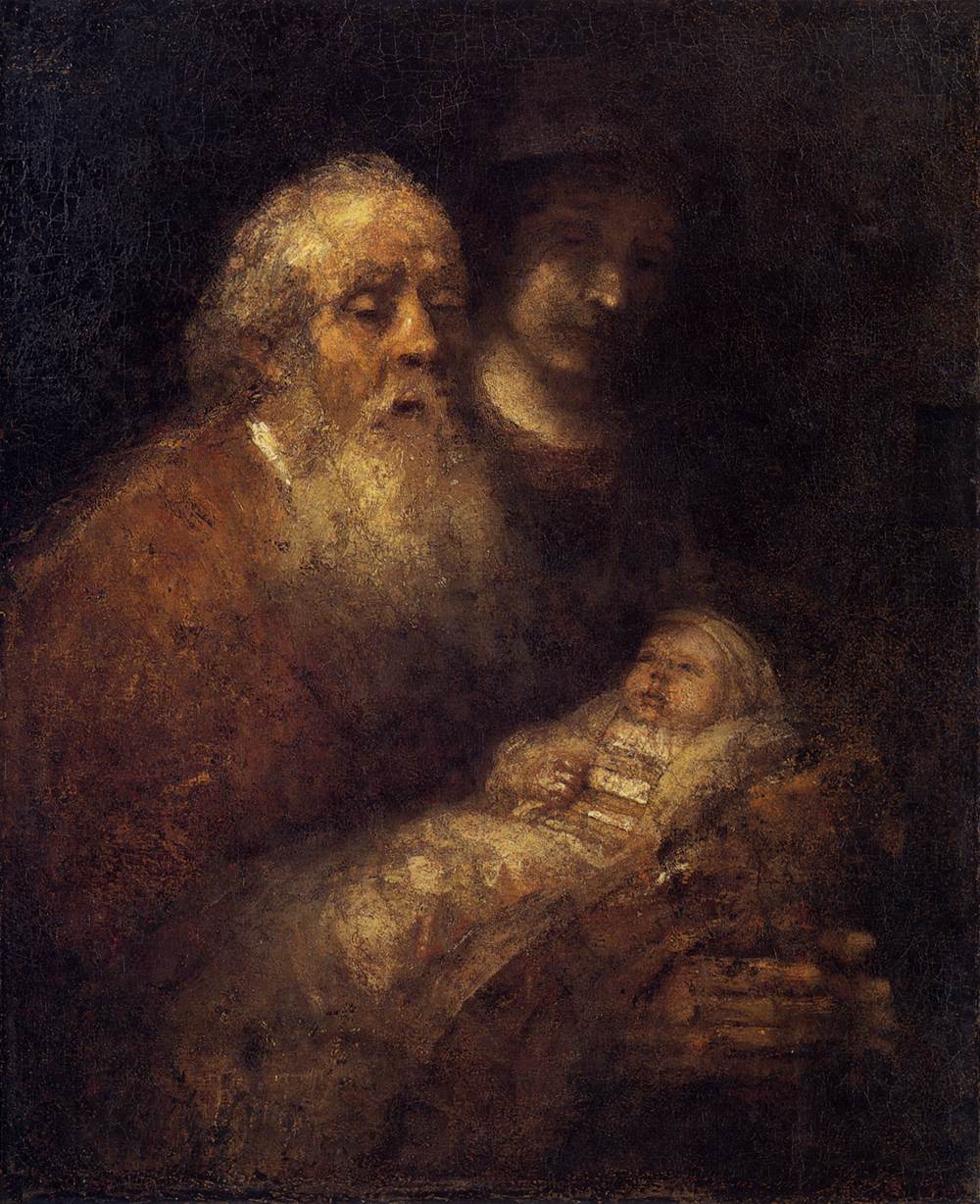
Rembrandt’s final painting, Simeon in the Temple, was found unfinished in his studio the day after his death. The painting is believed to have been inspired by an event seven months earlier, when Rembrandt stood as the godfather for his granddaughter Titia’s baptism. Titia’s father, Titus—Rembrandt’s only surviving child from his marriage to Saskia—had died from the plague before her birth. Shortly after Titia was born, her mother also passed away. For Rembrandt, Titia was all that remained of his love with Saskia.
Rembrandt’s grief after Titus’ death was deep. His painted works from this period, including Simeon in the Temple, reflect a longing for something beyond what this world can offer—a longing for divine peace and fulfillment, a longing for a love that would not fade, a love that could not be taken away. This seems to be the same longing of Simeon in the gospel of Luke, who had waited a lifetime for the Messiah, and when holding the infant Jesus in his arms, declared,
“Lord, now you are letting your servant depart in peace, according to your word; for my eyes have seen your salvation” (Luke 2:29-30 ESV).
Simeon’s waiting was over. And in his aged eyes, there was not only the peace of fulfillment but the peace of release. I wonder if, for Rembrandt, who many have said painted himself as Simeon in this picture, he looked at Titia as the fulfillment of his own desires for lasting progeny.
In this way, Simeon represents the moment when all the longings of a lifetime converge in the embrace of Jesus. What Simeon could not have known is that Jesus, the fulfillment of God’s promise, would one day take on ultimate loss Himself—bearing the weight of grief, suffering, and death for the sake of all who suffer.
In the depths of his own loss, Rembrandt may have found in Simeon’s story a reflection of his own journey: years of waiting, enduring, and aching for the promises of God to be fulfilled. But Simeon knew that peace is found not in the absence of pain, but rather the embrace of something greater.
For Rembrandt, Titia was a living symbol of that promise. Just as Simeon held the promise of salvation in his arms, so Rembrandt held a new generation, a new life, that reminded him of the love he had lost, but also the love that still remained.
What are you waiting for God to fulfill in your life? How can you hold onto God’s promises, even in the face of deep grief or disappointment? How might God be inviting you to see His faithfulness in the midst of your sorrow, as Rembrandt found in Titia and in his third Cornelia?