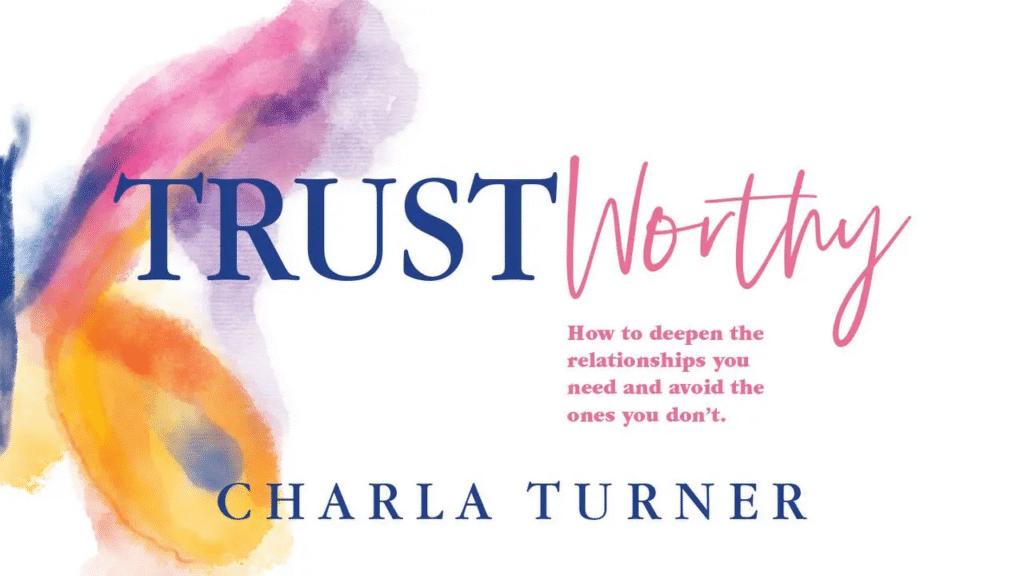
In the TrustWorthy plan by Charla Turner, readers will be equipped with a biblical understanding of what trust is, whom they should trust, and how they can deepen trustworthy relationships in their lives.
Four Rivers Media
Day 1
Scriptures: Hebrews 11:1, Proverbs 3:5-6, Jeremiah 17:7-8
What Is Trust, and Why Is It So Important?
Welcome to TrustWorthy! I’m so excited to share with you over the next seven days how you can deepen the relationships you need and avoid the ones you don’t. I pray this plan about trust encourages and equips you in your relationships. On day 1, we’re starting small and taking a look at what trust really is!
According to Strong’s Concordance, trust is defined as being “bold, confident, sure, [or] secure” in someone or something. Trust is an important foundation of all relationships. It is built over time and can be lost in an instant. It is easy to break but hard to build.
It has been said before that faith is trusting God. Thankfully, God’s Word gives us a definition of exactly what faith is in Hebrews 11:1: “The substance of things hoped for, the evidence of things not seen.” It’s a confidence that God will be true to His promises. Trust is a reliance on our faith. Trust is faith in motion.
It could be that when we embrace the concept of a God who created all things, is omniscient and omnipresent, and can perform supernatural miracles, and then combine that with a personal commitment to love people and care for others in our community that we have a greater ability to trust. If you can trust in a big God, then trusting people isn’t so hard because, even if they break you, you know He can heal you. When you know you are guided by God, then every experience you have—whether it is positive or negative—can be used by Him in your life to help you grow.
We can trust in our heavenly Father. When we put our trust in Him, He will make our paths straight (Proverbs 3:5-6), and His Word says we will be blessed and “like a tree planted by the water that sends out its roots by the stream” (Jeremiah 17:7-8).
The only questions that remain are these: Why aren’t we trusting in the Lord? What (or who) is getting in the way?
Day 2
Scriptures: Luke 6:45, John 10:4-6, Luke 11:4
Whom Should I Trust?
Today, we’re discussing whom we can trust and identifying the voices that compete for our trust.
Luke 6:45 starts to get us on track. The English Standard Version puts it this way: “The good person out of the good treasure of his heart produces good, and the evil person out of his evil treasure produces evil, for out of the abundance of the heart his mouth speaks.”
When someone is speaking good out of the abundance of their heart, pay attention! And when they’re speaking evil, be hesitant to trust them.
In John 10:4-6, Jesus tells a parable about the one voice we should always trust. His voice—the voice of the Good Shepherd. Additionally, we are told that His sheep (us) will not follow a stranger’s voice but instead run away from it.
In this parable, I believe the voice of the stranger is the voice of our enemy. We must discern whose voice we are believing and whose voice we are following. If we’re not following the Good Shepherd’s, we are being led to destruction. We can be sure that God’s voice sounds like his written word. If we are tempted to listen to a voice that does not align with scripture it is surely attempting to lead us into something that will result in unnecessary pain. Pain is unavoidable but there is some pain that we experience that is unnecessary and can be avoided if we will listen to God’s voice and those whose voices echo his.
To add to this point, Jesus gives us a model prayer in Luke 11. In verse 4, we see Him ask to not be led into temptation. This is exactly where the enemy wants to take us and why we should avoid his voice at all costs. He knows our fleshly desires and how to make us stumble, but when we follow our Good Shepherd, we can trust in Him to protect us.
What voice are you listening to? How well are you able to discern the voices that call out to you?
Day 3
Scriptures: Romans 12:2, Colossians 2:8, Proverbs 30:5
What’s My Filter?
Today, on day 3, we’re talking about filters! Filters are necessary if we’re to make good decisions about whom we trust and what we do. What are your filters?
If we don’t have filters of any kind, we will believe everything we hear. From things said on TV and in movies to what we read and hear on the radio, we will internalize it and, inevitably, it will become part of our belief system.
The Bible talks extensively about our belief system and how it is shaped. In Romans 12:2, we are told not to conform to the world but to be transformed by the renewal of our mind. If we are renewing our mind, that renewal will be a continuous process.
Again, in Colossians 2:8, we are warned to not be taken captive by the deceit and philosophy of anyone who is not Christ. Plenty of deceit, false philosophy, and deception exists in the world—some of it is from the enemy, and some of it may be from foolishness! If we’re not prepared to filter it through God’s Word, we are sure to fall victim to it like so many others have.
In Proverbs 30:5, we are told that EVERY WORD of the Lord is pure and that He is a shield to those who trust in Him! We can trust in Him and His Word, and He will shield us from the deception around us.
What shapes your belief system? What are your filters? We must root ourselves in the Word of God and, just as Proverbs 30:5 suggests, use it as our shield to deflect the deception and falsehoods that are all around us. We must examine our beliefs to determine their origin and make adjustments if they don’t align with biblical truth.
Day 4
Scriptures: Proverbs 22:24-25, James 1:19-20, Colossians 3:8, Proverbs 27:17
When to Stop and When to Proceed (Red and Green Lights)
Congratulations! We’re on day four which means after today, you’ll be over halfway through this plan. I hope that so far, you’ve learned about whom you can always trust—God! Today, we’re focusing on how you can discern which people you can trust and why.
First, let’s focus on when we shouldn’t give someone our trust—the red lights. (Hopefully) when you see a red light, you stop.
The Bible gives us plenty of wisdom regarding whom we shouldn’t associate with. In Proverbs 22:24-25 (ESV) it says, “Make no friendship with a man given to anger, nor go with a wrathful man, lest you learn his ways and entangle yourself in a snare.”
And this isn’t the only time God’s Word mentions the danger of anger. It says be quick to listen, slow to speak and slow to become angry in James 1:19-20 and to rid ourselves of anger, rage, malice, slander, and filthy language in Colossians 3:8.
Anger is a human emotion we all experience. But if someone continuously gives him or herself over to anger, we should not associate with them, and we definitely should not put our trust in them.
There are plenty more reasons not to put our trust in individuals, probably enough to write an entire YouVersion plan about! But for the sake of time, let’s move on to green lights—when we can put our trust in others.
If you haven’t already, read Proverbs 27:17. This verse sums up green lights perfectly! Iron sharpens iron. Friends sharpen friends. Those you associate with should sharpen you, not make you duller—both mentally and spiritually. They should benefit your life, and you should benefit theirs!
Whom are you associating with? Whom are you putting your trust in? It’s been said that you are who you surround yourself with . . . so, who are you?
Day 5
Scriptures: Psalms 118:8-9, Exodus 18:21, Proverbs 12:19, Proverbs 20:19
Trust Principles
We’ve talked about whom we can always put our trust in and the people we can trust, so today, we’re discussing some important trust principles from God’s Word.
Firstly, we are told in Psalms 118:8-9 that it is better to trust in the Lord than in man and that it is better to trust in Him than in princes. Depending on the translation you’re using, the word princes may be different, but the meaning is the same—no one on earth can or will be as trustworthy as the Lord our God. He will never let us down!
For the next principle, we’re going all the way back in the Old Testament to Exodus 18:21. This verse was intended for the Israelites, but we can still gain wisdom from it. It speaks of who is trustworthy—those who hate dishonest gain. If you’re putting your trust in someone who cheats, lies, steals, and manipulates, you’re asking for trouble!
Thirdly, Proverbs 12:19 is about truthful lips and lying tongues. One lasts forever, and one “endures only a moment.” Can you guess which is which? Those we are friends with and especially those we are in relationship with should be telling us and others the truth. If relationships are built upon trust, lies have no place there.
The final principle we’re discussing today is gossip! If you’re constantly getting told gossip by a certain individual, would you tell them something personal—something that you would not want to be shared with others? Probably not! The Bible confirms this in Proverbs 20:19 and tells us not to associate with gossipers/slanderers.
Which of these principles do you most need to work on? We know that the more trustworthy we become the more trustworthy our relationships will be because we will attract our likeness. God’s Word is full of wisdom regarding whom we should and shouldn’t associate with and whom we should and shouldn’t put our trust in, but it’s up to us to apply this wisdom to our lives even when it’s hard.
Day 6
Scriptures: Psalms 37:4-5, Isaiah 26:3-4, Nehemiah 8:10
Trusting God Through Hard Times
Today, we’re again talking about the only being we can fully put our trust in ALWAYS—God.
No matter what we are going through or will go through, we can trust God through it all.
Psalm 37:4-5 tells us to not only trust in the Lord and commit our way to Him but to delight ourselves in Him! Whether we’re on the mountaintop or in the valley, we need to commit our ways to Him and trust in Him to lead us to the next place we need to be.
Isaiah 26:3-4 (NIV) says, “You will keep in perfect peace those whose minds are steadfast, because they trust in you. Trust in the LORD forever, for the LORD, the LORD himself, is the Rock eternal.” When we heed this verse, we will not only have peace, we’ll have PERFECT peace—peace that only the Lord can provide!
What do you lean on in hard times? What motivates you to keep moving forward? Nehemiah’s author in 8:10 (ESV) says, “The joy of the LORD is [my] strength.” When we’re going through hard times, we need to shift our focus from the difficult situation and onto the Lord.
Don’t run away when things don’t go as you think they should. If you will be faithful in your commitment to Him and just stay close to Him, you will see His goodness, and you will find the healing you have been searching for.
We can trust God in any and every situation. When the going gets tough, put your trust in Him.
Day 7
Scriptures: 1 Kings 19:12, 1 Corinthians 13:4-7, Psalms 28:7
Moving Forward After Betrayal and Trusting Again
Congratulations! You’ve made it to the final day of TrustWorthy. On our last day, we’re covering an important topic—how to trust others again when you’ve been betrayed.
This is an especially important topic to me due to what I’ve been through. I delve into this more in my book, TrustWorthy: How to deepen the relationships you need and avoid the ones you don’t. You can find out more about it by visiting the link provided at the end of today’s reading.
Take time to read 1 Kings 19, focusing on verse 12. The important part of this is that the “Lord was not in the fire.” Similarly, the Lord is not ever the cause of our being betrayed, of our heartbreak, or of our hurt. But, after the fire, there comes a gentle whisper from Him. He wants to help us heal.
I don’t know how you’ve been hurt in the past or by whom, but I do know the definition of love God gives us in His Word. If you’ve been heartbroken, I’m almost certain your relationship didn’t look like what love is supposed to look like according to 1 Corinthians 13:4-7. These attributes of love give us a clear look into what our relationships should look like. Although you’ve been hurt by what you may have thought to be love at the time, God has something better ahead for you.
Moving forward, we also must remember to put God—and only God—first in our lives, even when we are in a relationship. We need to heed the wisdom of Psalm 28:7 and have our hearts trust in Him so that He will be our strength and shield. If we put Him first, we can defend our heart when others let us down and be able to immediately go to Him for healing.
Whomever has hurt you, however you have been hurt, God wants to help you heal. Will you surrender to Him and let Him heal your heart?
Thank you so much for reading this plan, and I pray it has helped you better understand biblical trust as well as whom you can trust.