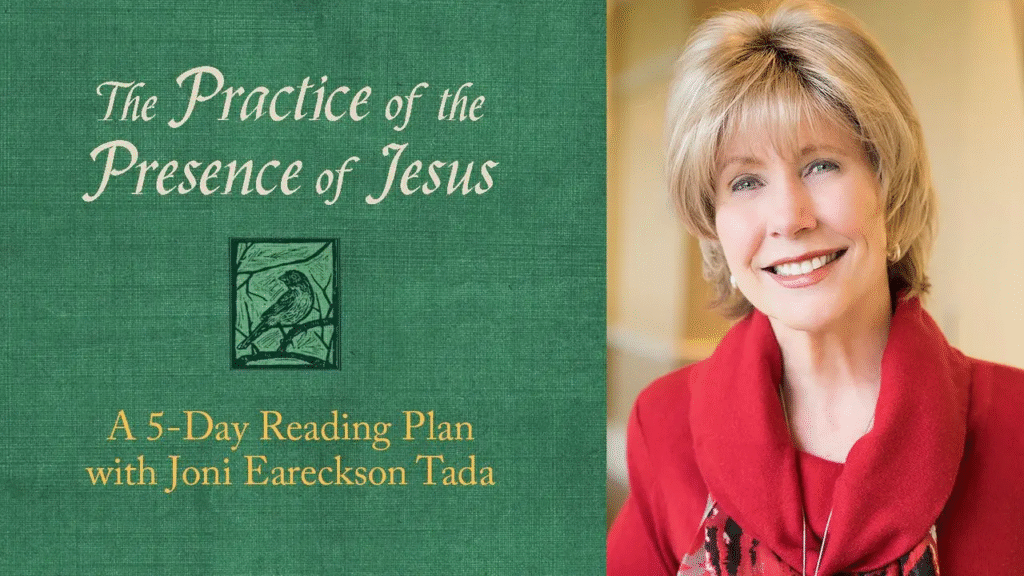
How can we continually receive God’s joy, comfort, and hope in the midst of physical or emotional suffering? Joni Eareckson Tada, who uses a wheelchair and is a cancer survivor, offers insights from Carmelite monk Brother Lawrence as well as from her own experiences in this powerful devotional.
WaterBrook Multnomah
Day 1
Scriptures: Psalms 30:1-12, Song of Songs 1:2-3, Isaiah 40:28-31
Songs in the Night
The seventeenth-century monk Brother Lawrence is best known for practicing the presence of God in the midst of everyday tasks and deep suffering. He once wrote, “I know that for the right practice of the presence of God, the heart must be empty of all other things; because God will possess the heart alone.”
I often practice the presence of my Savior in the dark of night when physical pain is keeping me up. Rather than contend with anxiety, I empty out my heart and pour the beauties of Jesus into it. I fill it with love words for him, each borrowed from the Bible: “Oh, Jesus, to me you are altogether lovely, the fairest of ten thousand, the bright and morning star, my Bridegroom for whom I long. You are the Rose of Sharon, the Lily of the Valley. As Song of Songs 1:2-3 says, ‘Your love is more delightful than wine . . . . Your name is like perfume poured out.’”
The heart cannot stay filled with muddled thoughts when its hollows are overflowing with the loveliness of Christ.
One night recently, my usual sleep position was not working, and I lay wide awake. This particular night I recited Isaiah 40:31 over and over: “Those who wait for the Lord shall renew their strength, they shall mount up with wings like eagles, they shall run and not be weary, they shall walk and not faint.” Eventually, I fell asleep.
In the morning when my friend pulled back the drapes, she gasped and stepped away from the bay window. There perched on my small birdbath was a massive hawk. His talons clutched the rim, he arched and ruffled his feathers, and we marveled at the awesome creature, sitting serenely, a picture of supreme beauty and breathtaking power. After my harrowing night, how precious of God to gift me with “strength in the morning.”
When we open the eyes of our hearts, God will always surprise us with signs of his grace. I suppose if God can direct a whale underwater to swallow Jonah, he can direct a huge hawk to greet me at the start of a new day. How did Jesus greet you this morning? What reminders has he given you of his love for you?
Meditate: Ask God to open the eyes of your heart to see evidences of his care.
Day 2
Scriptures: Romans 8:15, Romans 8:28, Galatians 4:6-7
Abba Father
Panic consumed me after I broke my neck at the age of seventeen. While my friends went off to college or landed jobs, I stayed stuck in a hospital. Life felt bleak, and I wanted someone to magically promise that everything would be okay.
It’s the heartfelt plea of all who suffer. We want assurance that somehow things will work out in the end. We want to know that our world is orderly and stable, not spinning off into nightmarish chaos. We want God to be at the center of our suffering, not only holding our lives together but holding us. Like a father who picks up his crying child, pats him on his back, and says, “There, there, honey, everything will be okay. Daddy’s here.” That’s our plea; we want God to be Daddy.
In Romans 8:28, we have the massive promise of that very assurance: “And we know that for those who love God all things work together for good, for those who are called according to his purpose.” Here our Abba Father tells us he is so in charge of everything that all hard things are ordered to serve our ultimate good. This is true whether we face tribulation, distress, persecution, famine, nakedness, peril, or sword (Romans 8:35). It’s true whether we face broken homes, broken hearts, or broken necks.
As Brother Lawrence wrote, “I prayed for strength to suffer with courage, humility, and love. Ah, how sweet is it to suffer with God! However great the sufferings may be, receive them with love.”
The robust hope of the believer is not that we will escape a long list of bad things, but that God will make every one of our agonies an instrument of his mercy to do us good—in the here and now and in the hereafter.
Meditate: Ask God to reveal the good things he is doing through the trials you face today.
Day 3
Scriptures: Deuteronomy 6:11-12, Psalms 103:1-5
Never Forget
An Iranian pastor and his wife escaped persecution by coming to America, but after a year she started panicking.
“Can we please go back home?” she pleaded. “I’m spiritually falling asleep here!”
She was being sung to sleep by Satan’s bewitching lullaby that promised comfort, prosperity, and an abundance of “milk and honey.” She was beginning to forget God.
There’s nothing wrong with grocery stores and gas stations. But we must never forget that we all live in houses richly stocked with goods we did not produce; we drink from wells we did not dig and eat from vineyards we did not plant. These are God’s extraordinary gifts, but they come with a warning: “When you have eaten your fill in this land, be careful not to forget the Lord, who rescued you from slavery” (Deuteronomy 6:11–12). There’s nothing wrong with “milk and honey,” but it can be a little like Valium, making you forget God.
That’s why the Lord gives lean times and hard afflictions. As Brother Lawrence wrote, “Make immediately a holy and firm resolution never more willfully to forget Him.”
Not long ago I had a scare with my heart and lungs (aging with quadriplegia makes it more difficult to inhale enough oxygen). After receiving treatment, I’m now able to breathe better, and I cannot stop thanking Jesus. Every breath is a precious gift from him. My daily afflictions prevent me from lapsing into amnesia when it comes to remembering the many great kindnesses of my Savior.
Practice the presence of Jesus today—and every day— by proclaiming, “Let all that I am praise the Lord; may I never forget the good things he does for me” (Psalm 103:2).
Meditate: What are the world’s lullabies that make you spiritually drowsy? What tends to wake you up to God’s presence and your dependence on Him?
Day 4
Scriptures: John 16:33, 2 Corinthians 6:9-10
Sorrowful Yet Rejoicing
I can be enjoying a glorious symphony, watching a breathtaking sunset, delighting in my backyard roses, or thanking God for his awesome creation, yet still, there will be an accompanying sorrow.
Part of my sorrow is related to my paralysis and pain, which never goes away; the other part is a heart-wrenching awareness that my crucified Lord gave his life so that I might enjoy the beauties of this world. Suffering has made me hypersensitive to God’s joys.
This wonderful and terrible mix of emotions—sorrow and joy—is described in 2 Corinthians 6:9–10, “Yet we live on . . . sorrowful, yet always rejoicing.” In my most glad moments, the mingling of sorrow never goes away, and I would never wish it away. Our joys and sorrows do not exist on a continuum like “I was joyful the last few days, but now, sorrow has taken over and I wonder when it will end so I can get to rejoicing once more.”
Joy and sorrow aren’t linear. Good things and bad things are always happening simultaneously in our lives.
The blending of joy and sorrow is a wonderful affirmation of who we are in Christ, a kind of litmus test that tells us, “This joy you are experiencing isn’t frivolous or superficial. So be glad in that!” There are countless reasons for our hearts to break, but Jesus Christ makes even those sorrows into repositories of his deep and profound joy. The example of our lives flies in the face of those who think that Christian joy is all about comfort.
When someone asks me, “Who is this Jesus, and what do you believe about Him, Joni?” I can confidently respond, “He is my fountain of joy in all my sufferings. Let me prove that by the way I trust Him.”
Meditate: If you are experiencing a strange mix of joy and sorrow, you are practicing Jesus’s presence.
Day 5
Scriptures: Isaiah 46:4, Isaiah 49:16, 2 Corinthians 1:3
Living with Hope
“Comfort yourself with Him,” Brother Lawrence urges us.
The Lord is delighted to call himself “the God of all comfort” (2 Corinthians 1:3). He does not supply merely a little comfort, or some comfort, but all that heaven can muster for your need. He offers you innumerable consolations through countless channels. One way is never good enough for God—he floods his comfort toward you through a thousand tributaries, seeking to support you where it hurts the most. I know this because I have experienced it.
There was once a season when I was so overwhelmed by chronic pain that I almost became blind to God’s offer of enabling grace. Pain has a way of heightening our natural inclinations to doubt God. But in Christ we have transcendent inclinations, for we are called to live supernaturally. We can live hopefully. Miraculously. Powerfully.
When you are wounded, it’s hard to find more personal words than Isaiah 46:4. God speaks here not through a prophet or some other messenger, but one-on-one with you, saying tenderly, “I am he, I am he who will sustain you. I have made you and I will carry you; I will sustain you and I will rescue you.” It’s a promise; he will sustain you. God stakes his character on it.
Perhaps the most heartwarming expression of God’s comfort is in Isaiah 49:16. Look at your Savior’s hands and hear him say, “See, I have written your name on the palms of my hands.” When the Son of God engraves our names in his “flesh,” it is much more than Joni, Ken, Bobby, or Jessica. It’s everything your name represents. If he has carved your many pains and concerns into his palm, will he not care for your tiniest problems? He has etched each one into himself! He has more compassion for your frailties than you could ever imagine.
Today, live hopefully, miraculously, and powerfully, for Christ has the final word when it comes to your suffering. Jesus is your Answer, so practice his presence in your suffering.
Meditate: What does it look like to practice Jesus’s presence in suffering?