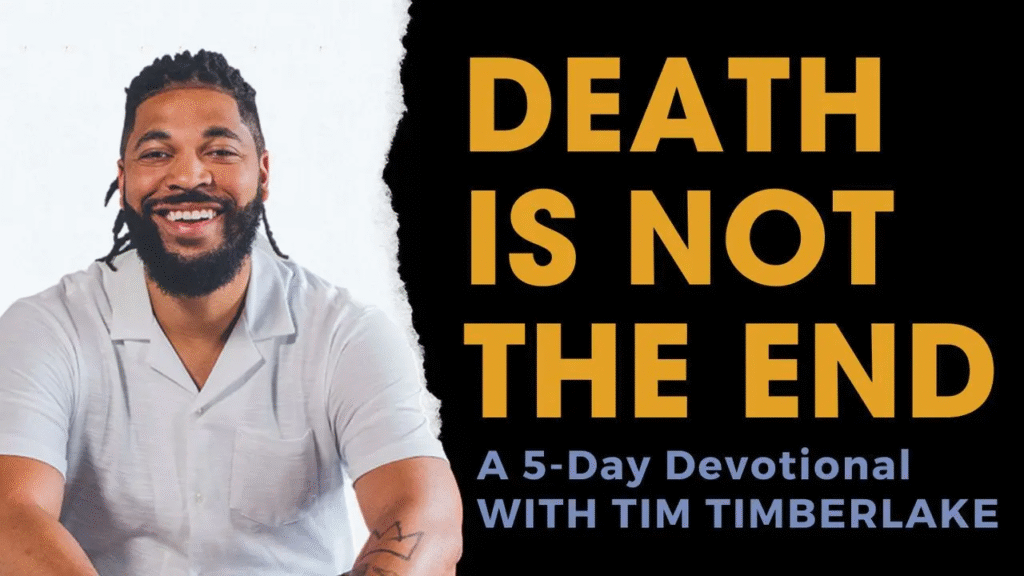
All kinds of deaths are woven through this life, from the physical death of loved ones to the figurative deaths of dreams, relationships, careers, trust, security, beliefs, and plans. Though grief is a universal experience, those who hope in God have a way through it. With great compassion, Pastor Tim Timberlake, author of The Art of Overcoming, shines the light on our ultimate hope: no death is ever the end.
HarperCollins/Zondervan/Thomas Nelson
Day 1
Scriptures: Genesis 50:20, Isaiah 25:8, Hosea 13:14, 1 Corinthians 6:14, 1 Corinthians 15:56-57, Philippians 1:21
Death Has No More Sting
The sting of death—whether we are talking about literal death or simply the loss of something we valued—is found in its finality. That’s why it hurts so much to lose someone close to us or something important to us. We can never get back what we’ve lost, and that creates grief.
But what if death is not as final as we think? What if death has less power, less authority, less of a grasp on the human soul than our experience would lead us to believe?
The more I read the Bible and the longer I follow Jesus, the more I’ve seen this simple truth at work: what we think are endings are usually just beginnings. What we think is loss often turns out to be gain. What should be weakness somehow becomes strength. What was meant for evil results in good. Why? Because that’s how powerful and good God is. He has a way of turning the worst thing that could happen into the best thing that could happen.
Nowhere is this clearer than in the promise of heaven. When it comes to the human soul, the hope of life after death lies at the core of the gospel message. The death of the body seems insurmountable, but God promises us that someday, death itself will be defeated. Death is temporary; heaven is eternal. This is a core tenet of the Christian faith.
The Bible provides a divine glimpse of this truth. God’s promise is not just life until death, but life in death, through death, and after death.
The grave doesn’t get the last word. God does. One day death will be swallowed up in the victory of heaven. This is called the resurrection, and it’s when those who have died become alive again. Death is defeated once and for all, and life wins in the end.
Respond
If grief has robbed you of all confidence that this death you’re facing is not the end, ask God to speak to your heart through the Scriptures attached to this passage.
Day 2
Scriptures: Psalms 22:24, Psalms 34:18, Psalms 106:44, John 11:1-43, 2 Corinthians 12:9
God Is Holding Your Heart
God is not far away in times of death. In fact, he’s closer than ever in these times. That nearness should inspire comfort, not fear or shame. If your view of God usually involves him being mad at you for something you’ve done, you need to get a new view of God. That’s not the way Jesus treated people, which means it’s not the way God treats people, especially when they are suffering.
God empathizes with our pain. Empathy is the capacity to comprehend and share the feelings of someone else. That describes God perfectly. The Bible frequently talks about how God “hears our cries” or “sees our suffering.” The little deaths we go through move the heart of God. He knows the future, but his foreknowledge doesn’t make him callous to our suffering in the present.
Before Jesus raised Lazarus from the dead, he first met with his sisters, Martha and Mary. They were brokenhearted, of course—even angry. You can hear it in their voices in John 11. At one point, when Jesus saw the grief of Mary and the others, he was overcome with compassion and began to weep.
Consider how much that says about God’s heart. Jesus knew he was going to raise Lazarus from the dead. He knew their sorrow would become joy in a matter of hours, maybe minutes. So when he saw the grief of Mary and Martha, he could have responded, “Where’s your faith? Where’s your gratitude? Be strong! Stop whining and just trust God.”
Instead, he wept. Think about that. Their pain mattered to him. He didn’t ignore the loss; he validated it. He sat with them in their suffering and he shared their tears.
Why? Why would our tears matter to God?
It’s simple. Because we matter to God. And not just our productivity, or our holiness, or our generosity.
Our loss matters.
Our pain matters.
Our anger matters.
Our anxiety matters.
Our confusion matters.
Our disappointment matters.
God is moved by your tears. When you weep, he weeps.
Respond
If you are going through pain and grief, imagine Jesus mourning with you. Visualize his embrace as you cry, argue, or vent. He’s not judging you—he’s holding you.
Day 3
Scriptures: Hebrews 11, Romans 4:19-20
You Can Live by Faith Even in the Dark
Allowing faith to coexist with death is important because sometimes we try to use faith to avoid death when God is asking us to use faith to deal with death. Instead of walking through death experiences with grace, we think we can believe, hope, trust, claim, quote, and pray our way out of them. When that doesn’t work, we blame ourselves for our lack of faith, or we get mad at God for not holding up his end of the deal, or we pendulum back and forth between the two.
Death, by definition, is beyond human control. If you think every bad thing that happens is because you didn’t have enough faith, you’re going to spend a lot of time feeling ashamed and condemned. Plus, what we are suffering from or what we have lost is only part of our story. Faith in God allows us to see deaths in their wider context: they are just one part of a complex, long, layered, beautiful life.
Hebrews 11 lists numerous people from Israel’s history. It’s easy to look at that list and think, Wow, those men and women were incredible. They believed, and God did miracles. Their faith was proved by their life.
But look at verse 13: “All these people were still living by faith when they died. They did not receive the things promised; they only saw them and welcomed them from a distance, admitting that they were foreigners and strangers on earth.”
They didn’t just live in faith; they died in faith, knowing that God is faithful in this age and in the age to come.
Having faith in God doesn’t mean you never lose a job, loved one, or friendship. It means that even when you lose what you thought you couldn’t survive without, you keep living. You keep loving. You keep giving. Your pain runs deep, but your faith runs deeper. Your circumstances have changed, but God hasn’t.
Respond
The next time you think your death experience is a sign that you lack faith, ask God to show you how it might be an opportunity to walk by faith.
Day 4
Scriptures: Genesis 22:2, Ruth 1:16-17, 1 Samuel 1:22, Esther 2:8, Matthew 14:13, John 19:26-27
Overcome by Letting Go
“Letting go” is easier said than done. It takes foresight and maturity to look beyond your present pain and realize something better is coming.
Many heroes of the Bible had to say goodbye to things they cared for deeply. We often forget the emotional choices they made to let go of a past or a dream or a relationship before they could step into the future God was offering them.
Remember when God asked Abraham to give up his son?
Remember how Ruth let go of her homeland and her own family?
Hannah had to leave her son Samuel behind to grow up at the temple. David had to say goodbye to his best friend, Jonathan. Esther had to leave her adoptive uncle to move into the palace of a maniacal, pagan ruler. Jesus had to find comfort and healing after his cousin John the Baptist was killed. Mary had to say goodbye to her son on the cross. I could go on and on, but you get the picture. Overcoming is not just about what we get, but it’s also about what we give up.
These stories from the heroes of our faith should remind us that letting go is just as much a part of faith as holding on. There is a natural movement or trajectory to life, and what works for one season doesn’t necessarily work for the next. Losing, leaving, and laying to rest are necessary stages of growth. Nobody likes to lose, but if we can’t lose, we can’t gain either. We will just stay where we are, and that’s unnatural.
Overcoming is not all rose petals and glitter. It’s not all trophies and medals and awards. A lot of overcoming is simply moving forward, growing, and adapting as we go. It is leaving the past behind without bitterness or regret, but rather with honor, knowing what we had was important for a season, but that the season has ended.
Respond
What is the Lord asking you to release to him? What makes you reluctant to let go? Don’t be afraid to confess your struggle and ask for God’s help: “Lord, please grant me the faith to entrust this loss to you. Please grant me the strength to trust your goodness and love as I open my hands and release this thing I have loved.”
Day 5
Scriptures: Psalms 27:13, John 12:24, Revelation 21:4-5
Endings Always Lead to New Beginnings
Sometimes I think we often hold on to the people, places, or dreams that we have lost (or are losing) out of fear of the unknown. Death terrifies us because we can’t visualize what’s ahead. We don’t have the language for it.
I’m reminded of something Jesus told his disciples. “Very truly I tell you, unless a kernel of wheat falls to the ground and dies, it remains only a single seed. But if it dies, it produces many seeds.” Though he was talking about how his death would bring life to many, the principle can also be applied to other forms of dying.
Our little deaths are often like seeds: when something is buried, something greater springs forth. Maybe you were fired from a job you didn’t think you could live without. Now, five years later, you’ve built an entirely new career that you love and that is providing twice the income. Maybe you moved to a new city and found yourself alone and homesick, missing your past life. Then, after being vulnerable for a while and opening yourself up to new relationships, you made lifelong friends who you wouldn’t trade for the world. Maybe you ended a toxic dating relationship after years of trying to make it work. Then, after the pain subsided, you met someone else, someone who truly valued you, and you found love, marriage, and a family.
Death is an ending, yes, but it’s not the end. It’s also a beginning, a necessary step before what is new can come into existence. Instead of panicking out of fear of the unknown, give whatever it is a proper funeral. Honor it, grieve it, process it. Then bury it in the ground of faith and return to the land of the living. Take a deep breath, choose to trust God, and walk through the doorway. That is your role and responsibility in the death process.
If we can see our death experiences from God’s eyes, we’ll realize that death never wins. Again and again, God gets the last word. Again and again, life triumphs over death.
And, again and again, endings become beginnings.
Respond
As you walk through this season of grief, keep a journal to record the ways in which the passing of this time in your life makes way for new opportunities and growth.