Are you in the middle of a crisis? Overwhelmed by impossible odds or a challenge that feels like more than you can handle? You’re not the first person to feel that way. In Numbers 13-14, a section of the Bible we often avoid, the people of Israel made a choice that changed their future. Their story can teach us a life-changing lesson. Scott Savage
Day 1
Scriptures: Psalms 34:18, Romans 8:37-39, Philippians 1:6
“I never expected to be here.”
Nearly all of us have said something like this when a crisis moment showed up for which we felt unprepared.
A medical diagnosis we didn’t see coming.
A family member betraying or abandoning us.
A financial disaster draining our savings.
It would be helpful if crisis moments provided advanced warning or sent a calendar request like a thoughtful coworker.
Many years ago, I was hired for a pastoral position, not knowing I had inherited a crisis moment. My situation differed significantly from the job I was told about in the interview. The longer I stayed in that job, the more painful discoveries I had and the more cynical I became.
Each day produced increasing fear and confusion. I was wounded repeatedly and put up walls of cynicism. I began to respond and lead out of that. Finally, someone I cared about profoundly came to me and said, “Scott, where’s the hope? You point out all that’s wrong and broken around here. But I’m depressed, and I’ve lost five friends to suicide in the last year or so. I need hope, and I don’t hear any in you.” That conversation over coffee convinced me that something needed to change.
If there’s one big idea in this plan, it’s this;1 how we respond to crisis moments reveals whether we live in fear or hope.
When I finally realized how wounded and cynical I’d become, God took me to a place I had repeatedly overlooked in the Bible. It was the place I got stuck every time I tried to read the Bible in a year. The Book of Numbers is far more than lists of people and collections of large numbers. Numbers includes a powerful story of a few people who ended up where they never planned to be, experiencing emotions they struggled to process and acting out fear rather than hope.
As I wore out the middle part of Numbers, God showed me how His people responded to a crisis moment. He showed me some profound lessons that I’ve been trying to put into practice ever since then.
I look forward to encouraging you through this plan if you’re in a crisis or a season of adversity and suffering. You may not be where you planned to be, but you are not alone here. God is present with you! As hard as it may be to see, God is at work in this circumstance. We serve a God who wastes nothing and finishes the work He starts in and through us.
On the following day of the plan, I’ll show you how one small shift can help you determine what you must do next in this crisis.
Day 2
Scriptures: Numbers 13:1-2, Numbers 13:17
After issuing the Israelites the 10 Commandments, God told Moses to send one of the best men from each tribe to spy on the Promised Land; with specific questions to answer about the people, the land, and the cities.
Then, Moses told them to be courageous and grab some samples of the land’s fruit.
I love Moses’s final comment: “Don’t get caught, but bring back some goodies to share!”
Why is this historical account significant? Why should you care about the details of the instructions some spies received?
When God calls us to have courageous hope in the middle of difficult circumstances, He doesn’t demand that we ignore the challenges. He wants us to see them and account for them.
The Hebrews left Egypt after 400 years of slavery, heading toward a place they had only dreamed about. For hundreds of years, the people heard about God’s promises to Abraham, Isaac, and Jacob to bring them into this land. They were living on that promise, and it’s as if God said, “Now, I no longer want you to live on a promise. Go see it for yourself. Study it, explore it, learn all about it.”
When I said yesterday that I wanted you to learn how to have hope and courage in the middle of your crisis, you may have thought I was out of my mind. “This guy on the Bible app has no idea what he’s talking about. If he knew what I was dealing with, he would know that hope is ludicrous and courage is impossible in the face of these challenges.”
The people in Numbers 13 may have thought the same thing. What God does by sending them out to spy on the land is shift their perspective from a telescope to a magnifying glass. It’s as if He says, “Don’t trust the view from far away that somebody told you about. Go see it and study it yourself, the good and the bad, the opportunities and the challenges.”
Is it time for you to go on your fact-finding mission? It may be time for you to study your enemy or your obstacles. God might be leading you to know in detail what you’re up against and what this crisis will require of you. God might also want to show you how He’s been preparing and equipping you for these adversities. He might even want you to sample some of the fruit you will enjoy when this crisis is complete.
Or do you need to do the opposite? Have you gotten so focused and fixated on all of the little details of every problem you’re facing that you’ve lost sight of the big picture? When I get overwhelmed and go into crisis mode, I often get tunnel vision and become blind to all the ways God provides for me, works around me, and even protects me. Until I step back and see a bigger picture, I don’t see things as clearly as I thought.
Do you need to grab a magnifying glass and focus on the little things? Or do you need to step back and take a panoramic view so you can see the big picture?
I will share a robust list with you the following day of the plan. If hope has felt impossible or illogical, the next reading may be the most important thing you read in this whole plan.
Day 3
Scriptures: Mark 8:34, Romans 5:3-4, Romans 15:13, 1 Peter 1:3
When all I could see were problems, somebody asked me, “Scott, where’s the hope?” This question was difficult to answer, as I struggled with how I viewed hope.
The hard part about hope was that when I heard that word, I thought of something puny and weak. In that season, God began to teach me and show me that my view of hope was not accurate. I began to see all of the ways I incorrectly defined hope.
During that time, I built a list of ten things that hope is not.
First, hope is not naive. So, if you hear the word hope and think I don’t live in reality, take a deep breath; hope is not naive.
Second, hope is not denial. If God wanted His people to live in denial, He would not have sent them to spy out the Promised Land.
Third, hope is not passive. The people in Numbers 13 would not take the Promised Land while sitting comfortably with cold drinks.
Fourth, hope is not avoidance. Avoidance doesn’t improve anything, including the noise your car may be making.
Fifth, hope is not an easy path. When you read the story of people like Noah, Joseph, Moses, David, and Jeremiah, you see God doesn’t call His people to easy things.
Sixth, hope is not comfortable. If you hold onto the truth about what you’re facing in one hand while holding on to hope in the other, you will be far from comfortable.
Seventh, hope is not cheap. If you’re going to hold on to hope amid a crisis, it’s going to cost you something. Sometimes, what it’s going to cost you is the view that other people have of you.
Eighth, hope is not an emotion or a feeling. Hope isn’t something we do or hold to when we feel like it. It’s much bigger than that.
Ninth, hope is not weakness. People who can hold on to hope in the face of dire circumstances, which causes them to feel anything but hope, aren’t weak; they are powerful.
Tenth, hope is not insignificant, as seen in this story from Numbers 13.
So, if hope is not those things, what is hope? I have a favorite definition. Hope is a strong and confident expectation for something good that God will bring about in the future. According to the Bible, hope is far more than wish.
Hope focuses on the future, rooted in who God is. Because of what we expect God to do, our hope gives us a strong and confident expectation. Therefore, if you think that hope means you have to deny what’s happening around you and pretend it’s not real, that is not hope because hope doesn’t deny reality! As we’ll see in the story, hope invites us to defy reality. “Yes, all of those things which make you afraid are true. All of those things are real and happening. But God will bring something good in the face of it all.”
If you respond with courageous hope in the middle of your circumstances today, you will have to defy reality and trust God’s power to bring good from what seems far from good.
The trip the spies embarked on would require great hope. As we’ll see in the next reading, what they discovered in the Promised Land tempted them to become very afraid.
Day 4
Scripture: Numbers 13:21-29
We choose what we will focus on daily with our time and energy. It’s one of the most significant choices we make.
The spies had this same choice. Numbers 13 shows us what they chose as they returned from a 40-day journey throughout the Promised Land. After acknowledging the good things they found in the land, the spies focused on all of the obstacles that stood in their way. Their report is riddled with fear, and their conclusion makes that clear: “We are not able to go up against the people, for they are stronger than we are.”
Because the spies saw literal giants in the land, found large and fortified cities, and discovered great warriors, they returned and spread a report to persuade the people not to enter the land God promised them.
I’ve noticed this as I’ve read this story again and again: Our temptation has always been to focus on the size of the problem rather than on God’s provision. This temptation is not a new challenge that we’re facing today. It goes back to the events described in Numbers 13, over 3,000 years ago.
We are tempted to focus on the size of our problems rather than on God’s provision. Like spies, we take all of our experiences, opportunities, advantages, and disadvantages and turn those pieces into a story that we tell other people and ourselves. All too often, that story focuses on all our problems rather than God’s power.
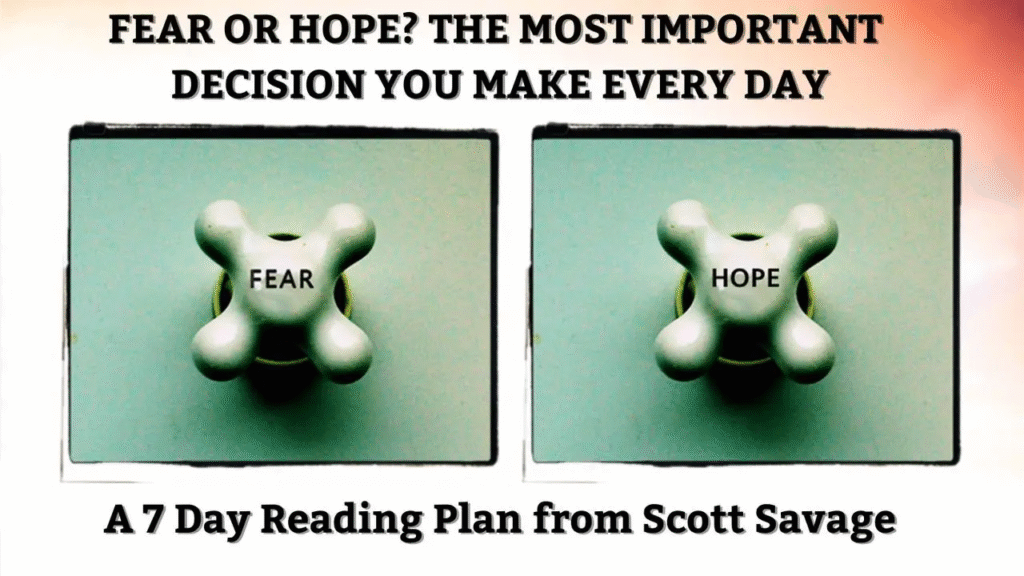
When I was in my “angry phase” as my wife described it, the story I told was primarily about the size of my problems. Everything changed one day when I stumbled upon an article while scrolling the internet. In that story, the writer included an image representing the fear of the economy. It was a picture of a knob like the one in the shower that you turn to change the temperature of the water labeled “fear.” I asked a graphic designer I knew to create some artwork for me. He created the art that you see in the image in this plan’s description, a fear knob and a hope knob.
In those days, I realized I had turned fear as far as it would go. Fear was intense in me, and fear flooded out of me because I focused on the size of my problems. Then, my friend I told you about earlier approached me and said, “Scott, where’s the hope?”
I began to feel like God was speaking to my heart, and He seemed to ask me, “Scott, are you going to be a voice of fear, or are you going to be a voice of hope? Are you going to turn the fear knob, or are you going to turn the hope knob?” During that season, I committed to being a voice of hope. I not only want to have God’s hope; I want to have God’s hope be loud through me.
If you want the same to be true for you, you need to focus on God’s solution and provision. When you open the next day of this plan, you’ll see how two hope dealers refused to let others’ responses diminish their trust in God.
Day 5
Scriptures: Numbers 13:30, Numbers 14:6-9
One of our immense privileges is hearing someone else share their story. Our family has a mantra, everyone has a story if you’ll stop long enough to listen. When you listen to people share their stories, you find that through a great deal of suffering and adversity, the person became who they are today.
That’s the fifth lesson in this plan; our hope in God turns our difficulties into opportunities. When we choose to focus on God’s provision and character, we build a strong and confident expectation in Him and the good He’s going to bring.
In Numbers 13-14, we meet a spy named Caleb. After the majority of spies shared their fears and doubts about taking the Promised Land, Caleb quieted the people before Moses and said, “Let us go up at once and occupy the land, for we are well able to overcome it.”
A few verses later, a spy named Joshua joined Caleb in his faith-filled dissent from the rest of the spies. They tore their clothes as a sign of grief and angst. They told the assembly that the land they passed through was “an exceedingly good land.” They pleaded with the people, “Do not rebel against the Lord, and do not fear the people of the land.”
Twelve spies went into the land. Ten of them came back, talking about the size of the problem. Two of them, Joshua and Caleb, came back talking about the size of their God.
Joshua and Caleb saw what the other ten saw, but they saw it differently. The same thing may be happening to you today. You may have friends and family going through the same circumstances, but they see it differently. Some are responding with fear, and some are responding with hope. Kevin Gerald describes this hope as “an unrelenting determination to not allow the hardships of life to downsize the bigness of God.”
When you choose hope, you express an unrelenting determination. Hope is not weakness, passivity, avoidance, or comfort. Hope doesn’t require less of us; it demands more of us.
So here’s the question for you. What opportunity is God opening up for you during your current difficulty? What is God making possible amid this difficulty you didn’t see coming?
Have you ever said, “I need to slow down and be more intentional about spending time with God?” You now have your opportunity.
Have you been saying, “There are some things I need to deal with?” Well, now, in this difficulty, you have an opportunity to face them and seek God’s help in that area.
I don’t wish you more pain, loss, grief, or disappointment. But, more than I don’t wish you that, I want you to not waste this crisis. I want you to see how God is present with you and how He is working, though you may not be able to comprehend it.
The outcome of the spies’ visit and report is the next day’s subject. It’s a sobering reminder that you need before you make a decision you may regret.
Day 6
Scripture: Numbers 14:20-32
The story of the spies ends shockingly. We learn that our lack of hope and courage has consequences.
Moses delivered terrible news to the ten spies and the thousands of people who believed their bad report on the land.
God tells them via Moses that they will wander in the wilderness for 40 years, die, and none of them will enter the Promised Land. Everyone over the age of 20 who sided with that report will not enter the Promised Land. Only Joshua and Caleb are exempt from this outcome because of their faith.
When I’ve shared this story in other settings, I’ve heard people say God’s decision sounds incredibly harsh. Many of us would prefer to live in a world where there are no consequences. We’d prefer to escape the consequences of our decisions.
But the truth is that what we do matters. What we do right now matters. If we choose to respond without courage and hope, there will be consequences.
Someone once asked me, “Where is the wealthiest real estate located?” It’s not in Manhattan, Hollywood, London, or Dubai. This person told me that the wealthiest real estate is in graveyards. The untapped potential permanently resides there, and unused gifts waste away.
Bronnie Ware knows that truth. As a nurse who worked in hospice work in Australia and New Zealand, she compiled her lessons into a book about the top regrets of the dying.
The number one regret for 1000s of dying patients Ware served was, “I wish I’d had the courage to live a life true to myself, not the life others expected of me.”
I have a lot in common with Ware’s dying patients. I’ve made many decisions based on what others would think, what I was afraid of, and the expectations I was scared not to meet.
Is your lack of hope and courage today rooted in a fear of others’ opinions? In your current crisis, are you seeking to honor God more than anything else? Are you responding in a way rooted in hope, or will you react in a way that will minimize other people’s criticism and adverse reactions?
If the voice of other people and your fear of their opinions are louder than the voice of God in your life, you will not live with hope and courage. You will live driven by fear!
I would hate for you to come to the end of your life with the same regrets as those hospice patients.
On the final day of this plan, we’ll examine the gift that God offers us amid our crisis moments, and how we can avoid those weighty regrets.
Day 7
Scriptures: Hebrews 12:27, Joshua 1:5-9, Romans 12:1, John 8:32
This statement may sound unbelievable, but your crisis today can be a gift.
A gift?! In what way?
This crisis can be a gift because it can expose the truth. If nothing else, crisis makes the truth visible. What you’ve discovered about yourself and the people around you through this crisis has been inside all along. It took the crisis to expose the truth because the crisis exposes where we’ve put our hope. When your world shakes during a crisis, you turn to the source of your hope without thinking about it.
The writer of Hebrews warned us this would happen. In chapter 12, we read that what can be shaken will be shaken so that what cannot be shaken will remain.
A crisis shakes us, exposing our idols. What’s an idol? I appreciate Timothy Keller’s definition. “An idol is anything you look to for what only God can give.” Have you seen that in your crisis? Have you seen yourself turning to things other than God for what only God can truly give?
I went through a major crisis in our church a few years ago. That crisis exposed my idolatrous relationship with control. I like being in control, and that 12-18-month period showed me how little control I had.
During that time, a friend who knew I was struggling sent me a quote from Barbara Brown Taylor. “We do not lose control of our lives. What we lose is the illusion that we were ever in control in the first place.”
Ten years ago, I lost the illusion that I was in control. My son was born with a hole in his lung, and I couldn’t hold him for the first five days he was alive. He was in the NICU (Neo-natal Intensive Care Unit) of the hospital. We were praying that his lung would reinflate so he could breathe on his own and get off of the machine. We prayed that he would eat enough that we could feed him. My daughter, his twin sister, ended up in the NICU too. In the middle of the night, while I was sleeping next to my son, the doctor woke me up at 12:15 and said, “Mr. Savage, your daughter’s not breathing. She’s got a fever. We’re going to have to tube her, and we’re not coming to ask your permission. We’re just coming to tell you and inform you. We thought you’d want to know.”
I felt completely out of control in those days. I learned that control was an idol and an illusion, and I was looking to it for what only God could give.
So, what illusions and idols is your current crisis exposing? In John 8, Jesus famously said, “You shall know the truth, and the truth shall set you free.” But the truth is, many of us would rather live in bondage than freedom.
We’d rather live in illusion than in truth. Before we can be free, we need to wrestle with what the truth reveals about our current situation.
I wish Jesus had kept on talking about the truth. If He had, He might have said, “The truth may set you free. It just may make you miserable at first.”
You may discover things you don’t want to see in this crisis. How we respond to crisis moments will likely be a choice between fear and hope.
So, each day, when you step in the shower and grab the knob to turn on the water, I hope you remember that a choice is before you. Yes, hot or cold. But, even more important, fear or hope! Like Joshua and Caleb, your choice can lead to freedom and a miraculous move of God.