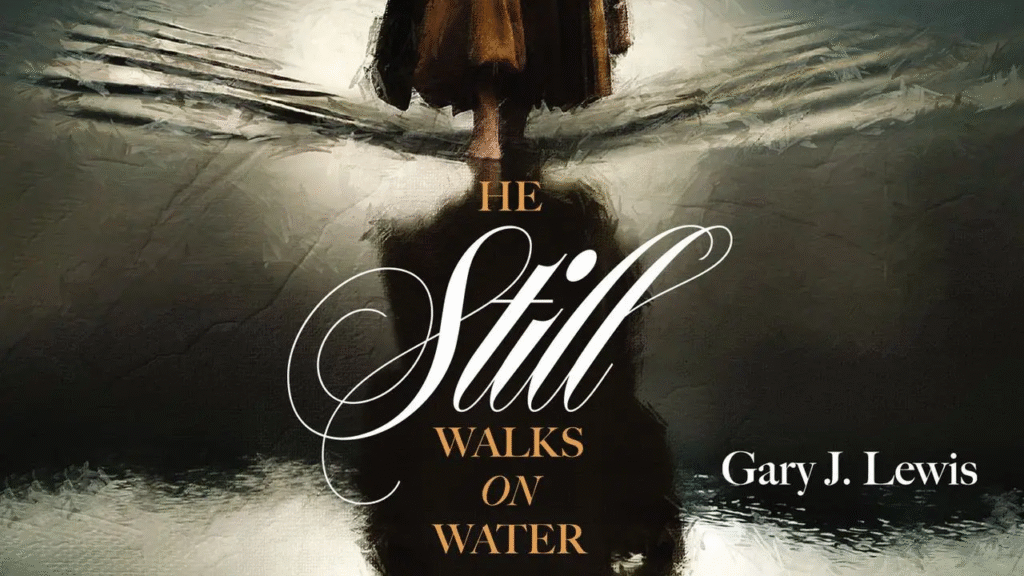
In this He Still Walks on Water Plan, Bishop Gary J. Lewis will equip readers with the biblical principles they need to face the storms of their life the way God intended.
Four Rivers Media
Day 1
Scriptures: Job 1, 1 Corinthians 15:57-58, James 1:27, Job 42
Into the Storm
Hello and welcome to the He Still Walks on Water Plan! I’m Bishop Gary Lewis, and over the next 7 days, I hope to equip you with the principles you need from God’s Word to stand strong in the midst of a storm.
Vicious, nasty, dark clouds of despair can overwhelm us without a second’s warning, such as in the case of Job. Like a tornado that swirls over the horizon, a succession of messengers brought the prophet the worst possible news.
The first told him that an enemy had attacked, killed some servants, and made off with his oxen and donkeys.
The second said that the fire of God had fallen from the heavens and burned up his sheep and other servants, and he alone had escaped to relay the news.
The third brought word that other enemies had formed three raiding parties to swoop down and steal his camels and put other servants to the sword.
Finally came the revelation that turned Job’s stomach into a churning mess: while his sons and daughters were feasting and drinking wine, a mighty wind had swept in from the desert and struck the oldest brother’s house. The four corners had collapsed and killed all of them, with only the messenger surviving to report the disaster (Job 1:13–19).
One danger of casual Bible reading is missing the full picture of what happened to the characters in Scripture. Sometimes, we treat Job’s anguish with a shorthand version of reality. You know: “Poor Job, he lost some of his possessions and really had it hard.” But let the details of that awful day sink deep into your spirit. Job had 7,000 sheep, 3,000 camels, 500 yoke of oxen, 500 female donkeys, and numerous servants. Plus, his pride and joy: seven sons and three daughters. And just like that, he lost it all. Anyone who has suffered through the death of a single child knows the awful, sinking feeling of agony and dismay that overwhelms any parent. The kind that leaves them gasping for air and asking the universal question: “Why did this have to happen to me?”
Once you better understand the magnitude of Job’s multiple losses, you may better appreciate his reaction to the parade of bad news messengers:
Then Job arose, tore his robe, and shaved his head; and he fell to the ground and worshiped. And he said:
“Naked I came from my mother’s womb,
And naked shall I return there.
The Lord gave, and the Lord has taken away;
Blessed be the name of the Lord.”
In all this Job did not sin nor charge God with wrong. — Job 1:20-22, (NKJV)
Job didn’t allow the storm to steal his hope. Every storm brings with it a spiritual battle, a clash where faith struggles to prevail over fear, and praise fights to drown out pain. Hope wrestles with helplessness. Love struggles to overcome loneliness. Only when we are equipped with vision and faith can we say as Paul did:
But thanks be to God, who gives us the victory through our Lord Jesus Christ. Therefore, my beloved brethren, be steadfast, immovable, always abounding in the work of the Lord, knowing that your labor is not in vain in the Lord. — 1 Corinthians 15:57–58 (NKJV)
But Job’s suffering doesn’t end there. Chapter 2 describes Satan (and remember, God permitted Satan to do this) afflicting Job with painful sores “from the sole of his foot to the crown of his head” (Job 2:7, NKJV). Imagine that — suffering so bad you sit with a shard of broken pottery and scrape yourself with it while sitting in an ash heap as your spouse tells you to curse God and die.
If that weren’t bad enough, Job has to endure the insults of Eliphaz, Bildad, and Zophar, who essentially place Job under a microscope saying in effect, “What have you done wrong, buddy? Why have you sinned and brought this curse on yourself?” There’s a reason similar second-guessers today carry the label “Job’s Friends.” And yet, after this series of charges and condemnations, Job is able to proclaim:
“For I know that my Redeemer lives, and He shall stand at last on the earth; and after my skin is destroyed, this I know, that in my flesh I shall see God, whom I shall see for myself, and my eyes shall behold, and not another. How my heart yearns within me!” — Job 19:25–27 (NKJV)
Not only was Job a wealthy man of faith, but he was also respected, generous, and known for helping the poor, widows, and orphans. Long before James wrote “Pure and undefiled religion before God and the Father is this: to visit orphans and widows in their trouble, and to keep oneself unspotted from the world” (James 1:27), Job was doing just that.
To grasp God’s goodness, we must contemplate the full story of Job. Too often, we can get hung up on his losses but forget the end of this ancient saga. Yes, Job walked through unimaginable grief and suffering, but he also came out in better shape than before the storm hit. This is the part of Job’s story worth remembering—that God is right there, walking through the storm by your side, whatever losses, grief, setbacks, or obstacles you are facing.
If you think of this as some kind of empty promise, consider the blessings God bestowed on Job at the end of the book, which included 14,000 sheep, 6,000 camels, 1,000 oxen, 1,000 female donkeys, 7 sons, and 3 daughters. And he lived 140 years — enough time to see four generations of his family (Job 42:12-17).
The best news is that Job isn’t some ancient figure whose relevance has faded with the passage of time. The same promises of restoration and blessing live on today through God’s Son, the Savior Jesus Christ. Just like He did in the story told in Matthew 14:22–33, Jesus still walks on water. He still takes our hand and guides us through gut-wrenching, fear-inducing, nerve-rattling setbacks.
Day 2
Scriptures: Matthew 14:22-33, 2 Corinthians 5:7, Daniel 3:26-29, 2 Corinthians 6:4, Proverbs 3:5-6
Get in the Boat
Life is a series of mountaintops and valleys. We must be careful not to focus too much attention on either. Valleys can run so deep that we allow our struggles to overshadow our victories and good experiences. Likewise, we can’t live on the mountain; God always has a purpose for our valleys.
I myself had a valley, which I write more about in my book, He Still Walks on Water. During my hospitalization, I developed a very deep appreciation for Matthew 14:22-33. The story of Jesus coming to the disciples and nearly scaring them to death by walking on water is one of the most stirring in the Bible, with six lessons that apply to our daily lives:
1) When He says go, we must respond.
2) When He says give, we must open up our bank account.
3) When He says trust, we must cast aside all fear, doubt, and misgivings and (to use a familiar phrase) go “all in.”
4) After pastoring three churches and serving in various church administrative roles for many years, I can assure you that our plans rarely match God’s.
5) Faith demands looking beyond what sits in front of our eyes or exists in our rational, logical thought processes.
6) God’s plans rarely make sense to human minds.
The lessons that stand out in the Matthew 14 passage start with the fact that God has a plan. In this story, we need to realize that the boat, the wind, and the waves were all a part of a grand design. The disciples were exactly where Jesus told them to be and doing what He told them to do. This is significant because it demonstrates that difficulties don’t necessarily mean we are out of the will of God any more than Job was when life plunged him into the midst of overwhelming grief. A storm can be an integral part of the Lord’s plan. So, while we may not like the idea of rowing into the midst of chaos and disaster, we have to get in the boat.
Obedience to the Lord isn’t always easy and can often be uncomfortable. Sometimes, we don’t understand the purpose of a valley or how it fits into God’s plan for our life. There are times when we must (as 2 Corinthians 5:7, NKJV, says) “walk by faith, not by sight.” These times require the belief to say, “God, I don’t understand why I’m going through this storm. It doesn’t make sense. But I choose to trust You!”
With God, the path we follow may lead through a fiery furnace like Shadrach, Meshach, and Abednego (Daniel 3:26-29), a stormy sea like the disciples, or (in my case) a mangled bicycle. It may be uncomfortable and even disagreeable, but whatever is going on, remember that God always has a purpose for what we are going through. Lori learned that when she went through the aftermath of my accident and saw how it helped grow her faith.
Heartache, sickness, and distress are inevitable in this world. In 2 Corinthians 6, Paul emphasized that we are workers together with Christ and equipped to persevere by His grace. No matter our circumstances or vocational calling, we are called to “commend ourselves as ministers of God” (2 Corinthians 6:4, NKJV) without getting offended but demonstrating patience and enduring distasteful things like tribulation, sleeplessness, and imprisonment. The sustenance of the Lord during adversity gives us a testimony and witness to the power of Christ.
How do we trust God’s plan when we don’t know what it is? When we go through a trial and ask ourselves, “What happened? I thought God had such great plans for me, but all I see is hardship!”
Well, our job isn’t to fit all the pieces together. It’s simply to follow God’s lead as He fits all the pieces together. Proverbs 3:5–6 (NKJV) says, “Trust in the Lord with all your heart, and lean not on your own understanding; in all your ways acknowledge Him, and He shall direct your paths.”
Day 3
Scriptures: Mark 4:35-41, John 8:44, John 10:10
Going for a Walk
As we begin Day 3, I have some great news for you: Jesus always walks beside us through our storms. His presence was a lighthouse in my dark days, like a vivid, strong, shining beacon of hope and healing. Regardless of the severity of my circumstances, His presence was a constant, unchanging harbor of peace.
Keeping our eyes on this harbor is essential when facing difficulties—vision moves us forward.
The disciples couldn’t go to where Jesus was on the mountainside; He walked to them on the Sea of Galilee. When we can’t go to Him, He comes to us. When He comes to us in our storm, He comes to us victorious over it.
To appreciate what happened in the pre-dawn hours of that historic night, consider the full picture. The disciples were in the middle of the sea, with wind and waves beating against the boat. Not a modern cruise liner that is three football fields long and can carry hundreds of passengers. Try a small craft about 27 feet long, 7.5 feet wide, and 4.3 feet deep, with enough room for fifteen passengers.
No matter the boat’s size, we know from Scripture that the disciples were sorely afraid of drowning in the raging waters. The Gospel of Mark contains another account of crossing the Sea of Galilee, where the disciples allowed their fear to trump their faith. Chapter 4 describes Jesus and His disciples leaving a crowd behind to cross the lake. As they sailed alongside some other boats, Jesus fell asleep. Verse 37 describes a furious squall coming up, which sent waves crashing over the boat and nearly swamping it. And there lay Jesus, sleeping like a baby.
Mark continues:
The disciples woke him and said to him, “Teacher, don’t you care if we drown?” He got up, rebuked the wind, and said to the waves, “Quiet! Be still!” Then, the wind died down, and it was completely calm. He said to his disciples, “Why are you so afraid? Do you still have no faith?” They were terrified and asked each other, “Who is this? Even the wind and the waves obey him!” — Mark 4:38–41 (NIV)
To that, I would add, “Wow!” We should all try to place ourselves in the midst of this raging storm. It’s no wonder the disciples were frantic. We’d be right beside them, yelling, “Hey, don’t You see what’s going on out here? We’re gonna die!” It is so easy to feel like God is sleeping during the storms in our lives or to think He is indifferent to our circumstances. The disciples couldn’t take it anymore, so they woke Him up to ask, “Teacher, don’t you care if we drown?” When we take our eyes off what God is doing and put them on our circumstances, the storm will always deceive us and make us believe we are drowning. But Jesus will never allow us to drown.
Fear causes us to forget God’s faithfulness in our lives. Satan will always try to make us forget that God performs miracles and that He has promised us a life of abundance. He will come and try to steal away every victory we have ever had. That is natural because lying springs from his nature. Jesus told the Pharisees: “When he [the devil] speaks a lie, he speaks from his own resources, for he is a liar and the father of it” (John 8:44). Later, He added, “The thief comes only to steal and kill and destroy; I have come that they may have life and have it to the full” (John 10:10, NIV).
Jesus brings abundant life, which is seen in the Mark 4 passage. He awakens, gets up, rebukes the wind, and tells the waves to be still. Jesus can do this because He has authority over creation. When we’re in a storm, we must remember that God can still the waves and calm the winds in the twinkling of an eye. He has already won the victory. We simply need to trust Him . . . Will you?
Day 4
Scriptures: Matthew 14:28-31, Matthew 17:20, 1 Timothy 4:14-16
What’s It Like to Sink?
Today we answer the important question: “What’s it like to sink?”
We can be assured of Christ’s love by examining what happened with the disciples in general and Peter in particular. As their boat tossed on the waves, the disciples were filled with doubt. The situation looked hopeless. Most of the disciples seemed helpless amid their waves of fear and shallow faith.
But Peter didn’t allow the storm to determine his faith—he looked past it and saw Jesus. Despite his apprehension, Peter gathered the faith to ask, “Lord, if it’s you, tell me to come to you on the water” (Matthew 14:28, NIV). In Matthew 14:29, without hesitating, Jesus said, “Come.” He will always say, “Come.” Apply that to whatever sickness, troubled child, overbearing boss, or financial worry you are facing right now, and remember that He is the Master of the sea, Creator of the wind, and Ruler of the universe. He is our Lord, Jesus Christ. It may seem like the boat is being tossed from stem to stern and is nowhere near a safe place, but He says, “Come.” No matter how impossible it may seem, He says, “Come.” The situation may not make sense, but He says, “Come.”
It was Jesus who made His disciples get in the boat and go before Him to the other side of the Sea of Galilee. But now the focus shifted from getting in the boat to getting out of the boat. Peter had to get out of the boat. The miracle was waiting for him on the water. Peter got out of the boat despite the towering winds and giant waves. Likewise, we can’t wait for the seas to calm and the storm to pass to test the waters. Sometimes, you just have to get out of the boat. Fear will tell us that we’re going to sink with the ship. But faith declares that even if the ship sinks, our hope is not in a man-made boat but in the power of God.
That is why Jesus called Peter to come to Him on the water. Peter obeyed. We must realize that we can never walk on water if we never get out of the boat. What boat is God calling you to step out of in faith?
A picture of God’s great love is woven throughout this passage from Matthew 14. After catching him, Jesus says to Peter that he has “little faith.” Jesus knew Peter was capable of even greater faith. In contrast, the disciples in the boat had no faith. He is bigger than our fears, and He will not let us sink. Whether we are walking on the water or sinking in it, He is the Master of the storm. And through Him, we are more than victorious.
Don’t believe you have enough faith to be victorious? Let’s look at what Jesus said to his disciples in Matthew 17:20 when they asked Him why they had failed to cast a demon out of a boy.
“. . . Jesus said to them, “Because of your unbelief; for assuredly, I say to you, if you have faith as a mustard seed, you will say to this mountain, ‘Move from here to there,’ and it will move; and nothing will be impossible for you.” — Matthew 17:20 (NKJV)
Truths such as this are why we need to be meditating daily on God’s Word and fellowshipping regularly with other saints and fellow church members. We need each other! We need constant reminders of God’s love, as expressed in this passage from Paul’s first letter to Timothy:
“Do not neglect the spiritual gift you received through the prophecy spoken over you when the elders of the church laid their hands on you. Give your complete attention to these matters. Throw yourself into your tasks so that everyone will see your progress. Keep a close watch on how you live and on your teaching. Stay true to what is right for the sake of your own salvation and the salvation of those who hear you. — 1 Timothy 4:14–16 (NLT)
Day 5
Scriptures: Proverbs 16:9, Genesis 49:4, Genesis 45:5-8, John 8:44
When God’s in the Boat
When Jesus and Peter got into the boat, the waves calmed, and the winds ceased. Something happens when God’s in the boat. We can chart our course, agonize over the “what-ifs,” and make our plans, but God is still in control. As Proverbs 16:9 (NKJV) says, “A man’s heart plans his way, but the LORD directs his steps.” God’s plan is bigger than our storm, and His purposes are greater than our circumstances. God will turn them around for our good and His glory.
This is a principle I find woven throughout Scripture from Genesis to Revelation. Just look at the formation of the nation of Israel through the twelve sons of Jacob. Jealousy and sibling rivalry led ten of them to toss Joseph into a pit before deciding to sell him to traveling Midianite merchants.
Of course, Joseph might not have been the object of scorn if his father hadn’t played favorites and given him a multi-colored coat while he bragged about his dreams and of ruling over them all (including their dad) one day.
Then there was the oldest son, Reuben, who slept with Jacob’s concubine—a fact Jacob never forgot: “Unstable as water, you shall not excel, because you went up to your father’s bed; then you defiled it—He went up to my couch” (Genesis 49:4, NKJV).
And Judah, who impregnated his daughter-in-law after she tricked him because he didn’t follow Jewish custom and give her his third son as a husband after the first two died. Jealousy, kidnapping, lying . . . their list of sins goes on and on. I doubt that any of us would have chosen this motley crew as the seeds of a great nation, but God knew what He was doing all along.
The way things go in this world proclaims the sovereignty of our God. He has the power and authority to transform every aspect of creation to work on behalf of His children. I mentioned this principle being seen in the formation of Israel, but we can also see God’s hand at work in the life of Joseph. Every struggle, indignity, false accusation, and unjust imprisonment Joseph fought through was part of a bigger plan that he couldn’t see in the moment. Yet it all worked for his good.
Chapter 45 records what happened when Joseph’s brothers come to him to plead for the return of their younger brother, Benjamin, whom Joseph was holding as a ruse to get his father to come to Egypt. After telling everyone else in the room to leave so he could meet privately with his brothers, Joseph revealed his identity and calmed their nerves with these words:
“But now, do not therefore be grieved or angry with yourselves because you sold me here; for God sent me before you to preserve life. For these two years, the famine has been in the land, and there are still five years in which there will be neither plowing nor harvesting. And God sent me before you to preserve a posterity for you in the earth and to save your lives by a great deliverance. So now it was not you who sent me here, but God.” — Genesis 45:5–8 (NKJV)
Joseph’s words should burn into our spirit: “It was not you who sent me here, but God.”
All the indignities and injustice this innocent man faced were part of God’s plan. These storms would have reduced many of us to tears, but Joseph pronounced them part of God’s plan. The Lord sent the storms for a higher purpose, just like He does today for His children.
God often uses the process of going through the storm as a platform for proclaiming the gospel. Regardless of the decisions that lead us into a storm, God still works on our behalf.
In John 8:44, Jesus called the devil the father of lies. So, whenever we encounter troubles, difficulties, or loss, we can be assured Satan will be there to whisper, “God won’t help because you did this to yourself. This is your fault. You created this mess.” But regardless of the path that led to the storm, He begins to work the moment we give it to Him.
Who will you believe?
Day 6
Scriptures: 1 Thessalonians 5:16-18, Philippians 4:6-7, Psalms 34:1-7
Oh Come, Let Us Adore Him!
God and God alone is worthy to be lifted on high and exalted. Worship is the one thing we can do when surrounded by the onslaught of a storm. The ups and downs of life have the potential to rapidly shift our attention from the Lord to our circumstances. But worship can turn our gaze from the storm to the Savior.
Praise and worship will change our focus. That may sound like a platitude or cliché, but I assure you that it is not. Maintaining a steady vision of the One who created the world and everything (and everyone) in it will help prevent us from sinking into doom and gloom when adversity strikes.
We don’t always feel like praising God in the middle of the storm, especially when we are struggling to keep our heads above water and breathe. When it feels like we are drowning, though, we can do more than survive. A storm can be a place of intimate worship. Our cry for help during a storm can become a declaration of faith to see us through the darkness. Worship helps to keep us laser-focused on the Savior.
It is vital to cling to the practice of worship because our storms can steal it away. The enemy will attempt to use the turbulence of life to shift our focus and get our eyes to drift from Jesus to our circumstances. But worship is not based on our circumstances, good or bad. Our praise isn’t reserved for clear skies and sunny days. We rejoice in every situation. In the good times, we are to praise the Lord. In the bad times, we are to praise the Lord. In everything, give Him praise!
This is what Paul admonished the church in Thessalonica to do–to “give thanks” in every situation: “Rejoice always, pray continually, give thanks in all circumstances; for this is God’s will for you in Christ Jesus” (1 Thessalonians 5:16–18, NIV).
How is it possible to be thankful in every situation, regardless of how difficult or traumatic the circumstances? Paul answers the question with a two-fold solution. First, “Rejoice always.” Put on the garment of praise for a spirit of heaviness. We walk through our storms with thanks because we walk through them with a heart of worship.
His second key to an attitude of consistent gratitude in the storm is a call to be in continual prayer: “Be anxious for nothing, but in everything by prayer and supplication, with thanksgiving, let your requests be made known to God; and the peace of God, which surpasses all understanding, will guard your hearts and minds through Christ Jesus. — Philippians 4:6–7 (NKJV)
Prayer is the key to unlocking the door of peace. In the center of a whirlwind, the peace that surpasses all understanding will only come through Jesus. David knew these truths well. See what he wrote in Psalm 34:1–7.
When we worship, we focus on who God is. He is our holy, loving, faithful, forgiving, caring, healing, helping heavenly Father. Praise isn’t about how we feel. There are times when we don’t feel like praising. But we are to praise despite what we see or feel. Praise is all about the character of God and the fact that He is worthy of praise. God’s character never changes, so our circumstances don’t change His character.
Day 7
Scriptures: Acts 4:12, John 14:6, Acts 3:4-6, Acts 4:29-31, Ephesians 6:12, 2 Corinthians 10:3-5
There’s a Miracle Waiting!
After Peter’s fateful walk on the water, the boat reached the other shoreline. The people of Gennesaret came out to meet them because they had heard about Jesus. Something always happens when people hear about Jesus. While Scripture doesn’t give us the full details, these men who recognized Jesus sent word to the surrounding area to tell people about Him. They must have known Jesus as a healer because the people responded by bringing all their sick to Him. His name means healing, salvation, and miracles. There is power in the very name of Jesus, which literally means “Yahweh saves.” It’s the reason He came to earth in the form of a man: to save and deliver. Jesus saves; it is His identity as Savior of the world. This demonstrates how:
1) The name of Jesus is mighty to save.
Our salvation rests on the finished work of Calvary. As the apostle Luke wrote, “Salvation is found in no one else, for there is no other name under heaven given to mankind by which we must be saved” (Acts 4:12, NIV).
The truth of Jesus as the only way to heaven is generally rejected by our world. The interfaith emphasis of modern American culture heralds all faiths as equally valid in their truth. But we who know the forgiving power of Jesus proclaim—even in the face of strong opposition—the same words that He did in John 14:6 (NKJV): “I [Jesus] am the way, the truth, and the life. No one comes to the Father except through Me.”
2) The name of Jesus is mighty to heal.
The first miracle recorded in Scripture after the ascension was performed in the name of Jesus. Acts records:
And fixing his eyes on him, with John, Peter said, “Look at us.” So he gave them his attention, expecting to receive something from them. Then Peter said, “Silver and gold I do not have, but what I do have I give you: In the name of Jesus Christ of Nazareth, rise up and walk.” — Acts 3:4–6 (NKJV)
The once-lame man leaped to his feet and began praising God.
Peter and John were doing what they had witnessed Jesus do. He promised they would receive power when the Holy Spirit came upon them. They were now walking in the promise and authority of His name. When persecution came, they prayed for that kind of authority:
“Now, Lord, look on their threats and grant to Your servants that with all boldness they may speak Your word, by stretching out Your hand to heal, and that signs and wonders may be done through the name of Your holy Servant Jesus.”
And when they had prayed, the place where they were assembled together was shaken; and they were all filled with the Holy Spirit, and they spoke the word of God with boldness. —Acts 4:29–31 (NKJV)
3) The name of Jesus holds the same power today.
It is mighty to overcome. As our world becomes more and more evil, we become increasingly aware that our battle is not with “flesh and blood.” We are facing demonic attacks and schemes. As Paul wrote to the Ephesians:
“For we do not wrestle against flesh and blood, but against principalities, against powers, against the rulers of the darkness of this age, against spiritual hosts of wickedness in the heavenly places.” — Ephesians 6:12 (NKJV)
Because we are wrestling with evil, when we face obstacles or accusers, we do not try to win debates, outwit the opposition, or resort to name-calling. We have spiritual weapons to withstand the enemy’s attack:
For though we walk in the flesh, we do not war according to the flesh. For the weapons of our warfare are not carnal but mighty in God for pulling down strongholds, casting down arguments and every high thing that exalts itself against the knowledge of God, bringing every thought into captivity to the obedience of Christ. — 2 Corinthians 10:3–5 (NKJV)
We may not understand why storms enter into our lives, but we must choose to set aside our plans and trust God. Remember that miracles are not hit or miss. God doesn’t just sometimes decide to do a miracle, and sometimes not. The miracle may not come when or how we want it, but we trust God because He is a miracle worker. While we are waiting for the storm to pass, there are faith actions we can take toward the miracle that God has for us.