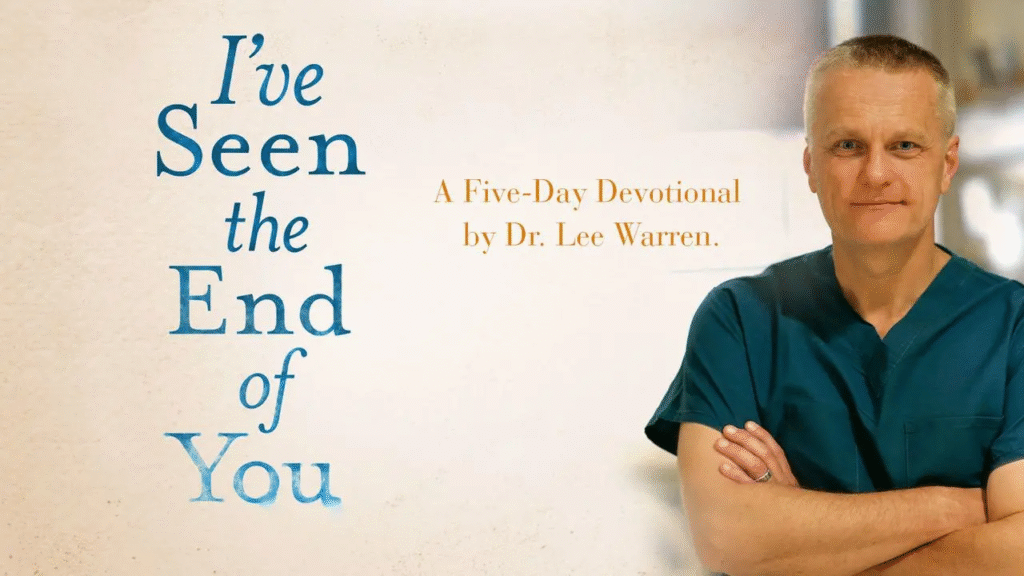
When shadows creep over our lives, it can be hard to see the light of faith that gives us hope. Neurosurgeon Lee Warren has faced the darkness many times in his professional and personal life. In this five-day devotional based on his memoir “I’ve Seen the End of You”, Dr. Warren offers reassurance that God’s goodness is real, no matter what circumstances say.
WaterBrook Multnomah
Day 1
Scriptures: Psalms 38:17, Lamentations 3:15-20, Psalms 34:18
Not Everything Is Going to Be Okay
I’m a brain surgeon. I’m a Christian. A man of science and a man of faith.
Years of training and experience have filled me with knowledge, facts, things that are always true. Things I know. And I’m a firm believer in God’s desire and ability to heal, to repair, to make things right when all the doctors believe there’s no hope.
But sometimes my beliefs and my knowledge smash into one another.
I spend a lot of time with patients who have terminal illness. Among the worst of the diagnoses is a brain tumor called glioblastoma, or GBM. For a long time, when I worked with these patients, I felt stuck in a crossfire between my faith—God can heal our disease—and my knowledge—This disease is 100 percent fatal.
How could I navigate this as a Christian who’s also a scientist—a scientist who believes that medicine doesn’t provide all the answers to life? My upbringing and my basic personality lead me to say, “Everything’s gonna be okay,” but when GBM is the diagnosis, everything is not going to be okay.
I have seen people face the worst diseases known to humanity who stood up to the test and became the best version of themselves they could possibly be, despite their bodies losing to their illness.
And I have witnessed people miraculously survive incurable cancers, people who were, nevertheless, rotted and malignant humans by the time they were “cured.”
What does this mean for us who are trying to find our way through life’s tribulations? That was a question I couldn’t answer before I experienced my own personal suffering: the sudden death of my nineteen-year-old son. The most important surgery I would ever perform would be the stitching together of my faith, my doubt, and the things I thought I knew.
I’ve come to realize the difference between survivors (even those who perish) and the dying (even those who live): the survivors have a prism—faith—that allows them to see through the pain and hardship to the hope and purpose and beauty in their lives.
The trick is to hold on to the light of faith in the darkest shadows of our experience.
What makes it hardest for you to hold onto your faith?
Day 2
Scriptures: Job 2:3, Job 2:10, Jeremiah 12:1, Matthew 5:45
Faith Is Stronger Than Doubt
The loss of a child plunged me into utter darkness, where there is weeping and gnashing of teeth.
Even for a person of faith, it’s hard to understand why bad things happen. And some of the most hard-core doubters might agree, no science can explain why nice people so often get malignant cancers while their meth lab neighbors survive multiple head injuries.
Two common responses to life’s troubles are (1) a belief that we’re alone in the cold and random universe and (2) a belief that God is real but either is against us, or doesn’t care.
The problem with the first response is that a person in crisis has no rational basis for hope. The second generates feelings on a spectrum from shame and regret, to anger and hostility. In this paradigm you respond to crisis by blaming yourself or God, withdrawing and becoming an empty person, or lashing out and becoming a grade IV cancer in the world.
But there is a third response: faith. Faith doesn’t magically change our circumstances and make everything happy; it merely bends the light of our current circumstances in such a way that we can see God’s presence in the moment, despite the outcome. Faith allows us to see hope when all seems lost, to survive the furnace of suffering, to grow despite the pain.
Faith isn’t a belief that God will spare you from problems; it is a belief that he’s still God and will carry you through those problems. I now know you can have faith and it doesn’t always mean everything will be okay.
Doubt isn’t optional if you’re an honest person, because as soon as you think you’ve banished doubt forever, another problem will plunge you right back into it. But take heart: Doubt is not the absence of faith. You can doubt and believe at the same time. I do—every day. I’ve learned over time that faith is stronger than doubt.
The Bible is full of examples of people doubting, questioning, and being mad at God. See how many you can find in Job, Psalms, Jeremiah, and Lamentations.
Day 3
Scriptures: Matthew 26:39, Mark 9:20-24, 1 Thessalonians 5:17
Why Pray?
It doesn’t make sense to me that God can know everything, yet still tells us he wants us to pray and believe that our prayers can make a difference. When I follow this train of thought very far, my faith plummets and I want to throw up my hands and denounce any possibility of God existing at all.
A dear friend, who is also a pastor, once challenged my notions about prayer: “You think your prayers are valid only if the outcome is what you want. Like it counts only if you get what you ask for. And you think we’re supposed to know what to ask for when we pray.”
One day after glioblastoma took the life of a patient, I sat in the silent hospital chapel and stared at the stained-glass wall behind the pulpit—The Last Supper, spread out in bits of colored glass in front of me—Jesus and the disciples eating before he went out to die on a cross. Pilate would convict him of crimes he did not commit, and he would be crucified for the sins of humankind.
Even as they shared that final meal, the outcome was already determined. But Jesus, who surely had a more eternal perspective than I do, prayed for relief from his coming torture and death. In the garden, moments after the Last Supper, he said, “May this cup be taken from me.”
Of course, God, as he is prone to do, either did not answer Jesus’ prayer, or said no.
So I often feel like the guy who came to Jesus and said something like, “Heal my son, if you can.”
Jesus said, “If I can?”
I imagine God saying, “Don’t come to me and half believe I’m able to do the things you need.”
So I pray, and I end up being like the “if you can” guy, and I say two things at once: “I do believe; help me overcome my unbelief!”
What causes you to pray—or not to pray? Why do you think Jesus prayed in Gethsemane to be relieved of his purpose on earth?
Day 4
Scriptures: Hebrews 6:18, Titus 1:2, Romans 8:28, Psalms 34:18, Romans 12:11-12
God Cannot Tell a Lie
In the months after my son’s death, I was caught in a quandary: I knew that holding on to God was the path forward, but I believed and I doubted and I actively disbelieved at the same time.
I believed in God. I believed he’s good. I believed he can heal people, solve problems, work miracles, and give us strength to go through difficult times.
I doubted I would ever heal from losing my son. I doubted my words could offer any real comfort to another grieving parent. I doubted that tomorrow would seem any more hopeful than today.
What changed this for me was the revelation that God cannot tell a lie. And if it is true, then even when it seems impossible, it must also be true that God can use everything for good.
That realization was a subtle bit of grace I wasn’t fully able to appreciate at the time. But I could feel its weight and somehow knew it was the rope I’d been looking for that would pull me out of the hole: all God’s promises are true, or none of them are. Said another way, if God cannot tell a lie, then all his promises are true. Even when it doesn’t feel like it. Even when you’re going through the hardest thing you can imagine.
During this time I found Psalm 34 incredibly comforting. Verse 18 says, “ If your heart is broken, you’ll find God right there; if you’re kicked in the gut, he’ll help you catch your breath.” (The Message). I could read those words, and even on the days when intellectually I wanted to shake my fist and declare my hatred for a God who would let my son die, in my spirit I knew the verse was true.
When the worst things happen, when your son dies or your doctor says it’s cancer, when your husband strays or the bank forecloses, Romans 12:11-12 seems ridiculous on its face: “Don’t burn out; keep yourselves fueled and aflame. Be alert servants of the Master, cheerfully expectant. Don’t quit in hard times; pray all the harder” (The Message). This is ludicrous when your life is falling apart, unless it is actually true.
Name a promise of God that you have always wanted to be true, even if you sometimes doubt it. How might the belief that God cannot lie affect your moments of doubt?
Day 5
Scriptures: Hebrews 11:1, John 20:29, Psalms 119:105
The Candle of Faith Lights the Way
I’m still living with the crushing weight of losing my son. But faith gives me the eyes to see that the map of God’s Word and his promises will lead me through it. I’m not downplaying the devastation and pain hardship brings us. But I am saying that the map will lead us to a place of shelter where those things cannot destroy us.
Faith, my friend, is being able to look for hope even when it seems impossible to find. Faith is hope waiting for tomorrow.
I’ve been waiting for it since the night I received the worst news of my life. I’ve been trying to show it to my patients, even moments after I’ve given them their worst news ever.
Sometimes it’s right there and it’s everything. Sometimes it’s so far away that all I can hold on to is the memory of the map and the touch of my wife’s hand.
There is an important difference between faith and knowledge: if you have to lay eyes on everything to believe it, you won’t know what to believe when it’s too far away to see. That’s why Jesus said those folks who believe even when they can’t see are more blessed, because we humans spend a good bit of our lives in places where it’s too dark for knowledge and only the candle of faith can light our way.
In every situation life brings, there are opportunities to learn, to change, to blossom, and to fail. To live well involves somehow managing to walk through these times and discovering that faith is enough of a footbridge.
In the end, we have to keep taking steps, no matter how twisted and dark the path becomes. Believing there will be a light, even just a crack in the door, is how we keep moving. And in so doing, we somehow make it through.
Name one hopeful thing you can decide to believe in today, even though you might not be able to see it.