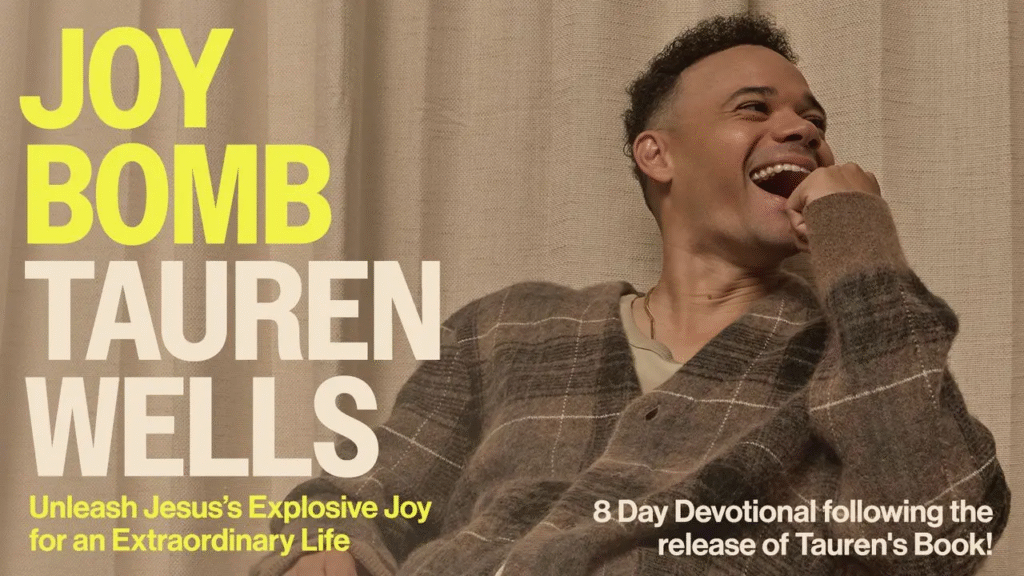
Tauren Wells presents an 8-day devotional plan based on his book, ‘Joy Bomb’. Join Tauren as he explores themes of Joy and the meaning and verses behind his book.
Capitol CMG Label Group
Day 1
Scriptures: Matthew 5:3, Malachi 4:6
You ever feel like joy is just slipping through your fingers? Like, no matter what you do, it always seems tied to something that can change in an instant? That’s because, too often, we anchor our joy to things that just don’t last.
Think about it—if your joy comes from getting that promotion at work, what happens when someone else gets the job instead? Instant disappointment. If your joy is wrapped up in a relationship, what do you do if that person walks away? Suddenly, it feels like your happiness left with them. Or maybe you’ve tied your joy to big achievements, but when you fall short, that joy crashes and burns with your unmet expectations.
But here’s the thing—when our joy is connected to its true, unshakable source, it doesn’t have to be temporary. When we stay rooted in God, joy doesn’t just come and go with life’s ups and downs. It becomes a constant, flowing stream of strength that carries us through every season and every storm.
The secret? Joy in Jesus isn’t fragile. It’s untouchable. When our joy is found in Him, the enemy can’t take it because the enemy would have to go through Jesus first! That’s why staying connected to Him is everything. When His joy fills you up, you’re equipped with a supernatural strength that helps you handle whatever life throws your way—right now and in the future.
I was reminded of this recently while reading the last book of the Old Testament, Malachi. It ends on a pretty heavy note—the word “curse” (Malachi 4:6). The Israelites had been given God’s law, but they just couldn’t live up to it. Over and over, they fell short, showing just how impossible it was for humans to meet God’s perfect standard on their own.
But then, Jesus shows up. And the first words of His first recorded sermon?
“Blessed are the poor in spirit, for theirs is the kingdom of heaven” (Matthew 5:3).
Did you catch that? Where the Old Testament ended with “curse,” Jesus started with “blessed.” It wasn’t a coincidence—it was a divine mic drop moment. He was announcing that things were about to change. Instead of being stuck in a life defined by failure and condemnation, Jesus was offering something completely new: hope, renewal, and grace.
And here’s the really cool part—the word “blessed” in the original language actually means “happy.” Jesus used that word eight times in His sermon to drive home this truth: real happiness doesn’t come from perfect circumstances. It comes from being in right relationship with God.
Jesus wasn’t just offering a feel-good moment; He was laying out a way of life—a life of joy that doesn’t break under pressure, a happiness that isn’t at the mercy of circumstances.
Devotional Questions:
- Where do you usually place your joy? Is it in something that can change or something unshakable?
- How would your life look different if your joy was truly anchored in Jesus?
- What areas of your life are you trying to control instead of trusting God’s plan?
- Jesus connected the word “blessed” with real happiness—how can you shift your mindset to find happiness in Him rather than in temporary things?
- What’s one practical step you can take this week to stay more connected to Jesus, your true source of joy?
Let this truth settle deep in your heart—real, lasting joy isn’t found in promotions, relationships, or achievements. It’s found in Jesus. And that kind of joy? It can’t be taken away.
Day 2
Scriptures: Matthew 5:3, James 2:5
Happy are the Spiritually Bankrupt? Wait, What?!
At first glance, Jesus’ words—“Happy are the poor in spirit”—sound kind of backwards, don’t they? How can being “poor” in any sense lead to happiness? But here’s the thing: Jesus wasn’t talking about financial poverty. He was getting at something much deeper.
Being poor in spirit means recognizing that, on our own, we don’t have what it takes. It’s realizing that we’re completely dependent on God, that we can’t muscle our way into joy, peace, or even righteousness. It’s the moment we drop our pride, let go of self-sufficiency, and admit, “God, I need You.”
Oswald Chambers put it like this:
“The knowledge of our own poverty brings us to the moral frontier where Jesus Christ works.”
That hits, doesn’t it? The moment we stop pretending we have it all together is the moment we open the door for Jesus to actually do something in us. It’s the space where our efforts end, and His grace begins. And the best part? When we come to Jesus empty-handed, He doesn’t meet us with shame—He meets us with grace. Right there, at the point of surrender, is where real transformation starts.
This isn’t about feeling defeated or worthless—it’s about finally letting go of the exhausting pressure to prove ourselves. It’s understanding that joy doesn’t come from what we achieve, how strong we are, or how put-together our lives look on the outside. Joy comes from knowing we belong to a God who loves us right now, in all our mess, and who promises to fill us with something so much greater than anything we could manufacture on our own.
That’s why Jesus said the poor in spirit are blessed. Because when we stop striving, stop pretending, and start depending on Him, we experience life the way it was meant to be—full of grace, full of peace, and full of joy.
Devotional Questions:
- What does being “poor in spirit” mean in your life right now? Are there areas where you’re still holding on to self-sufficiency?
- How do you typically try to create joy in your life? Is it through accomplishments, relationships, or external things?
- What would it look like for you to truly rely on God’s grace instead of your own strength?
- Have you ever experienced joy in a difficult season because you were relying on God rather than your circumstances? How did that change your perspective?
- What’s one step you can take today to surrender more fully to God and trust Him to fill you with real, lasting joy?
At the end of the day, the happiest people aren’t the ones who have it all figured out. They’re the ones who know they need Jesus—and let Him take the lead. 💛
Day 3
Scriptures: Matthew 5:4, John 20:24-29, 2 Corinthians 1:3-4
Joy Bombs: What Are You Focusing On?
Let’s be real—no one makes it through life without getting hit by sorrow at some point. Even though we serve a good and faithful God, the Bible never promises us a life free from pain. Life is this crazy mix of highs and lows, of breathtaking wonder and deep wounds. But here’s the thing: what we choose to focus on shapes our entire experience. Are we going to fix our eyes on the wonder or get stuck staring at the wounds?
When we choose well, we set off what I like to call a joy bomb—those unexpected, powerful moments of joy that explode into our lives and remind us that God is present. Maybe it’s in a stunning sunset, a child’s laughter, a song that hits just right, or a deep moment of peace that makes no sense given your circumstances. These moments don’t erase our pain, but they do remind us that joy is real and available—even in the middle of hardship.
But here’s the catch: if we focus too much on the wounds, we’ll start seeing joy as temporary, fleeting, even insignificant. The reality, though, is that joy has staying power—if we choose to embrace it. Even in hard seasons, choosing to hold onto moments of joy gives us strength and hope to keep moving forward.
Take Thomas, for example. In John 20:24–29, he had the chance to witness something absolutely mind-blowing—Jesus, fully alive and standing in front of him after the crucifixion. Jesus even walked through a wall! And yet, what did Thomas focus on? The wounds. He needed proof, something to touch and feel before he could believe. He glanced at the miracle but fixated on the pain.
Sound familiar? It’s so easy to do the same thing. We get so wrapped up in what’s wrong that we miss what’s right. We let our struggles, doubts, and disappointments steal our focus instead of being in awe of what God is doing. Thomas had the opportunity to be amazed by the presence of Jesus, to be captivated by the fact that the Savior of the world was standing before him, alive and victorious. But instead, he needed to feel the scars first.
This is a reminder that our perspective matters. If we let our emotions define our reality, we risk losing sight of the bigger truth: that God is still working, still showing up, and still filling our lives with moments of wonder. The pain is real, but so is the joy. And when we choose to shift our focus, joy becomes more than just a brief explosion—it becomes part of how we see the world.
Devotional Questions:
- Do you find yourself staring at the wounds in your life more than the wonder? Why do you think that is?
- What “joy bombs” has God placed in your life recently? Have you taken the time to recognize and appreciate them?
- When have you experienced a moment of joy in the middle of a hard season? How did that shape your perspective?
- Thomas needed to see and touch Jesus’ wounds before he could fully believe—what kind of “proof” do you find yourself asking for in your faith?
- What’s one practical way you can shift your focus toward joy this week, even in the midst of difficulty?
Life is never just one thing—it’s joy and sorrow, beauty and brokenness. But the good news? You get to choose what you stare at. Choose the wonder. 💛✨
Day 4
Scriptures: Matthew 5:5, Matthew 11:28-30, Psalms 25:9
True Strength is Found in Humility
With four boys, my wife and I spend a lot of time at sports fields, courts, and gyms. And let me tell you, kids today have a swagger about them that’s on another level. When I was growing up, confidence was a thing, but we didn’t have the same phrases they use now. If a kid catches a pass over someone’s head, his teammates yell, “Head top!” If he locks someone down on defense, he might do the seatbelt motion, letting everyone know he strapped ‘em up. But the one that cracks me up the most? After a killer move or a deep three, they’ll shout, “I’M HIM!”
Now, I love the energy and the confidence—I really do. But it’s got me thinking… when did we become so focused on hyping ourselves up instead of humbling ourselves before God?
The Bible flips this whole mindset on its head. Jesus teaches that God does more in and through us when we humbleourselves, not when we put ourselves on a pedestal. Scripture even says that if we exalt ourselves, we’ll be brought low, but if we humble ourselves, God will lift us up (Matthew 23:12). That’s real greatness—not self-promotion, but surrender.
See, joy isn’t found at the top of our accomplishments. It’s found on the bottom shelf, where only those willing to humble themselves can reach it. Proverbs 27:2 lays it out clearly: “Let someone else praise you, and not your own mouth; an outsider, and not your own lips.” God isn’t against greatness—He’s against pride. He’s not looking for people to shout, “I’m him!” but for those who declare, “He’s Him!”
The Strength of Meekness
Humility is powerful. It attracts grace, opens doors that pride would slam shut, and aligns us with God’s heart. True greatness is rooted in knowing who we are in Godand allowing Him to work through us.
But let’s be real—when was the last time you heard someone described as meek? It’s not exactly the go-to word for Instagram bios or LinkedIn profiles. In today’s culture, being bold, outspoken, and extra is celebrated. Meekness, on the other hand, is often misunderstood as weakness.
But check this out—two of the most powerful leaders in Scripture, Moses and Jesus, were described as meek. And neither of them was a pushover. Jesus, the King of Kings, could have come with thunder and fire, demanding honor. But instead, He said this about Himself:
“Come to me, all you who are weary and burdened, and I will give you rest. Take my yoke upon you and learn from me, for I am gentle and humble in heart, and you will find rest for your souls.”
—Matthew 11:28-30
Gentle. Humble.
That’s how Jesus described Himself. And when He talked about His heart, He wasn’t just talking about emotions—He meant the very core of who He is. His driving force wasn’t power, prestige, or popularity. It was meekness.
But don’t get it twisted—Jesus was not weak. Meekness isn’t about hiding your strength; it’s about using it under control. It’s knowing where your power really comes from.
Jesus knew He was the Son of God. He knew He had all authority. But over and over again, He pointed back to the Father:
“The Son can do nothing by himself; he can do only what he sees his Father doing.” —John 5:19
“The words I say to you I do not speak on my own authority. Rather, it is the Father, living in me, who is doing his work.”—John 14:10
Jesus wasn’t out there hyping Himself up. He was fully surrendered to the will of God. And that surrender wasn’t weakness—it was the ultimate display of power.
The Joy of Surrender
Real joy isn’t found in proving ourselves. It’s found in trusting that we don’t have to. It’s found in laying down our pride and letting God be the one to lift us up. Jesus showed us that the happiest people aren’t the ones chasing applause—they’re the ones walking in humility, fully surrendered to God’s plan.
Devotional Questions:
- Have you ever found yourself trying to “hype yourself up” instead of humbling yourself before God? What was the outcome?
- How do you typically respond when someone else gets the recognition or success you wanted?
- What does meekness look like in your life right now? Is it something you embrace or struggle with?
- Jesus described Himself as gentle and humble—how can you reflect those qualities in your daily interactions?
- What’s one area where you need to surrender your strength and rely on God’s instead?
The world tells us to be the greatest. Jesus tells us to serve the greatest. And that’s where real joy is found. 💛🔥
Day 5
Scriptures: Matthew 5:6, Hebrews 11:1, Matthew 13:31-32, Romans 4:18
Hungry Prayers, Happy Hearts
Bedtime at our house is always a mix of fun and faith. Some nights it’s stories and songs, and if I’m in charge, there’s probably a dance party thrown in for good measure (whether my wife approves or not is another story). But no matter how the night plays out, we never skip prayer.
When our boys started praying, they’d begin every prayer with: “I hope…” And at first, I almost corrected them. But then I realized—maybe they had it more figured out than I did.
“I hope” is where hunger starts.
Hebrews 11:1 says, “Faith is the substance of things hoped for, the evidence of things not seen.” Hope gives birth to faith—and faith gives legs to prayer. Hope imagines something better, faith believes it’s possible, and prayer says, “God, let it be done.”
Hope and faith together awaken a hunger for more of God. They stir something deep in our soul that says, “I need to talk to my Father. I need to be near Him. I need to be filled.”
Jesus said, “Blessed are those who hunger and thirst for righteousness, for they will be filled” (Matthew 5:6). That hunger? It doesn’t start with discipline—it starts with desire. With hope that there’s more. With faith that He’s near. With prayer that draws us close.
Let me put it like this: prayer curbs our spiritual appetite. It retrains our cravings. Because let’s be honest—we’ve all reached for something that doesn’t satisfy. Maybe it’s food. Maybe it’s scrolling. Maybe it’s another purchase, another post, another dopamine hit. But prayer? It resets the palate of the soul.
I love candy. Hot Tamales, sour Mike & Ikes, Almond Joys… don’t judge me. And after a few days of crushing sugar, my body crashes—but my cravings keep rising. That’s how spiritual appetite works too. The more you consume empty things, the emptier you feel. But the more time you spend in God’s presence, the more you want what truly satisfies.
Jesus said faith is like a mustard seed (Matthew 13:31–32). It starts small—but when planted, it grows into something strong and life-giving. Prayer is the same. It may feel simple or weak at first, but it grows your joy, strengthens your faith, and deepens your hunger for God.
Romans 4:18 says Abraham hoped against hope—and it was that kind of gritty, soul-deep hunger that positioned him for promise. And Psalm 126:5 reminds us, “Those who sow in tears will reap with songs of joy.”
So what does this mean for us?
It means if you feel spiritually empty, don’t stuff yourself with substitutes.
It means if you’re longing for peace, stop chasing distractions.
It means that when hope rises, and faith follows—prayer becomes the natural response.
And when prayer becomes your rhythm, joy becomes your reality.
Prayer fuels hunger for God, and hunger for God leads to joy.
So keep hoping.
Keep believing.
Keep praying.
And watch how your appetite changes.
Because once you taste the presence of Jesus, nothing else will do.
Devotional Questions:
1. What have I been feeding my soul lately—things that satisfy, or things that leave me empty?
2. Do I see prayer as a last resort or a daily rhythm that shapes my desires?
3. What are the “sugar cravings” in my life that I need to replace with time in God’s presence?
4. How can I stir up my hunger for righteousness in a practical way this week?
5. Where is God inviting me to hope again, even if it feels hard or delayed?
At the end of the day, prayer isn’t just about asking—it’s about trusting. And when you truly believe that God hears you, loves you, and is working on your behalf, hope and joy are the natural responses. So keep praying, keep believing, and keep hoping. Because God is faithful, and joy is coming. 💛✨
Day 6
Scriptures: Matthew 5:8, 1 Samuel 16:7
What’s Really in Your Heart?
God isn’t impressed by appearances. He’s not looking for the flashiest, the most talented, or the people who seem to have it all together. What matters most to Him? Your heart.
What drives you? What moves you? What do you really believe about God—and yourself?
Take King Saul, for example. He started off strong. The Bible says that when he was chosen to be king, God gave him a new heart (1 Samuel 10:9). The Spirit of God even came upon him, and he started prophesying. That sounds pretty amazing, right? Saul had all the potential in the world. But here’s the thing—having a new heart from God wasn’t enough to keep him on the right path.
Over time, Saul’s heart drifted. He stopped listening to God. He started doing things his way instead of God’s way. And eventually, God said, “I regret that I have made Saul king, because he has turned away from me” (1 Samuel 15:11). That’s heavy. Saul looked like a king on the outside, but on the inside, his heart wasn’t right.
So, God chose someone else. But this time, He wasn’t looking for someone tall or strong or impressive. He told the prophet Samuel:
“People look at the outward appearance, but the Lord looks at the heart.” —1 Samuel 16:7
And that’s when David entered the picture. He wasn’t perfect, but he was different. God described him as “a man after my own heart” (Acts 13:22). David didn’t just sayhe wanted to follow God—he actually did it. His heart was aligned with God’s, and that made all the difference.
A Pure Heart Isn’t a Perfect Heart
Let’s be honest: We all have motives and desires that aren’t always pure. We want to follow God, but we also want control. We want to trust Him, but we also want things our way. The question is—are we willing to surrender?
To have a pure heart doesn’t mean we have to be flawless. It means we’re fully committed to following God, doing what He wants, and not just what we want. It’s about surrendering our own agendas and trusting His plan.
Jesus said, “Blessed are the pure in heart, for they will see God” (Matthew 5:8). A pure heart brings clarity. When our motives are right, we see God’s hand more clearly in our lives. We hear His voice more easily. We experience His joy more deeply.
Gut-Check Time
Take a second and really think about this:
- Am I truly willing to do everything God wants me to do?
- Is there anything in my life I know God wouldn’t want me to do, but I keep doing it anyway?
- If God looked at my heart right now, would He find someone who is fully surrendered to Him?
This isn’t about pressure or perfection. It’s about trust. It’s about saying, “God, I don’t want to live for myself. I want to live for You. Shape my heart. Align my motives. Make me someone You can trust to do what You ask.”
Devotional Questions:
- Are there areas in your life where you’ve been doing things your way instead of God’s way? What needs to change?
- When you think about surrendering your plans to God, do you feel resistance? Why do you think that is?
- How can you start aligning your heart more with God’s today? What small steps can you take?
- What do you think it means to be “a person after God’s own heart”? What would that look like in your daily life?
- What’s one prayer you can pray today to invite God to refine your heart?
God isn’t looking for perfection. He’s looking for hearts that are willing. Hearts that trust Him. Hearts that are ready to say, “Lord, I’m all in.” Is that you? 💛
Day 7
Scriptures: Matthew 5:9, Romans 5:3-4, Philippians 4:8
Finding Peace in the Pressure
Ever notice how the hardest seasons in life tend to be the ones that shape you the most? Tension, pressure, and pain aren’t just random struggles we have to push through—they’re often signs that we’re stepping into something bigger than ourselves.
Think about it: When you work out, your muscles only get stronger by facing resistance. The same is true spiritually. Growth happens when we face challenges that stretch us beyond our comfort zones. Romans 5:3-4 spells it out clearly:
“We also glory in our sufferings, because we know that suffering produces perseverance; perseverance, character; and character, hope.”
In other words—hard times aren’t pointless. They’re producing something in us. They’re strengthening our faith, deepening our character, and building the kind of hope that doesn’t crumble under pressure.
The Peace That Doesn’t Make Sense
Paul talks about a kind of peace in Philippians 4 that goes beyond our understanding. It’s not the kind of peace that comes from perfect circumstances or everything going our way. It’s the kind of peace that doesn’t make sense—the kind that holds you steady even when everything around you feels like chaos.
Isaiah 26:3 gives us this promise:
“You will keep in perfect peace those whose minds are steadfast, because they trust in you.”
This kind of peace isn’t automatic. It’s something we choose to cultivate through daily connection with God—through prayer, worship, time in His Word, and reminding ourselves of His promises. The more we anchor ourselves in Him, the less life’s storms can shake us.
Jesus made it clear: “In this world, you will have trouble. But take heart! I have overcome the world” (John 16:33).
That means peace isn’t about avoiding trouble. It’s about trusting Jesus through it.
Letting Peace Rule
Colossians tells us to let peace rule in our hearts. That doesn’t mean life will always feel peaceful on the outside, but it does mean that peace can be the authority over our inner world. When peace is what’s ruling in our hearts—not fear, not anxiety, not chaos—it changes how we respond to everything.
But here’s the key: we have to choose it. The world gives us every ingredient for fear, stress, and worry. But Philippians 4:8 tells us what we should be focusing on instead:
- What is true
- What is honorable
- What is right
- What is pure
- What is lovely
- What is praiseworthy
It’s not always easy, but when we intentionally guide our thoughts toward God’s truth instead of our fears, we start to experience the kind of peace that lasts.
Devotional Questions:
- What pressures or struggles are you facing right now that might actually be growing your faith?
- How do you usually handle stress? Do you let it rule over you, or do you let peace take the lead?
- What’s something you’ve been praying about that you need to trust God with fully?
- When was a time you experienced peace that didn’t make sense in the middle of a difficult season?
- How can you be more intentional about filling your mind with things that bring peace instead of anxiety?
Life will always have tension and pressure. But the real question is—what will rule your heart? Fear? Worry? Or the unshakable peace that comes from knowing God is in control? Choose peace today. 💛
Day 8
Scriptures: Matthew 5:10, 2 Timothy 3:12, James 1:12
The Cut That Confirms the Call
Let’s talk about something we don’t always like to admit: sometimes being called by God means facing the criticisms of the world.
Jesus said it plainly:
“Blessed are those who are persecuted because of righteousness, for theirs is the kingdom of heaven.” (Matthew 5:10)
He didn’t say avoiding persecution brings joy. He said being in it does.
That means rejection can be a result of obedience.
Criticism can come as confirmation.
And hardship might be evidence that you’re doing something right.
2 Timothy 3:12 echoes it: “Everyone who wants to live a godly life in Christ Jesus will be persecuted.”
It’s not punishment.
It’s proof.
If no one’s resisting what you carry, it might mean you’re not carrying anything threatening to darkness.
And here’s where it flips: persecution and favor are not opposites—they’re overlaps.
Two sides of the same coin called obedience.
Favor isn’t just about applause—it’s also about assignment.
And sometimes, being celebrated by God means being criticized by people.
Think about Joseph. Highly favored, but misunderstood, mistreated, and thrown into a pit.
Or Mary. “Highly favored”, yet ridiculed and wrapped up in scandal.
Favor didn’t shield them from hardship—it sent them into it. But it was never without purpose.
A Lesson from Stained Glass
I was reminded of this while visiting San Gimignano, Italy, with my wife. We were filming with Andrea Bocelli (still surreal), and while exploring the town, we stepped into a cathedral built in 1148. Simple. Sacred. Beautiful.
As we stood inside, light streamed through a stained-glass window above the altar. It stopped me in my tracks.
Each piece of glass was shaped differently. Some were smooth, others jagged. Some colorful, others muted. But all were cut—intentionally—to fit the larger design.
And when the light passed through?
It wasn’t the unbroken pieces that made it beautiful.
It was the cut ones.
That’s favor.
It’s not always about smooth edges and perfect conditions. It’s about being fit into a greater story, where God shines through the places we’ve been pressed, misunderstood, or wounded.
Favor and persecution often show up together—not as contradictions, but as companions.
Favor doesn’t protect you from the fire—it gives you purpose inside it.
So does God play favorites?
In a way—yes. But not like we think. Lisa Bevere once said, “God doesn’t love us all the same; He loves each of us uniquely.” And Augustine echoed, “God loves each of us as if there were only one of us.”
God’s favor isn’t limited. It’s tailored.
It’s not that He chooses one person over another—it’s that He chooses each of us for something specific.
So if you’ve been walking through criticism, pressure, or spiritual tension—don’t mistake it for abandonment. It might be evidence that you’re in the middle of your calling. You’ve been cut to fit. And the same light that breaks through stained glass is ready to shine through you.
Devotional Questions:
1. Have you ever experienced resistance as a result of following God? How did it shape your faith?
2. Does the idea of favor and persecution overlapping change the way you see hardship in your life?
3. In what areas have you felt “cut” or pressed lately? Could God be using that to fit you into something greater?
4. What’s one example of God’s light shining through a broken part of your story?
5. How can you embrace both the favor and the friction of your calling this week?
At the end of the day, favor isn’t just about God blessing us—it’s about God using us. And sometimes, the greatest signs of His favor aren’t the easy moments, but the ones that push us closer to Him. Keep trusting. He’s making something beautiful out of you. 💛✨