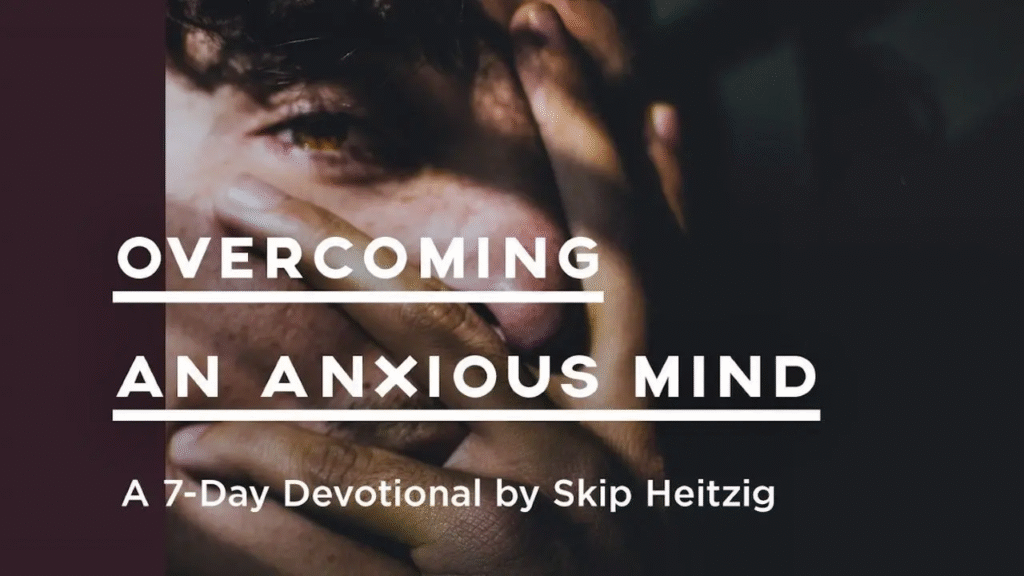
Anxiety is a thief. It steals your thoughts, peace, confidence, and joy. But God can restore what anxiety wants to take from you. In this seven-day devotional, Skip Heitzig addresses the nature and causes of anxiety and how you can learn to lean into God for a security system that will help you understand and overcome anxiety.
Connect with Skip Heitzig
Day 1
Scriptures: Philippians 4:6-7, Deuteronomy 31:6, Isaiah 41:10, John 16:33
Anxiety Is a Thief
I once read a humorous but instructive story about the toll anxiety can have on a person:
“For several years a woman had been having trouble getting to sleep at night because she feared burglars. One night her husband heard a noise in the house, so he went downstairs to investigate. When he got there, he did find a burglar. ‘Good evening,’ said the man of the house. ‘I am pleased to see you. Come upstairs and meet my wife. She has been waiting ten years to meet you.’” (William R. Marshall, Eternity Shut in a Span [1949])
The point is simple: A burglar can steal from you once. Anxiety can steal from you for decades. We all deal with anxiety at some point, a fact that Paul the apostle was well-acquainted with, as he penned two of the most hopeful, anxiety-curbing verses in the Bible:
“Be anxious for nothing, but in everything by prayer and supplication, with thanksgiving, let your requests be made known to God; and the peace of God, which surpasses all understanding, will guard your hearts and minds through Christ Jesus.” (Philippians 4:6-7)
One of the worst things about anxiety is that it gives us spiritual amnesia: We forget who we are in Christ. We forget that as His coheirs, we have access to His power and glory, that when our priorities line up with His, He will meet our needs. This doesn’t mean we go from miracle to miracle in life. Rather, it means that whatever we are facing, we can rest assured that our heavenly Father is aware of it and will stick with us through it all, no matter what. He will even give us the grace and courage to face our challenges.
You might be tempted to dismiss those verses in Philippians, thinking, Well, that sort of approach to anxiety is nice, but my problems are just more complex than that.Though these verses may be simple, they are not simplistic. They are grounded in God’s unchanging character and nature, which means they are very needful for us today.
So many of us live huge chunks of our lives trying not to worry but worrying anyway. We tell God what we need, and then, we bite our nails over whether He will provide. We believe He exists, but we’re often not convinced He loves us enough to really help us. We hold on to only certain bits and pieces of the truth, leaving us stuck in a world of anxiety where it’s tempting to believe that failure, uncertainty, and worrying is all there is in life.
We know we’re sinners who fall short of God’s glory, and we know that Jesus died to save us from our sin, but somewhere along the way, we’ve failed to embrace what that means for our outlook on life. To be a Christian means to be adopted by God as His child—to have access to His otherworldly love, power, strength, and peace. That’s why, if you can come to embrace and trust in the promise of Philippians 4:6-7, it will revolutionize your life.
Day 2
Scriptures: Matthew 6:25, Luke 10:41, 1 Corinthians 7:32, James 1:5-8
The Problem
Paul didn’t mince words when he identified the problem of anxiety. The term he used for anxious in Philippians 4:6 is from the Greek word merimnaó, which shows up in the New Testament nineteen times. It’s the word Jesus used when He said, “Do not worry about your life” (Matthew 6:25). He used it again when He spoke to a distracted, busy Martha, saying, “You are worried and troubled about many things” (Luke 10:41). And Paul used it when he told the church at Corinth, “I want you to be without care” (1 Corinthians 7:32).
Merimnaó comes from two Greek words, the first of which means to tear or separate, and the second of which means the mind. So the biblical concept of worry or anxiety literally means to tear the mind. It’s an apt description. Anxiety divides your mind between legitimate concerns and destructive thoughts, ripping it in two different directions. It leaves you double-minded, unstable in everything you do (see James 1:5-8).
Many things can cause anxiety—health, the holidays, unexpected hardships, current events—and our reasons for worrying are often multifaceted and complex. Add to that the fact that most people in the world face life without any real purpose, believing that they inhabit an inexplicable universe that has no rhyme, reason, or God. That’s a lonely, frightening place to be.
Of course, the unbelieving world recognizes that anxiety is rampant, and a lot of well-meaning psychologists, doctors, therapists, and counselors are trying to help stem the tide. It’s not hard to find advice about how to cope with anxiety. One well-researched and well-intended article said, “Our goal shouldn’t be to dismiss [anxiety] entirely—just to make it a healthy, manageable part of our lives.”
We’re left with the seemingly reasonable idea that the best we can do is manage our anxiety and keep it from overwhelming us. But if you belong to Christ, is that enough for you? Are you satisfied with that answer? Because God offers us a way to eliminate anxiety, as impossible as that might sound. Ask Him to open your heart and mind to the truth that He is enough to help you face all your problems. Tomorrow we’ll look at our Great Physician’s prescription for our very real worries.
Day 3
Scriptures: Matthew 6:25-34, 2 Timothy 1:7
The Prescription
Paul wrote the prescription for anxiety in plain language: “Be anxious for nothing” (Philippians 4:6). Notice that’s in the form of a command. Doesn’t that sound absurd in the face of your worries? How unrealistic and naïve could this guy be?
But Jesus said something just like it: “Do not worry about your life, what you will eat or what you will drink; nor about your body, what you will put on” (Matthew 6:25). Maybe you’re wondering how it’s even possible to stop worrying. How do you stop fretting over the things that stress you out? Anxiety often feels all-consuming, like there’s nothing else in the world besides you and your worries. But you are more than the things you worry about, and, as Jesus explained, God is very much aware of what you need.
God takes care of birds and flowers, providing all they need. Yes, their needs are simpler than yours, but God also loves you much more than anything else in His creation. That’s why Jesus said, “Will He not much more clothe you, O you of little faith?” (Matthew 6:30). Now, He wasn’t saying to kick back and be lazy. He wasn’t telling people, “Just chill—it’ll all work out somehow.” Even birds still have to do some work.
But have you ever seen a bird pacing along a branch, his head in his wings, wondering how he’s going to pay the rent on his nest? Jesus was saying, “Don’t you see that God is so much bigger than your problems? Don’t let life’s hardships rent space in your mind, where they can transform from ordinary life stress to the anxiety that God is going to let you starve or run around naked.”
Consider the three reasons Jesus said we shouldn’t give anxiety a foothold in our minds:
1. Anxiety is unhealthy. Experts have warned us for years about the negative physiological consequences of anxiety. Think of all the times you or someone you know has suffered physically under the cruel whip of a fearful, fretful, or restless mind. When anxiety dominates your mindset, it will eventually deteriorate your physical well-being.
2. Anxiety is unbecoming. To constantly be in a state of worry is to say that you don’t trust the Lord to take care of you. But if you’re a Christian, you have a personal relationship with God as your Father. He promised to take care of you, and He will not fail you. Worrying simply isn’t fitting for a child of God.
3. Anxiety is unproductive. What good has worrying ever done you? You can’t change a thing with worry. Jesus poked gentle fun at habitual worriers by asking, “Which of you by worrying can add one cubit to his stature?” (Matthew 6:27). Other translations ask if worry can add “a single hour” (ESV) or even “a single moment” (NLT) to your life. Worry is like a rocking chair: it moves you around a lot but doesn’t take you anywhere.
In Jesus Christ, God has given you what you need to overcome anxiety. So don’t be anxious for anything. That’s God’s prescription for your anxiety. Next time we’ll see how to put that prescription into practical action.
Day 4
Scriptures: 1 Peter 5:6-7, Psalms 34:4, Matthew 11:28-30
The Point of Prayer
How do we put the prescription for the problem of anxiety—that is, to “be anxious for nothing”—into action? Through prayer. Here’s how Paul laid it out: “Be anxious for nothing, but in everything by prayer and supplication, with thanksgiving, let your requests be made known to God” (Philippians 4:6). Paul pivoted from “don’t do this” to “do that.” If the problem is anxiety, then the solution is substituting something in its place. It’s like God’s replacement therapy: the cure for worry is to redirect your energy and replace your anxiety with prayer.
The Bible gives this process a name: casting. You’re probably familiar with the verse that word comes from, 1 Peter 5:7: “Casting all your care upon [God].” Care in that verse is related to the same Greek word we already looked at, merimnaó, referring to thoughts that divide the mind. When you cast your cares on God, you bring unity to your mind by focusing on His ability to take care of you, “for He cares for you” (1 Peter 5:7). As The Message puts that verse, “Live carefree before God; he is most careful with you.”
When you cast your worry on God, you have to do it wholeheartedly. When you skip a rock over the surface of a lake, for instance, you don’t look at where it sank, thinking, I’ll go back for it later. It’s gone, so let it go. Prayer is like taking off the burden of, say, a heavy backpack and tossing it before the Lord. We ask Him to handle our issues or help us handle them, and we take a moment to breathe Him in and remind ourselves of who He is.
So why is it that prayer, the first thing we should do, often ends up being the last thing we try? We finally get to a point where we say, “There’s nothing left to do but pray.” But that’s where we should have started back when the issue began. When worry first rears its head, we need to cast it away like a hot potato—”Here, God, it’s all yours!”—and keep doing that all along the way.
Day 5
Scriptures: Luke 11:2-13, Hebrews 4:16
How to Pray, Part 1
Prayer is the practical prescription for the problem of anxiety. And Paul was specific about what ought to go into our prayers: “In everything by prayer and supplication, with thanksgiving, let your requests be made known to God” (Philippians 4:6). Let’s break that verse down into its constituent parts: prayer, supplication, thanksgiving, and making requests. We’ll unpack the first two today, and the others tomorrow.
Prayer
The typical Greek New Testament word for prayer means worship or devotion. That tells us there’s a time for crying out to God, but first there must be worship. In other words, there’s a protocol for entering into God’s presence—sort of like with human royalty. You can’t just barge into Buckingham Palace and start chatting with the queen of England. To show respect for her authority, you need to know how to enter her presence, where to stand, what gestures to make, and how to exit. If that’s true of a human ruler, how much more is it of God?
Your privilege as God’s adopted child is to go before Him whenever you want, but there’s still a right way to do it. Note how Jesus recommended we begin our prayers: “Our Father in heaven, hallowed be Your name. Your kingdom come. Your will be done on earth as it is in heaven” (Luke 11:2). That’s worship. Why does it matter? Because worship and worry cannot coexist in the same heart. You focus on one, and the other diminishes. Choose worship over worry, and your worries will shrink.
Supplication
Supplication is a word that implies strong crying, even begging. It’s more emotional, engaging the heart’s deepest desires and asking God for something relentlessly—as in, save-your-child’s-life relentless. This is more familiar territory for most of us. The default setting of our prayer life is pleading with God when something goes wrong.
Jesus touched on this when He spoke of a man who went to see a friend at midnight to ask for three loaves of bread to feed an unexpected guest (see Luke 11:5-13). Hospitality is central to Middle Eastern culture, so the idea of being caught empty-handed when you have a guest is anxiety-inducing. Jesus said the friend didn’t get out of bed to give him the bread because of their friendship but because of the man’s persistence. That’s the idea of supplication, of asking wholeheartedly.
God wants you to come to Him about everything—but He also wants you to first remember who it is you’re approaching: your heavenly Father, Almighty God, Maker of heaven and earth. When it comes to overcoming an anxious mind, there’s no better place to start than there.
Day 6
Scriptures: 2 Corinthians 12:7-10, 1 Thessalonians 5:16-18, James 1:12, 1 Peter 5:10
How to Pray, Part 2
Philippians 4 calls us not just to prayer and supplication, but also to thanksgiving and making our requests known to God.
Thanksgiving
Giving thanks is a necessary part of the prayer equation. Without it, our prayer life quickly becomes imbalanced. Now, it’s easy to thank God for obvious blessings—a promotion, a bonus at Christmas time, a healing. It’s not so easy to thank Him when the cupboards are bare and the bills are overdue. It’s even harder when you’re back in the hospital again, when the car breaks down again, when your kid gets in trouble again, when you’re so stressed and consumed with worry that you wonder, What could I possibly thank Him for?
Giving thanks in those situations isn’t easy, but it’s necessary. Here’s why: God uses the trials you go through to mature you. He thinks you’re ready to go deeper into faith and trust, so He in His unsurpassed wisdom and love, allows hard times in your life. It’s a test of sorts, one that He feels you’re ready to take. So whatever trial you find yourself in, stop to think and then thank. Think about what God has done for you in the past, and thank Him for His promise to walk with you through this trial now and use it to grow your faith.
Gratitude develops the right attitude in you. Thankfulness increases the confidence with which you make supplication, because you develop the expectation—the faith—that God will do a good work even in the midst of your pain.
Request-Making
The final aspect of prayer Paul talked about was “[letting] your requests be made known to God” (Philippians 4:6). Notice he didn’t say to let your demands, your ultimatum, your temper tantrum, or your claim-it-by-faith be made known to God. Think of your request as a wish, because a wish often represents something we deeply want but know we need help to get. The idea of wishing on a star carries that sense of hopeful humility.
But unlike wishing on a star, you’re going before the God who created the stars and sprinkled the heavens with them, which means respect is required. You are to lay down your request before Him and wait on His response. You don’t demand an audience with Him or trust that your speak-to-the-manager attitude will intimidate Him.
Because God might say yes. He might say no. He might say maybe, or wait. If your request lines up with His will, He might act immediately, or it might take a while to unfold. However He chooses to respond, your part is to ask, seek, and knock, being persistent but reverential.
God knows the whole story and has a fuller picture than you ever could have. Yes, that means He already knows what you want to ask Him, but He still wants you to ask. That’s because you’re not informing God when you pray but rather being conformed to Him, expressing your trust in Him. And He loves you and wants to help you. So let Him know your requests.
Day 7
Scriptures: Isaiah 26:3, Psalms 23, Psalms 94:19
The Promise
Being anxious for nothing, prayerful in everything, and thankful for anything sets the stage for the best part: the promise. “And the peace of God, which surpasses all understanding, will guard your hearts and minds through Christ Jesus” (Philippians 4:7).
I’ll let you in on a little trade secret: not every believer has the peace of God. When you come to faith in Christ, you have peace with God, but not necessarily the peace of God—at least not yet. Peace with God comes when you put up the white flag and say, “I’m done fighting You, God. I give my life to You, Jesus. Please forgive me.” At that moment in time, you may not feel peace, but that’s because peace with God is a fact that comes at salvation.
The peace of God, on the other hand, is a feeling that is the result of sanctification. Look at it like this: Jesus as Savior brings peace with God, but Jesus as Lord brings the peace of God. The peace of God is a tranquil feeling of confidence that no matter the circumstances, God is in control of the universe and your life.
One of the ways you’ll recognize the peace of God is right there in Paul’s description: it surpasses all understanding. It transcends human intellect and analysis. You can try to explain it, but you never fully could. When anxiety overwhelms you, this is just the kind of peace your heart cries out for. I often remind myself of the power of God’s peace by reciting Isaiah 26:3 in times of stress: “You will keep him in perfect peace, whose mind is stayed on You, because he trusts in You.”
And this perfect peace “will guard your hearts and minds through Christ Jesus.” Remember what anxiety does to your mind? It divides it. God’s peace will watch over your mind and keep your heart safe by the strength of Christ—by the same power that raised Him from the dead and glorifies His name above all others.
With God, anxiety is never the endgame. It’s something you go through. It’s just like David wrote: “Though I walk through the valley of the shadow of death, I will fear no evil; for You are with me” (Psalm 23:4). With God at our side, we walk through the dark places in life. We’re not stuck in them, or at least we don’t have to be.
With Jesus guarding your heart and mind, you’ll have a peace that doesn’t make sense under the circumstances but makes all the difference in staving off the anxiety that threatens to take you down.
Consider using this closing prayer as a template for responding to what you’ve learned over the past seven days:
Father, in this moment of prayer, my mind can grab hold of any number of things that threaten to steal my peace, divide my mind, and pull me away from trusting in You. So I bring myself to recall: You are my Father. I am Your child. I come to You for help with these specific requests. Help me redirect my energy and my thoughts toward You. Replace my anxiety with worship, supplication, and thanksgiving. Let me experience Your inexplicable peace, and guard my heart and mind from worry. Thank You that although hard times are part of life, You give joy to those who walk through it all with You. Will You help me walk in that joy today? Thank You, Jesus. Amen.