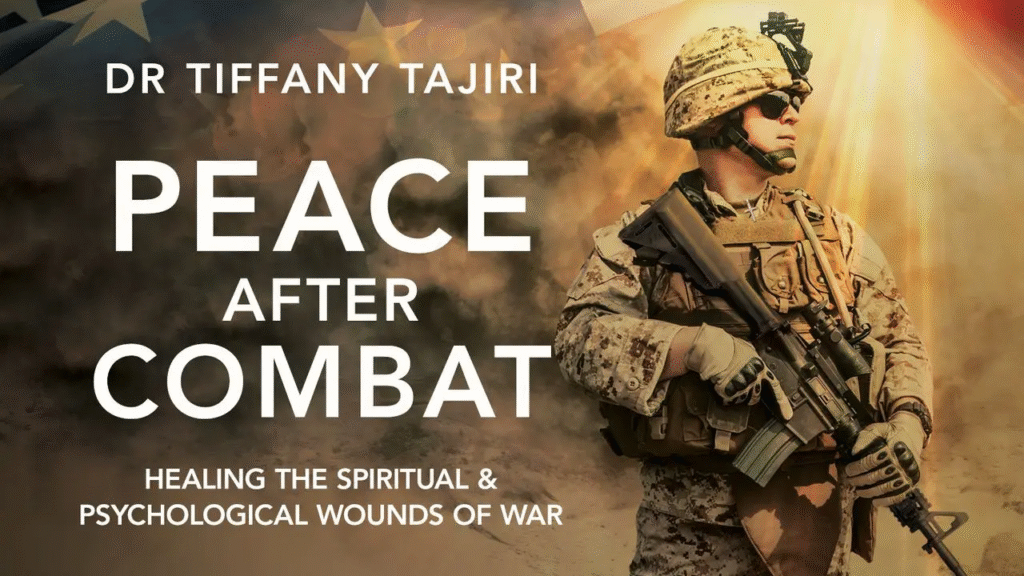
If you are like many combat veterans, being at home can feel even more foreign than being overseas. With compassion, scientifically proven exercises, and biblical truths, Dr. Tiffany helps you find deep spiritual peace and freedom. You are worthy. You are profoundly loved. And you are not alone.
David C Cook
Day 1
Scriptures: John 15:13, Ephesians 6:11-12
Peace After Combat
Is it possible to find peace after returning from combat? One US combat veteran dies by suicide every hour. Over 90% of our combat veterans profess a belief in God and goodness, but many of them lose their faith after experiencing the horrors of war. Even if they can somehow hold onto their faith, many insist that their combat sins will only send them to hell. Such flawed and tragic beliefs make it easier to consider suicide.
After each traumatic deployment, combat veterans are dramatically less inclined to believe. Faith and family are the strongest protective factors in suicide prevention, but often families fail to survive because of the strain deployments place on marriages. All that’s left is faith, but what happens when faith is seemingly lost?
God cannot and will not fail you. In fact, it is He who can bring an unexplainable peace to your life and those you love.
Let me remind you of the truth that sets you free:
• God understands you, never left you, loves you, forgives you and will do anything to have a relationship with you.
• God is not the author of your hurt and suffering. He is not the author of the terrible things you saw in combat.
• Every day we are engaged in spiritual warfare. Whether the battlefield is in the Sandbox (Middle East) or in our heads, we cannot succumb to the enemy (Satan) who wants us to lose sight of God.
Have you ever stopped to think about how much you are like Christ? Yes, you read that right—Jesus Christ—as in the Son of God! Just as Jesus selflessly sacrificed His life for our eternal salvation, you (and of course, those lost along the way) volunteered to sacrifice your life for God and country. The Bible tells us “Greater love has no one than this: to lay down one’s life for one’s friend” (John 15:13 NIV).
Jesus wasn’t immune to experiencing the hurt and pain caused by our world. In fact, He completely understands your suffering, as everything pales in comparison to what He endured during His life and finally His death on the cross.
Jesus never abandoned you and your brothers and sisters whom you lost in combat; He was always there.
I pray that you do not succumb to the lies of the enemy: lies of self-blame, lies of shame, lies about God not loving you, lies about God punishing you, lies about your life never getting any better, and lies about being unworthy.
Spiritual warfare is as real as you and me. Don’t forget that you are called to be a warrior of the flesh and of the spirit. Now it’s time to fight for your life and take back everything the enemy has stolen. You’re not alone. God is on your side and the victory is already yours—you just need to fight for it. Let’s put on that battle rattle (Eph. 6:11–12) and press on.
Day 2
Scriptures: 1 Peter 5:8, 1 John 3:19-20, Isaiah 43:18-19, 2 Corinthians 10:5
Recognizing Twisted Guilt
Twisted guilt is blaming yourself for an external event over which you had no control. More specifically, you take on responsibility because you felt you could’ve or should’ve done more or known better to prevent the injury or death of your brother- or sister-in-arms.
Twisted guilt is faulty because it occurs when you falsely convince yourself that you had control of external events. We never have control of external events, only influence over them. This sort of guilt makes us prone to self-punishment as a means to reconcile our perceived wrongs.
To contrast, actual guilt occurs when your chosen behavior directly and negatively impacts another. For example, imagine a person receiving a letter explaining he owes $20,000 to the IRS. When he walks into his house, he’s so angry at the IRS that he kicks his happy dog and then he feels bad. This is true guilt because the person had full control of his emotional response (internal stimuli) and yet he chose to let negative emotions erupt and he hurt an innocent bystander: the dog. This person could have chosen to behave differently.
Remind yourself: Your intention was to bring everyone home to his or her family. You did your best with the limited knowledge you had at that time. You cannot hold your past self accountable for what you know now. That’s absurd!
The enemy, or Satan, loves your twisted guilt because it destroys your family, it destroys your connection to God, and ultimately it destroys you! The enemy plants a toxic seed in your mind, and you choose to water that seed by allowing yourself to experience shame, self-isolation, substance abuse, anger, twisted guilt, thoughts of unworthiness—the list goes on. It slowly eats you from the inside out as you push everyone out of your life until you’re alone in the darkness of your own despair.
Don’t allow the enemy to win this battle; fight it for the sake of those who love you and, of course, for yourself. Here are four courses of action you can take:
Be ready. God knows that twisted guilt is a favorite weapon of the enemy so He gives us a warning. (Reread 1 Pet. 5:8.)
Don’t be afraid. The Lord knows what’s in your heart and all your intentions. God knows the difference between true guilt and twisted guilt. (Reread 1 John 3:19–20.)
Release it. God wants us to make peace with our past to make room for a new beginning. The past can easily be forgiven if you allow it. (Reread Isa. 43:18–19.)
Understand. Don’t pay mind to the lies of the enemy. Focus on God’s truth and it will set you free. (Reread 2 Cor. 10:5.)
Day 3
Scriptures: John 3:16-21, 1 John 1:9, Luke 15:7, 2 Corinthians 12:9
Does God Care? Punish? Forgive?
Below are three questions about God and His role in war that I’ve encountered in many sessions with my combat vets.
Does God care about my suffering?
No one is immune to suffering—not even Jesus! In order for God to have a relationship with us, He had to first relate to us, so He sent His holy Son Jesus (John 3:16–21). Because He was both fully God and fully man, Jesus understands what it’s like to be human and He empathizes deeply with the experiences of humanity.
Even in His perfection, Jesus allowed Himself to be tempted in every way, just to remind us that He, too, has been here—but most importantly, He has overcome! He was then put to death in the most horrific way. If Jesus, the Son of God, was not immune to the hurt and pain of this world, what makes us think we are?
Jesus gladly chose to sacrifice His life so we may have eternal salvation and walk again in God’s loving grace, as Adam and Eve enjoyed before the fall.
Is God Punishing Me?
God is the one and only perfect Dad. His love is perfect. He does not teach us or punish us by bringing any form of evil into our lives, but He allows hardship so we will pull into Him. That is where His grace is sufficient (2 Corinthians 12:9).
Grace is the unearned, undeserved, and unmerited favor that God grants us despite our fallible nature. God wants us to run to Him when we find ourselves in trouble—whether we or someone else caused that trouble.
Would you want to run to a punishing God who desires to teach you by using hurt and suffering as lessons? No way! Our God is a God of love and trust. Would you place your own child’s hand on a hot stove to teach her not to touch it? Of course not! Similarly, your Father handles you with great love and care. Remember, if it’s not love, it’s not God.
Does God forgive me?
No one is free from sin. God wants nothing more than for us to seek His forgiveness when we recognize our wrongdoings. “If we confess our sins, he is faithful and just and will forgive us our sins and purify us from all unrighteousness” (1 John 1:9). When we demonstrate awareness and accountability for our actions going forward, we demonstrate our love for God. We will falter more than once, and that too is forgiven. “I tell you that in the same way there will be more rejoicing in heaven over one sinner who repents than over ninety-nine righteous persons who do not need to repent” (Luke 15:7).
Next Steps
With this reading plan concluded, what comes next?
• Continue being disciplined in your spiritual life including pushing into prayer, reading God’s Word, and being a part of a church community.
• Talk to others, either a family member, a friend who was in the military, or a therapist. Being vulnerable in your struggles is a sign of strength, not weakness.
• Find resources, like Peace after Combat, that help you restore peace to your soul.