For a long time, my wife and I dealt with our infertility in private. Only when we began to speak publicly about our ordeal did we realize that infertility affects far more couples than we knew. You are surrounded by fellow Christians who know what you’re going through, and never separated from the God who is alongside you through every difficult day. He is with us. We are with you.
HarperCollins/Zondervan/Thomas Nelson
Day 1
Scriptures: Psalms 139:1-16, Luke 12:7
He Knows You
Infertility can leave us feeling unseen and unknown. Few around us have faced its griefs, fewer still seem able to empathize, and sometimes we lack the words for all we’re experiencing, leaving us unknown even to ourselves. But the objective fact beyond all feelings to the contrary, the truth as true as the sun’s existence at nighttime, is that God knows you. He knows your pain and your longing. There is no part of what you are going through that He does not see or understand.
He knows every detail and nanosecond of your existence—every atom, molecule, skin cell, and ligament; every hope, dream, sadness, and achievement. He knows you intimately, through and through.
He knows every movement you will make today (Psalm 139:2–3)—every action, step, and pause for rest; every blink, glance, and breath. He knows each thought you will have—every joy, question, and concern—and every word you will speak before you speak them (v. 4). He knows your complete personality—your emotional triggers, behavioral patterns, bad habits, and comfort zones. He knows what you’re good at, bad at, tempted by, and victorious over. He can unravel the intricate workings of your heart when you remain confused.
The next time you are feeling abandoned, alone, and unknowable on this difficult journey of infertility, remember that the One who made you knows you – including everything you’re going through today.
Reflect: What have you found to be the most difficult aspect of infertility so far? In addition to turning to the God who is with you, is there someone trustworthy in your life you can share the burden with today?
Pray: Dear God, fill me with the comfort of Your presence. Remind me that I am loved and seen by You. No one understands my life more perfectly. Grant me the peace of that knowledge. Amen.
Day 2
Scriptures: Mark 6:35-44, John 9:1-7
The Human Part of Miracles
One of the many unique struggles we face amid infertility is determining which family-building options are ethical and right for us. As Christians, we want to glorify God with our lives and choices, prayerfully pursuing what we perceive to be God’s will for us. But that isn’t always easy to discern. One thing many Christian couples wrestle with is how much we should try to change our situation—for instance, by taking supplements or using assisted reproductive technologies—or whether we should simply wait for Him to provide a miracle.
This can be a complicated reckoning, and no path is one-size-fits-all. But the story of Jesus feeding the crowd can help us here, with thousands of people miraculously fed on a little bread and some fish (Mark 6:41–42). But notice who feeds the crowd. It isn’t Jesus but the disciples (v. 37). And who provides the food? The disciples do (v. 38). Who distributes the meal and cleans up afterward? Again, it’s the disciples (vv. 39–43). Jesus did the miracle, but He did it through the disciples’ actions, blessing what they had in their hands.
God can accomplish anything without us, but sometimes He wants our involvement. This divine-human partnership is God’s general way of working. God’s miracles often come by praying and using the ethical options He’s placed in our hands.
Reflect: How has God worked with humankind to accomplish His will in the past? What decision could you combine both prayer and action in today, trusting God to lead you forward?
Pray: Dear God, give for the decisions we have to make, guiding us with your peace through each option. We place our future in Your hands and look forward to your guidance. Thank You for any and all miracles. Amen.
Day 3
Scriptures: Psalms 7:17, Psalms 107:1-9, 1 Thessalonians 5:18
Five Good Things
Science has long touted the mental and physical health benefits of gratitude practices. But God’s Word predates all such scientific study, having promoted the benefits of thankfulness for thousands of years. From the beauties of creation (Psalm 104) to meals and marriage (1 Timothy 4:1–5), it calls us to see such things as gifts and thank the Giver for them. Psalm 107 even lists five things Israel could be especially grateful for: their rescue from the desert (vv. 4–9), their release from captivity (vv. 10–16), healing from disease (vv. 18–22), safety at sea (vv. 23–32), and their flourishing in a barren land (vv. 33–42). “Give thanks to the Lord,” the Psalms say, for these are all signs of God’s “unfailing love.”
Gratitude can be a helpful practice for those of us experiencing infertility, which so often keeps us focused on what we lack. Do you have a notepad handy? Why not write down five good things you’re grateful for right now? It might be the meal you just enjoyed, or your marriage, or like Israel, God’s rescue points in your life. Give thanks for the bird’s song outside, the smells from your kitchen, the comfort of your chair, the support of loved ones. Each one is a gift and a sign of God’s unfailing love for you.
Reflect: Why has infertility made gratitude more difficult for me? What can I thank God for today that will remind me that I am still blessed despite what I am lacking?
Pray: Dear God, open my eyes to all the good things in my life today. Despite my grief, help me to find joy in them as your gifts to me, and empower me to make gratitude a habit even as I wait for what I long for. In Jesus’ powerful name, I pray. Amen.
Day 4
Scriptures: Job 42:1-6, Psalms 90:13-14
Relinquishing the Questions
My wife, Merryn, and I tried for more than ten years to have a child, and our relationship with God suffered as a result. We had prayed together and individually for years, only to face disappointment and prolonged pain. We did not understand why God seemed to hold out on us when we wanted something so simple, so natural to human existence. It reminded us of how our niece, when she was two years old, used to tell her mother, “You’re ruining me!” when she didn’t get what she wanted. In a way, we felt God had ruined us too.
Little did we know that expressing this frustration aloud meant a breakthrough was happening. There is a time to express our disappointment to God at His seeming lack of action in our situations. The Psalms repeatedly express such feelings (Psalm 13:1, for example), as do prophets like Jeremiah (Jeremiah 20:7). But like Job, there also comes a time to relinquish our questions to God, trusting His character when He doesn’t give us answers (Job 42:1–3).
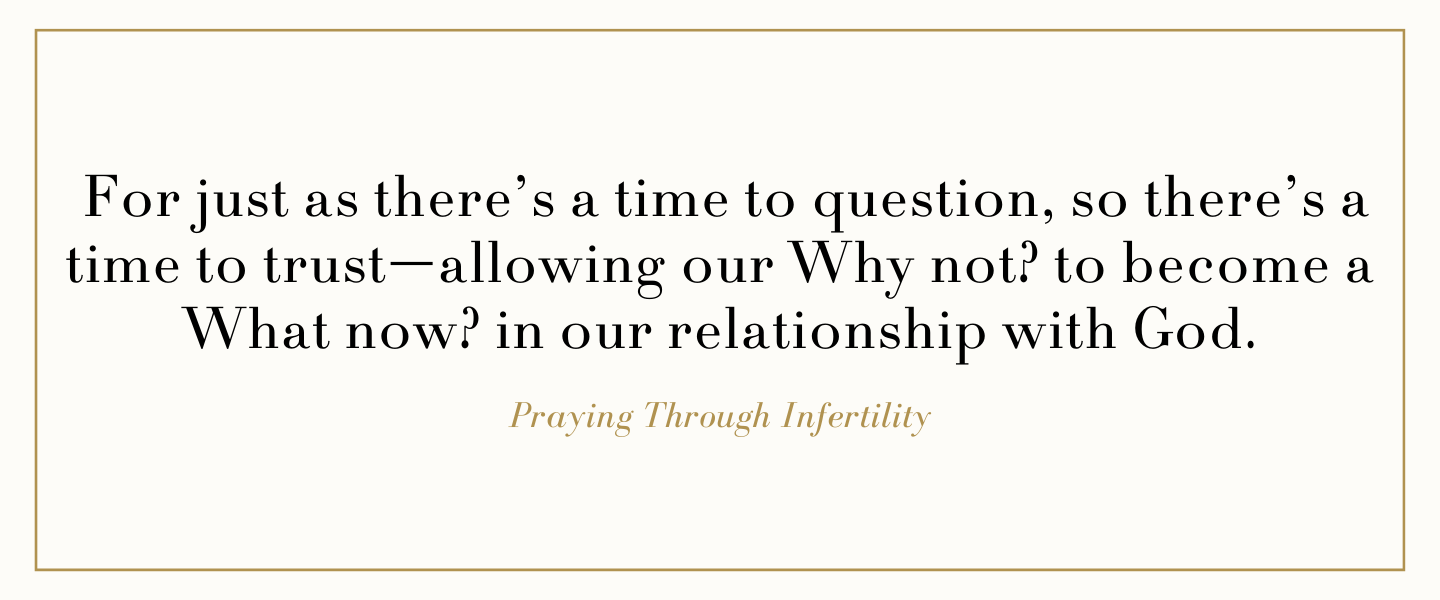
“I don’t understand why God hasn’t given us a child,” Merryn said to me one day. “Perhaps I never will. But I know Him, and I know He wouldn’t have meant this for evil.” For just as there’s a time to question, so there’s a time to trust—allowing our Why not? to become a What now? in our relationship with God.
Reflect: What might faith look like for you if answers to your “why” questions don’t come? How can you turn your Why not? question to God into a What now? prayer today?
Pray: Dear God, I may never understand your plan for me this side of heaven; but I believe in Your goodness and love toward me. Grant me peace and acceptance when I do not understand the “whys” of what I’m going through. I may not know “why” but I do know You, and will walk forward today confidently because of who You are. Amen.
Day 5
Scriptures: Ecclesiastes 3:1-14, Colossians 3:12
Wintering Moments
I recently came across a helpful word: wintering. Just as winter is a time of slowing down in much of the natural world, author Katherine May uses this word (in her book Wintering) to describe our need to rest and recuperate during life’s “cold” seasons. Sometimes we resist the need to slow down, hoping instead for a more eventful season. But sometimes winter, when things appear silent or sometimes even dead, is the season when the most important growth takes place.
Ecclesiastes famously says there’s “a season for every activity under the heavens”— a time to plant and to harvest, to weep and to laugh, to mourn and to dance (3:1–4). I had read these words for years but only started to understand them in my wintering season. For though we have little control over them, each season is finite and will pass when its work is done. And while we can’t always fathom what it is, God is doing something significant in us through them (v. 11). Just as plants and animals don’t fight winter, I needed to rest and let it do its renewing work.
I wonder now how often I fought the wintering moments of our infertility journey, trying to push through the energy-sapping experience of an adoption assessment or IVF round, when I really needed a season to recuperate.
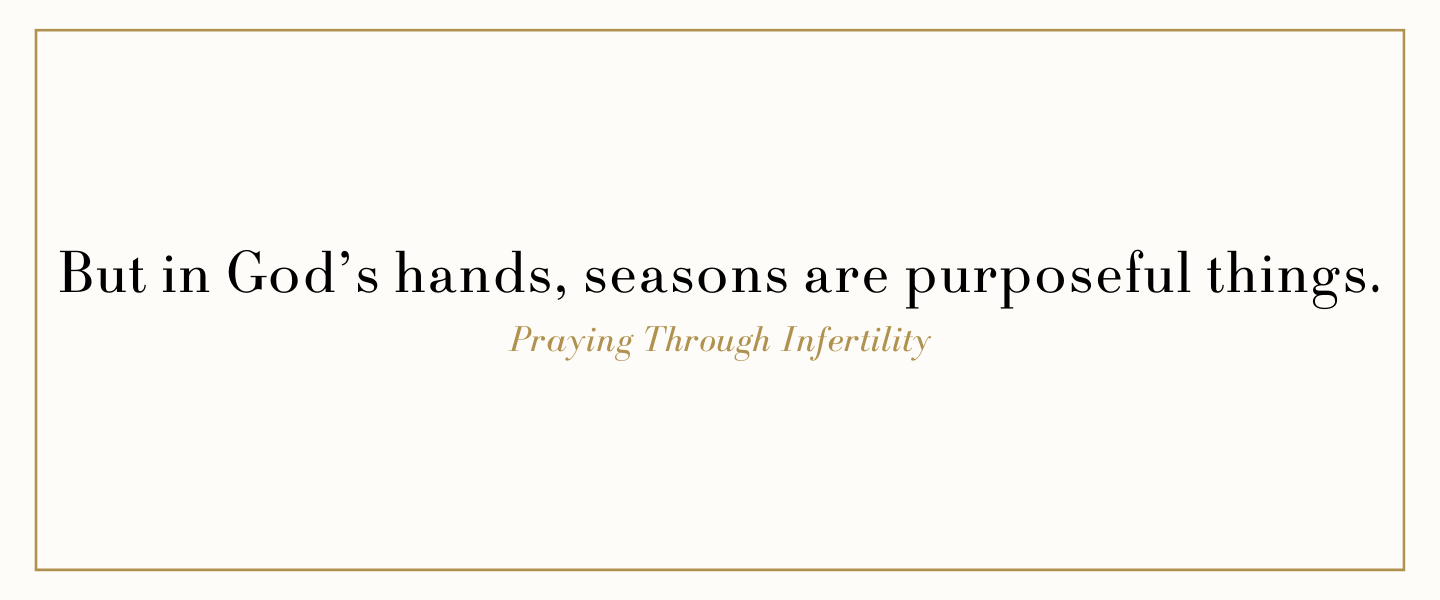
Infertility is an exhausting circumstance. But in God’s hands, seasons are purposeful things. They will pass when their work is done. Let’s make space for such times of wintering, receiving His renewing work in each one.
Reflect: What might God be wanting to do in your heart and soul this season? What lessons can you learn that others may need to learn from you one day?
Pray: Dear God, help me rest in this season of wintering. I may not know what You are doing with this time, but I trust You are doing Your good work in me. Help me to be patient and moldable in Your hands. I trust You to bring something beautiful and unexpected out of this season. In Jesus’ name, amen.