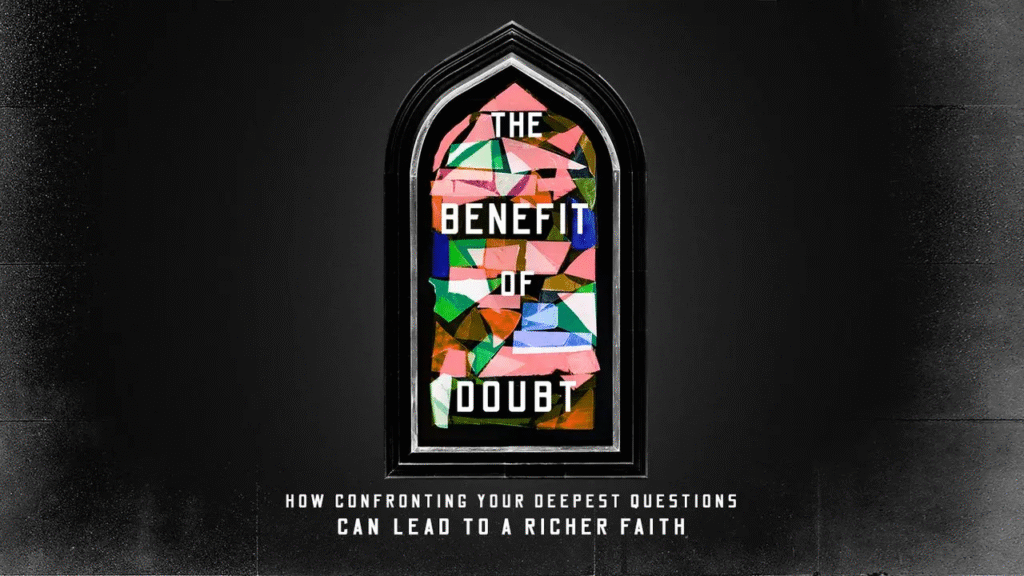
Wrestling with doubt? That doesn’t make you a bad Christian—it can actually be an important part of deepening your faith. In this 7-day Bible Plan, Pastor Craig Groeschel shows us how asking our deep questions and seeking answers can lead us into a deeper, more authentic relationship with Jesus.
Life.Church
Day 1
Scriptures: Matthew 28:16-20, Jude 1:22, 2 Timothy 1:9-10, Romans 5:8
Am I a Bad Christian?
Let me tell you about one Sunday morning in 2017. I was standing on the front row of our church service, singing a worship song, minutes away from going up to preach. I realized in that moment that I felt nothing. By nothing, I mean …
- I didn’t feel God’s presence.
- I didn’t feel like preaching.
- I didn’t feel like I had any faith.
Panic erupted in me, as I thought, What if all this isn’t real? What if it’s all just been emotions? Some say religion is just a crutch; what if they’re right?
I wondered if the people near me could hear my heart pounding, because I was sure it was louder than the music.
I started shaking and began to cry. That’s when I noticed the exit sign.
I thought, Maybe I could just leave? Just walk right out of church.
The reality is that, for quite a while now, a lot of people have had those same feelings, those same questions, and have been heading for the exit, walking out of church. And they’ve not returned.
Why are people leaving?
I think most don’t have a problem with Jesus. He’s hard not to like. Instead, they have questions but feel like they can’t ask them, so they’ve found no answers.
Yet, there are answers. Many people just don’t feel safe asking. They want to, but they’re embarrassed, ashamed, or insecure, thinking, What if I’m the only one? Whatwill people think of me? They’re afraid, and church may not seem like the safest place to express their doubts.
Some of those who have mustered up their courage and finally asked their questions have, too often, been met with bumper sticker theology that dogmatically states, “The Bible says it. I believe it. That settles it.”
Many are left wondering if there are any answers at all. And then, just like I did, they noticed the exit. Perhaps it’s left you wondering. Maybe that’s exactly why you started this Bible Plan.
So, before we go any further, I need to tell you this powerful truth: Doubts don’t make you a bad Christian. They make you human.
How do I know? Just look at Jesus’ closest followers.
Before ascending into heaven, Jesus gave them their divine assignment. Starting in Matthew 28:18, He tells them to go into all the world and tell people everywhere the good news of what’s happened so everyone might know and follow Him.
But just before Jesus gives that great commission, there’s a verse we can easily miss. It’s a crucial three-word phrase. Matthew 28:17 says, “When they saw him, they worshiped him; but some doubted.”
Ever noticed that before? Some worshiped, but … some doubted.
We read that “some doubted,” but in verse 18 Jesus gives all of them the mission of going out into the world to share the gospel and make disciples. Even the doubters.
Why?
Because doubts don’t make you a bad Christian. They make you human.
Doubts are a part of faith and, as we’re going to see over the next few days, they can actually invite us into a deeper faith.
Day 2
Scriptures: John 20:24-30, John 11:14-16, Romans 3:23-24, James 4:8, Psalms 23:1-6
What Do You Doubt?
It’s an important question because, until you get clarity about what you’re doubting, you’ll feel confused instead of getting answers that can satisfy you.
Are you asking …
- Is there a God?
- Is Jesus who He said He is?
- Who is God? Is He really Jesus? Or Buddha? Or Allah?
- Does science contradict some things in the Bible?
- Does God really love me?
- Does faith in Jesus really change people?
- Why isn’t God answering my prayers?
- Why are there so many controversies among Christians about the Bible?
- Why does God allow so much pain and suffering in the world?
While you’re pondering what you doubt, you may also want to assess why you doubt. What’s lurking behind your doubt? Consider the why behind the what.Let’s look at some common dynamics that can be at the source.
Doubts may be driven by circumstances.
We may hate what’s happening and feel like there’s no way a good God would allow something so bad, which leads us to wonder if maybe there is no God or He’s just not as good as we were told.
Doubts may be driven by intellect.
I’ve found people are especially vulnerable to intellectually driven doubts if they don’t know why they believe what they believe. Then, one day, a friend poses a question, or a teacher belittles what they believe, and suddenly, there’s a fissure in their faith, and the foundation starts to falter.
Doubts may be driven by emotion.
We may realize our faith is built almost entirely on feelings. Perhaps a person had a euphoric experience when they came to Jesus. After being emotionally pumped for a bit, eventually, that spiritual high began to wear off. Now, panic sets in, and the questions come: Is my faith disappearing? What if I was never really a Christian in the first place?
Doubts may be driven by other people.
Maybe someone has been around some hypocritical Christians—a pastor who was loved and respected but then fell morally, or a dad who supposedly loved Jesus until an affair came out. So the person decides, “If that’s what Christians are like, then the whole thing must be a joke.”
Doubts may be driven by a relationship with an absent or abusive father.
If you look at the most famous atheists of all time, many of them had absent or abusive fathers, including Karl Marx, Sigmund Freud, Bertrand Russell, Jean-Paul Sartre, and Friedrich Nietzsche. I get it. I bet it’s easy to come to the conclusion, If this is what earthly fathers are like, I sure don’t want a heavenly father!
Doubts may be driven by personality.
Some people are just naturally more cynical or contrarian. That can make it more challenging to have faith or easier to rebel against a family or a culture founded on faith.
Doubts may be driven by decisions.
When Christians make deliberate decisions to sin and keep sinning, they’ll feel further and further from God. Why? Because sin separates us from God. Then this person is upset because God seems distant and may start to wonder, Where is God? Why don’t I feel His presence? Is He even real? But the issue is not with God. It’s with the choice to stubbornly cling to sin.
Did any of these resonate with you? The “why” behind the “what”?
Our doubts cannot be diffused until they are defined. If you don’t know what’s behind your doubt, you may never experience the benefit of your doubt.
So consider the question today: What is your doubt all about?
Day 3
Scriptures: Ecclesiastes 3:3, Matthew 5:43-44, Romans 8:31-35, John 16:21-26, John 14:7-9
What Is Faith Deconstruction?
You don’t have to scroll for long on social media, YouTube, or through the news to hear about young people leaving the church and “deconstructing their faith.”
I’ve found that deconstruction is when a Christian examines their faith to let go of what is untrue and hold on to what is true. It’s going on a spiritual journey to release what’s contrary to God’s heart and embrace what’s true to His heart.
Typically, deconstruction happens in three stages of spiritual maturity. When done right, these three stages can lead to a stronger faith.
Stage One: Construction
Your faith was constructed.Building your faith is like building a house. You take the “materials” from everything you learn through the Bible, sermons, conversations with friends, and your spiritual experiences—and build your understanding of God and the Christian life.
But there are cracks in your construction you can’t see yet. Why? Because what you were taught wasn’t perfect, conversations with friends may have led you to believe some lies, and you might have developed a simplistic understanding that couldn’t handle the pressures of life.
Stage Two: Deconstruction
So what if you discover your house has some issues? Some wood is rotten, or there’s a crack in the foundation. What do you do now? When that house is your faith, you deconstruct.
We may assume our beliefs all come from the Bible, but that’s probably not as true as we think. Too often we subconsciously absorb our beliefs from other people, our church, or our culture and then assume they’re from the Bible.
Then one day we wake up and realize several things we deeply believe may not actually be biblical. Or, worse, we don’t realize that it’s not biblical, but we do realize that it’s not true. And now what do we do? Do we walk away from Jesus?
No. We deconstruct, letting go of what’s not true. Then we reconstruct. Holding on to what is true.
Stage Three: Reconstruction
Years ago, we discovered that two side-by-side rooms in my house were infested with a dangerous, toxic mold. Did we nuke the house? No.
If the whole house was dangerous, we may have. But it wasn’t the whole house; it was only two rooms, so we deconstructed those two rooms. We got rid of what was toxic, rebuilding it with something better.
When you realize that parts of your faith aren’t true—aren’t personal or credible or beautiful—you don’t discard your faith. You discard the parts that aren’t true. And you do some rebuilding.
So how do we rebuild our faith? We look at Jesus, which allows us to develop an accurate picture of God.
When you look at the life of Jesus, you realize He was amazing in His character, His love, His compassion. The way He cared for those who were hurting and cried with His friends. The way He treated people with grace and tenderness. The way He saw the best in the worst of sinners and reached out to the lonely, the lost, and the least of these. If God is like that, I can trust Him, no matter what’s going on in my life.
And God is exactly like that.
It may be scary to go through a thoughtful deconstruction, but it’s worth it. You will grow as a result of change, but change isn’t always comfortable.
Don’t give up. Don’t settle for deconstruction only. Keep moving forward, knowing that new life is coming on the other side as you reconstruct.
Day 4
Scriptures: Psalms 46:1, Psalms 145:18-19, Psalms 10:1, Matthew 22:37-39, Romans 5:6-9, John 16:33
If God Is Good, Why Do Bad Things Happen?
Unexpected loss, painful tragedy, and life-changing bad news lead many people to throw God’s goodness into question. Maybe something terrible has happened in your life, such as:
- You lost a loved one.
- You lost a job.
- Your spouse asked for a divorce.
- You battle chronic physical or mental health challenges.
- You look around the world and see the innocent suffering.
If you’ve ever doubted God because of something that seems unfair, you’re certainly not alone. For a long time, people have wondered, if God is good and all-powerful, then why do bad things happen?
As followers of Jesus, do we have an answer to that question?
Is God either unable or unwilling to prevent evil? Or is it possible that Christianity actually makes sense of the existence of good and evil?
Rather than ignoring the negative aspects of life, the Bible contains countless stories of heartbreak, suffering, and pain.
God describes David as “a man after God’s own heart,” yet in the Psalms David cries out:
“Why, Lord, do you stand far off? Why do you hide yourself in times of trouble?” Psalm 10:1 NIV
John the Baptist, the man chosen to prepare the way for Jesus, was wrongly arrested and sat in prison awaiting execution. Surely Jesus could have come and rescued His friend. But He didn’t, and John was beheaded.
Even Jesus, the Son of God, though a conquering, victorious King, is called, “A Man of sorrows and acquainted with grief” (Isaiah 53:3 NKJV).
Why would God show us that so many of His faithful servants experience pain? Perhaps we’re supposed to learn that God can be loving and allow suffering at the same time. Let’s try to understand why.
Above all else, Scripture teaches us that God is love and He created us for love. To be loved by Him and to love Him. To be loved by other people and to love them.
That is awesome. And that is the problem.
Picture someone you don’t love demanding that you love them, threatening, “Love me now or else!” Would you love that person? No. Because you can’t be forced to love. Love is only love when it’s freely chosen.
At His core, God is love and made us for love, so He gave us the power to choose. That’s the issue.
- If you can choose love, you can also choose hate.
- If you can choose right, you can also choose wrong.
- If you can choose good, you can also choose evil.
Freedom allows us to love. But it’s also our freedom that brought sin into the world. And, ultimately, sin leads to suffering. Could God remove evil and suffering? Sure. But to do so, He’d either have to remove our freedom, or He’d have to remove us.
So why does God allow bad things to happen in our lives?
I don’t know what the answer is in every specific situation, but I know the answer is not that God doesn’t love you.
God loves you so much that He sent Jesus to die for you. And Jesus’ death might help us understand at least part of the answer to this big question. Because Jesus’ death and resurrection show us that:
- There can be healing after hurt.
- There can be freedom after bondage.
- There can be resurrection after death.
God never promised to protect us from pain. In fact, Jesus actually assured us of the opposite. However, He did promise His presence in the midst of our pain. If you’re hurting, depressed, or discouraged, hold on to the promises from God’s Word. Look for some in today’s verses.
Day 5
Scriptures: John 13:34-35, Matthew 5:43, Matthew 5:9, John 8:1-11, Matthew 23:27-28, Luke 6:41-43
Why Are Christians Such Hypocrites?
Instead of being known for love, as Jesus commanded, His followers can sometimes be known more for who they hate and what they’re against. For example:
- Jesus commanded us to love our enemies, but today people claiming to be His followers relentlessly attack their enemies on social media.
- Jesus taught that we are to be peacemakers, but Christians today scream hate-filled words at their protests and rallies.
- Jesus said that the one without sin could cast a stone, leading the people who wanted to punish a guilty woman to drop their weapons. Today, Christians quickly and easily pick up “stones” and throw them at the guilty and, sometimes, the innocent.
Maybe you’ve been confused, hurt, disappointed, or disillusioned by followers of Jesus whose lives don’t look anything like His. If so, you’re not alone. Turns out Jesus didn’t like it when people claimed one thing and lived another. He really didn’t like it.
If you’ve been frustrated, turned off, or disgusted by Christians who say one thing and do another, Jesus is with you.
Jesus never spoke more harshly about anyone than those He called “hypocrites.” In Matthew 23, we find seven times that Jesus said “woe to you” to the religious leaders who claimed to live in holiness, but were actually self-absorbed, self-glorifying men who did “not practice what they preach.”
Jesus condemned hypocrites, yet many people today who claim to follow Him could be described that way. Why do so many Christians get it wrong?
Let me offer three reasons.
- Some who claim Christ are not really Christians. These people may attend church, go to Bible studies, and share Bible verses on social media but have never truly put their faith in Jesus.
- Some people who misrepresent Jesus are Christians but they’re still brand new or very young in their spiritual development. They may have not yet learned right from wrong and how to make better choices.
- Others are Christians who are imperfect and in process. To be clear, that’s the rest of us. You and me. Every day, even with Jesus in our lives, we can make bad choices and say bad things. When we do mess up, that doesn’t necessarily mean we’re hypocrites. We genuinely love Jesus, but in a weak moment might tell a lie or speak harsh words.
We all sin, and being aware of our sin can help us show grace toward others who fall short. So let’s be slow to label people hypocrites and remember that God loves everyone, including you, me, and the worst hypocrites.
I understand the biggest complaint against the church may be that it’s full of narrow-minded hypocrites. I don’t want that to be true, but the greatest hurts I have experienced personally have been from church-going, judgmental hypocrites.
Some in the church say one thing and then do another. Some have abused their power. Some can be arrogant, harsh, and unloving.
It is ugly. And that’s not Jesus. There is no excuse.
If your faith is struggling because of hypocritical Christians, can I encourage you to look to Jesus? Not the hypocrites, not the people, just Jesus.
Look at how He lived and loved, confronted hypocrisy, showed compassion to the least of these, and defended the abused and the oppressed. Look at how people who were turned off by religion were drawn to Jesus, and how people who were sinful or broken wanted to be around Him.
People will fail you. Jesus won’t. So can I encourage you to build your faith on Jesus instead of fallen people?
Trust in Him. Rest in Him. Jesus will never let you down.
Day 6
Scriptures: Psalms 88:13-14, Matthew 27:46, Hebrews 4:15, Jeremiah 29:13, Psalms 16:8-11
Why Does God Feel So Far Away?
I have a long history of feeling like God was absent when He promised to be present.
Once I was invited to a men’s spiritual retreat. My friends said it was THE. BEST. THING. EVER. But it ended up being just a bunch of smelly guys in a gym. Though most of them seemed to love it, I hated every minute and wondered what was wrong with me. My friends said it was the closest they ever felt to God, yet I felt nothing.
I remember asking myself, What were they experiencing? And what am I missing?
What do you do when you desperately want to feel the presence of God, but don’t?If you struggle with this question, don’t panic. You are not alone. Several heroes in the Bible, who were some of God’s most faithful servants, wondered why they didn’t feel God’s presence—including His very own Son.
No one was closer to God than Jesus. His mission was to glorify God in every way and He was obedient even to death. On the cross, Jesus was insulted and mocked. On the cross, Jesus became sin for us. And, on the cross, in some mysterious way, God pulled back or looked away.
While this is very difficult for us to understand, here’s what I do know: Jesus, the Son of God, who had done nothing but His Father’s will, cried out in desperate agony, “My God, my God, why have you forsaken me?” (Matthew 27:46 NIV)
If you’ve ever wondered why you don’t feel the presence of God, you are not alone. Jesus understands.
Maybe you’re single and trying to make a decision about someone you’re dating, or you want to know if you should change jobs. Or you’re considering a cross-country move and want some kind of confirmation that it’s a good idea. Or you have two kids and want to know if you should try for a third.
It may not be about a decision at all. You might be hurting and just want to experience God’s peace in the pain. Or you feel alone and just want to know that He’s with you.
So if God is always there and loves us, why don’t we always feel Him?
- Perhaps you’re looking for an awe-inspiring, supernatural experience with God when He’s trying to help you see Him in ordinary, quiet moments.
- Or you might be a Christian who has allowed bitterness or ongoing sin to harden your heart, making it difficult to feel close to God.
- Or maybe your life has become more about performing Christian duties than about pursuing God’s presence, turning your faith into a religious checklist rather than a loving relationship.
How about you? Why don’t you feel God with you?Could it be that you’re sensationalizing His presence? Or that you’re rationalizing a sin and allowing your heart to grow hard toward the things of God? Or maybe yourstruggle is that you’re prioritizing performance over God’s presence?
God is relational and wants to be pursued. So if God seems far away, remind yourself, just because He feels distant doesn’t mean He is absent. Your feelings are not facts, and they can fool you.
He is there. He’s close. And He’s trying to draw you close. God’s not far from you.
Day 7
Scriptures: Job 13:15, Job 19:25, Habakkuk 1:2-3, Habakkuk 3:17-19, Colossians 1:15, 1 John 4:16
The Benefit of Doubt
Imagine you’re supposed to be meeting a friend for lunch, and your friend is late. You keep checking your phone for a text or call for twenty minutes. Nothing.
What do you think of your friend? It depends on which friend it is.
You may have a friend where you’d think, “This is totally believable. He’s so unreliable. Why’d I even think he’d show up?” But you have another friend where you’d think, “Wow, this is so unlike her. Maybe she’s sick? But she would have called. I hope she’s okay.”
Your response would reflect what you already believed about each person. You would be giving your typically reliable friend the benefit of the doubt.
In the Old Testament story of Job, he loses everything. He’s distraught and confused, and he understandably starts questioning God. But in the middle of unbearable pain, he holds on to his faith and declares his belief in the goodness of God. While he struggles with doubt, he gives God the benefit of the doubt.
Job has doubts, but he doesn’t allow his doubts to define God. Because he had already decided who God was, when he was hit by troubling doubts, Job could still give Him the benefit of the doubt.
How about you?
We’ve learned that it’s completely normal to have questions. Just as Job did, we should feel free to ask away. But, at the same time, we can give God the benefit of the doubt.
When Job asked questions, God showed up.
But God didn’t give Job any answers. In fact, He asked Job a bunch of questions of His own.
Why doesn’t God explain everything to Job or to us?
Perhaps God is trying to build our faith. Or, more significantly, it may be that the answers are simply beyond us—because there are some things we could never fully understand, even if God Himself were to explain them to us.
Job wanted answers. Instead, God gave him the Answer. He gave Job Himself. God showed up, and God’s presence was enough for Job. Why? Because of their relationship.
In the same way, God’s presence can be enough for you. Just as Job had to decide, so do you.
When you want to trust God, but He doesn’t seem to be doing what you think He should do, you typically make one of two choices:
- You deny your faith.
- You deny your questions.
With choice one, you deny your faith and stop believing in a God who didn’t come through for you in the way you thought He should. With choice two, you deny your questions. You push them down and pretend they aren’t there.
Though both options feel tempting at times, neither will lead you where you really want to go. But there’s a third option. It’s the much better, but more difficult path.
The third option is to declare, “God, I’m still going to trust You. Even if it doesn’t make sense to me. Even if I don’t like it. I’m going to give You the benefit of the doubt.”
If you continue to pursue God one day at a time, He’ll take you to a place of greater trust, stronger faith, and deeper intimacy with Him than you’ve ever seen before. When we keep asking Him our questions, we get to experience intimacy with the God who modeled a perfect sacrificial life of love, and paid the penalty for all of our sins—yours and mine.
While you’ll never have all your questions answered this side of heaven, you can be sure of one thing: You can give God the benefit of the doubt.