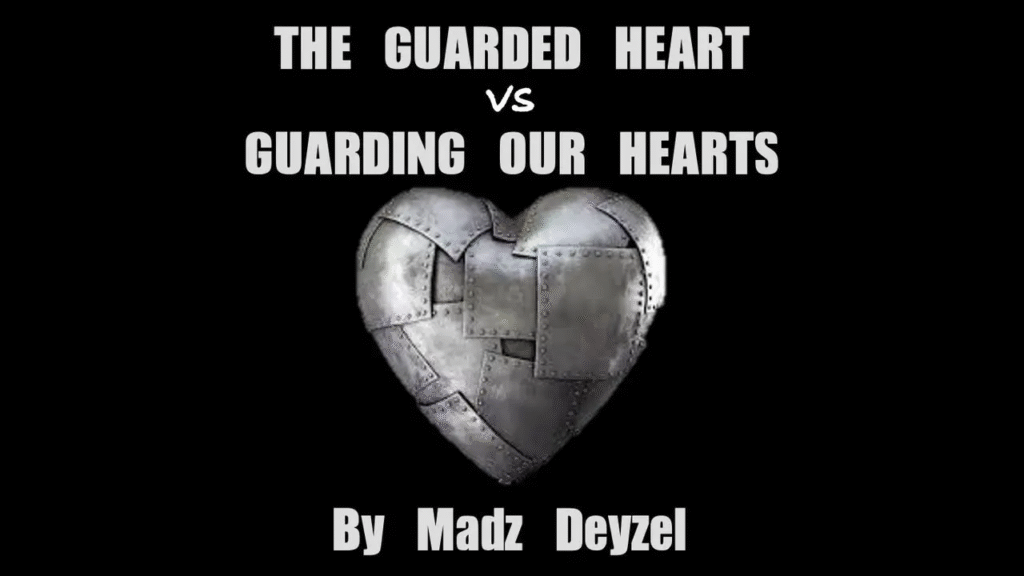
Proverbs 4:23 tells us to guard our hearts, but many are living with guarded hearts instead. This reading plan will help you understand the difference between a guarded heart versus guarding your heart, whilst unpacking the broken, bickering, bruised, betrayed, boundaryless and burdened heart. Madz Deyzel
Day 1
Scriptures: Proverbs 4:23, Proverbs 23:7, 2 Corinthians 10:4, Psalms 139:23-24
GUARD verses GUARDED
There is a big difference between guarding our heart versus living guarded.
Proverbs 4:23 says, “Guard your heart above all else, for it determines the course of your life.” The biblical understanding of guarding your heart means to be alert, through Christ, to what enters and dwells in our hearts. Be careful about what takes root in our hearts because this will determine how we live our lives. This means we must consider the things that can easily take root in our hearts, such as unforgiveness, bitterness, competitiveness, revenge and jealousy. These dynamics cause us to live guarded in an attempt to not feel the pain of hurts, insecurities around value or inadequacies around failure.
Psychology calls this a defence mechanism or self-protective strategy. Theology calls this a stronghold – any behaviour we turn to to hold safety other than God. Living guarded means we protect ourselves from hurt by not allowing anything in. We do this in our own strength, hoping the cover-up will block out the bad. However, we also end up blocking out the good, which can result in a hardening of the heart.
The amplified version of Proverbs 23:7 says, “For as he thinks in his heart, so is he (in behaviour—one who manipulates).” We all have around 40,000 sensory neurons and neurotransmitters in our hearts that contribute to our emotional experiences and perceptions of this world. Hence, as we journey through the ups and downs of life, we develop beliefs that we think will protect us from further pain. Most of the time, these beliefs are mindsets that support our defence mechanism.
For example, you may vow never to show vulnerability because it was used against you or have declared that you will never trust again due to betrayal. These beliefs then drive our behaviour of emotional guardedness towards anyone who tries to come to a close.
The complexity of the guarded heart versus guarding the heart then lands on how one processes the painful experiences of life without living with a hardened heart behind closed walls. This reading plan seeks to give you tools of truth for this tension.
Reflective Questions:
- Are you living with a hardened heart?
- Are there certain people that you have hardened your heart to?
- In what way is this robbing you from living free?
Prayer:
Search me, O God, and know my heart; test me and know my anxious thoughts. Point out anything in me that offends you and leads me along the path of everlasting life. Amen.
Day 2
Scriptures: 2 Corinthians 10:4-5, 1 Corinthians 13:11
HEART VOWS & HEART DEFENCES.
When my youngest son was around 9 years old, he was betrayed by a close friend who killed him on Minecraft, a popular video game. I found him lying on the bed sobbing his eyes out, declaring, “I will never trust a friend ever again.” The counsellor in me jumped into action, trying to help him unpack the emotions so he would dismantle the heart vow. He then looks at me with tear-stained cheeks and says, “Mom, you are a mental health counsellor, not a Minecraft counsellor.” As funny as it was, I reminded him that I understand the experience of betrayal even though I don’t know much about Minecraft. I also understand human nature and the danger of making heart vows.
Heart vows will lead to heart defences.
Never trusting again means you will never allow anyone in. 2 Corinthians 10:4-5 tells us to demolish the strongholds AND the arguments. The arguments are the mental computations behind our behaviour. In other words, the vow behind the defence. 1 Corinthians 13:11 reminds us to put away the thinking and reasonings of our childhood ways. To put the ways of childhood behind us, however, there can be parts of us still stuck in the vows and defences we made in childhood. Parts of us are still stuck in child-like ways of thinking and behaving. These are what I am calling our “Guarded Parts.”
Guarded parts may even compensate in one area of life to distract others from the parts of us still stuck because of inadequacy. For example, to lean on cognitive processing to avoid sitting with emotional conflict.
Guarded parts may be living, calculated to protect parts of us that have been hurt from being hurt again. For example, respond to others in need but hide showing your needs.
Guarded parts may be living concealed to avoid revealing parts of us that we are ashamed of. For example, never allow others into a person’s wrestle one has, which keeps those you love at arm’s length.
A CONTAMINATED HEART…
- Will live with calculated authenticity.
- Will produces careless ears.
- Will distort the truth into lies.
- Will live in enemy mode, assuming the worst of others.
- Will reject before getting rejected.
- Will harden over time with callouses.
Therefore, we must be alert to what takes root and enters our hearts because this will determine how we live. Remember that the mind can gather any evidence to back up the fear narrative we already believe. Living in a broken world means you can find the evidence to back up your fears.
For the remainder of this reading plan, we will unpack five heart spaces that can cause guardedness: The broken heart, the bickering heart, the bruised heart, the betrayed heart, and the boundaryless burdened heart. My encouragement is to work through each, reflecting on how you have processed these spaces and then invite the wisdom of Jesus in to guard against the fruit of these experiences taking root.
Prayer:
Jesus, I pray that you point out vows and defences in me that I have been living behind. Reveal to me my hiding spaces. My heart desires to live free from fears and to love wholeheartedly. Amen.
Day 3
Scriptures: Jeremiah 17:5, Isaiah 61:1, Luke 4:18, Genesis 3:7-13, John 16:33
THE BROKEN PARTS OF OUR HEARTS
We all have experienced the pains and troubles of life that can leave parts of our hearts broken. Parts of us feel inadequate, resulting in insecurity. Parts of us feel like failures, resulting in shame. Parts of us have experienced hurt, resulting in fear of being hurt again. Our tendency as human beings is to find ways to cover up these parts of ourselves to prevent ourselves from feeling pain. We can cover up inadequacy through performance as a means of compensating. We can cover up failures through self-medicating behaviour as a means of numbing shame. We can cover up hurts through hiding as a means of rejecting before being rejected.
To trust in our cover-up is a means of self-sufficiency. Psychology calls this a defence mechanism or self-protective strategy. We have been using them since Genesis where we see Adam and Eve run, hide and cover themselves with fig leaves. They also became defensive and used the defence of blame when God confronted them. The more broken we are, the more complex the cover-up. Jeremiah 17:5 warns us against trusting in self. Whilst these defences work in childhood, when we are victims of circumstances and need to survive, however, they rob us in adulthood.
So, how do we guard our hearts from living a cover-up because of experiences that have caused a broken heart?
Firstly, we need to right-size brokenness experiences. We live in a fallen, broken world; this reality exists all around us. If we allow brokenness to define us, it will break us. We can spend our lives angry, defensive and blaming, or we can own our heart’s need for healing.
Secondly, allow Jesus in. Isaiah 61:1 declares that he has been anointed to “bind up the broken-hearted.” The Hebrew understanding of bind up means to wrap back together a person who has been shattered and fractured by life. The image is one of placing a bandage on the brokenness to hold it together. However, Jesus declared in Luke 4:18 that he has come to “heal the brokenhearted.” The Greek understanding is to cure, make whole, release, and set free one from the destructive effects of brokenness. To not be held captive by the emotional pain of brokenness. Jesus doesn’t just want to bind us back together again. He wants to remove the bandages and heal us from the effects of brokenness. This is incredible news.
We don’t have to live with broken parts, as Jesus’ heart is to heal broken parts.
Reflective Questions:
- What parts of your identity and value feel broken due to inadequacies that cause insecurity in you?
- What parts of your feel broken due to the pressures of performance and the fear of failure?
- What parts of you are broken due to hurts and rejections from others that have left you hiding your heart to avoid feeling hurt again?
Prayer:
Jesus, thank you that your heart is for my healing. Thank you that you desire me to live free from brokenness and in the fullness of what you created me for. I choose to bring before you today the parts of me that feel broken, inadequate, fearful and ashamed. I pray for a revelation of your love for me and your peace to fill my heart and mind with your truth. Amen.
Day 4
Scriptures: Luke 22:24, Matthew 20:20, Matthew 20:24, Luke 9:46-48, 2 Timothy 2:23-24
THE BICKERING PARTS OF OUR HEART
My sons are aged 10 & 11, and I consider them professional bickerers. They bicker over who will be sitting in the front, who controls the remote, who is the best, who is the fastest, and who is the greatest. They kind of remind me of the disciples who also bickered over who was the greatest, not once but three different times. I can just imagine Jesus placing his hand on his forehead whilst shaking his head in disbelief over the immaturity of the bickering.
I use the word immaturity because bickering is evidence of immaturity and insecurity regarding our value. Bickering is evidence of one trying to compete with others for our value. Bickering is evidence of the power struggle one engages in to compete with others for value. Bickering is evidence that others are seen as a threat to our value. Bickering, therefore, becomes how we guard our fears around inadequacy. Sadly, it doesn’t heal it but exacerbates it, as it will tend to hook another person’s insecurity. We see this in Matthew 20:20-24, where the mother of James and John asks Jesus if her sons could sit next to him in his Kingdom. Verse 24 tells us that when the other disciples heard this, it made them resentful and angry.
Some of us may not bicker out loud with others, but we are bickering in our minds through ruminating conversations. In the long term, either way, it will lead to relational mistrust, disconnect and potentially bitterness as we see others as a threat.
So, how do we guard our hearts from the fruits of bickering taking root?
First, we need to disconnect our value from performance and competitiveness. We are all parts of the same body, and we belong together. This mental shift needs to happen so that we don’t see others as a threat to compete with.
The second takes this first step even deeper by adopting a servant-hearted posture. Serving others is what leads to maturity. Jesus responded to the disciples’ bickering in Luke 9:48 (The Message Version) by reminding them, “You become great by accepting, not asserting. Your spirit, not your size, makes the difference.” Bickering decreases as serving increases. So don’t get hooked by bickering; ask God for his wisdom in response.
Reflective Questions:
- In what spaces do I find myself bickering either out loud or in my mind?
- What need in me drives the bickering?
- Why do I find it hard to let the competitiveness go?
Prayer:
Lord, forgive me for trying to find my value in success. I surrender my self-worth to your truth. Help me live in peace and serve others instead of seeking to compete with them. Thank you that you believe in me, that is enough. Amen.
Day 5
Scriptures: John 16:33, Matthew 12:20, Matthew 5:5
THE BRUISED PARTS OF OUR HEART
Bruises happen as we journey through life’s bumps, knocks, jabs, and troubles. John 16:33 tells us there will be troubles. It’s not a matter of if but when. The problem with bruises is that they cause tenderness, but they are not painful enough to inhibit us nor big enough to make an issue about it. However, bruises can cause us to become jaded over time, putting our hearts on edge, on guard, and, over time, cynical.
The two biggest dangers of bruising are when we or others minimize it. You are told to stop making a big thing out of nothing. That one is exaggerating or being dramatic. Gaslighting is a psychological manipulation that causes you to doubt your perceptions and understanding of an experience. This leaves a person feeling like they are losing their minds. When we try to put boundaries around bruising behaviour, we doubt ourselves because it’s not a big thing, but it still hurts. The second mistake we make is we start to personalize it; we absorb the mild dysfunction that causes the bruising into our value and self-worth. There must be something wrong with me. These tender bruises are judged as weak, like the fragileness of a bruised reed—which is seen as good for nothing but to be eventually cut down and discarded.
So, how do we guard our hearts from becoming jaded due to bruises?
The answer is simply to allow ourselves to receive Christ’s gentleness in those tender spaces in ourselves and others. Isaiah prophesized in Matthew 12:20 that Jesus would not break a bruised reed. Jesus doesn’t see a bruised reed the way the world does. He has incredible compassion for the weak, downtrodden, bruised, and despairing. Jesus shows tenderness to those in the most delicate and fragile places. Jesus declares that the meek will inherit the earth. The Greek meaning of meekness is “power under control.”
Meekness is not the absence of strength but the application of strength to a tender situation. I believe Jesus wants you to bring those bruises before him today so that he can heal you.
Reflective Questions:
- In what area of your life have you struggled with bruises?
- How has it impacted your heart?
- How have those who caused the bruising responded?
- What emotions are you most struggling with?
Prayer:
Jesus, thank you for your heart and compassion for my bruised heart. I pray for your healing as I process the emotions and hurts that have happened over the years. I pray your meekness will guard my heart from jadedness. Thank you that I don’t have to do this healing journey alone.
Day 6
Scriptures: Psalms 41:9, Micah 7:5-7, Genesis 15:6, John 2:24-25
THE BETRAYED PARTS OF OUR HEART
Betrayal is brutal and one of the most painful human experiences. It occurs when another is loyal to oneself despite the impact on others. Even David expressed the pain of his best friend’s betrayal in Psalm 41:9. Betrayal can cause deep bitterness due to the intensity of wounding and rejection despite the depth of the relational investment. The tension is the space between loyalty, investment, sacrifice, and the betrayal experience. It leaves one asking WHY? It often makes no sense and catches people off guard as they never saw it coming. The inability to find answers often adds to the heart’s bitterness, guardedness, and hardening.
So, how do we guard our hearts from becoming bitter and hardened because of betrayal?
Firstly, we have to own what we put our absolute trust in. The Hebrew word for trust or belief is “Aman,” which means to be firm and certain of its steadiness. Micah 7:5warns us not to “trust” (Aman) anyone, not even our best friend or wife. In other words, don’t place your Aman / trust on a human being; this should only belong to the Lord. Micah 7:7 affirms this mindset when stating that he will only look to the Lord for help. Even Jesus in John 2:24-25 states that he did not trust people because he knew about human nature. We are fallen, fickle, fragile, and fallible. To place absolute “trust” in another is unwise. YET, Jesus entrusted the mission of the church to all of us. Good thing it wasn’t to just one of us, but all of us. One body part alone will fail, but the body made up of many parts is powerful.
Secondly, we must hold the space between calamity and calling with wisdom. (I have a reading plan called ‘Between Calamity and Calling’; I encourage you to read if this is a space you are wrestling with.) Jesus wrestled with his Father when facing the most brutal experience of betrayal any person could have gone through. Wrestling with the Father is the key to rising despite coming face to face with a betrayer.
Betrayal is a painfully difficult space to process; the only way to do it well is with Jesus. He understands it better than anyone. I have not listed any reflective questions for today’s plan. However, my encouragement is to bring those painful emotions to the foot of the cross and pour out your heart before Jesus. Let him carry the pain with you; we don’t have to do this journey alone.
Prayer:
Jesus, I invite you into the betrayed spaces of my heart. I surrender revenge to you today and lay it at your feet. Thank you that I no longer need to carry the burden of bitterness alone; I chose to surrender daily to you as I journey these emotions with you. Thank you that your death on the cross carries my betrayal as much as those who have betrayed me. Amen.
Day 7
Scriptures: 2 Thessalonians 3:8-9, Galatians 6:9, Proverbs 16:3
THE BOUNDARY-LESS & BURDENED PARTS OF OUR HEARTS
Poor boundaries tend to result in carrying burdens that don’t belong to us. Establishing healthy boundaries is related to knowing one’s internal self-worth. In the same way that a house worth millions will have strong security and boundaries to protect its value, so it is with our self-worth.
When people struggle to see their self-worth, they find it hard to say no to others because they fear failing people and being rejected. Often, their worth and value are found in what they do for others; hence, the need to be needed feeds their value. This drives picking up burdens that don’t belong to them. The danger is often what one picks up is not heavy to begin with but over time, it leads to weariness and even bitterness due to the belief that one has been taken advantage of. In the message version of 2 Thessalonians 3:8-9, there is a warning about lazy people taking advantage of generous people. Sadly, there is a fine line between good-hearted, generous people who also need to feel needed and those who take advantage of their generosity.
Over time, it generates weariness and an experience of being taken advantage of, leading to bitterness of heart, especially when one has nothing left to give. I find it liberating that Jesus never set up a healing ministry at the pool of Bethesda. We know he only did what the Father told him, not what the need demanded. Galatians 6:9warns us not to become weary in doing good. Burdens will lead to burnout, which often leads to behaving badly. Behaving badly is a biblical description of the root meaning behind weariness.
So how does one guard their heart against boundaryless burdens that can lead to weary bitterness?
Firstly, one has to invest in the foundations of self-worth. If you find it hard to say no to others out of fear of rejection, then an insecurity root needs to be healed.
Secondly, Proverbs 16:3 instructs us to commit our plans to the Lord instead of being driven by the needs around us. If the enemy can’t stop you from becoming a Christ follower, his next strategy is to make you ineffective. Burnout is the easiest way to do that.
Reflective Questions:
- What is the fear behind saying no to others? (Being rejected, being seen as inadequate, not being needed?)
- What are you carrying or doing now that does not belong to you?
- Who do you find saying no to the hardest?
Prayer:
Jesus, thank you that I can cast my burdens onto you. You said that your yoke is light. Help me walk in your way instead of my own. Help me discern the areas of my life in which I struggle to place boundaries. I pray, too, for a revelation of my value in your eyes. Amen.
Day 8
Scripture: Philippians 1:8-11
GUARD YOUR HEART WITH THE POWER, PLAN, PROTECTION AND PURPOSE OF JESUS.
To end this reading plan, I want to share with you four verses written by Paul to the church in Philippians. These verses give us the right strategy for guarding our hearts so that life still flows from them.
Philippians 1:8 “God knows how much I love you and long for you with the tender compassion of Christ Jesus.”
Our heart power is Jesus. We love with Jesus’s tender compassion. He is our source for safeguarding our hearts from every broken, bickering, bruised, betraying, boundaryless, and burdened experience. We cannot do this in our strength.
Philippians 1:9 “I pray that your love will overflow more and more, and that you will keep on growing in knowledge and understanding.”
Our heart plans to display the Authentic Love of Jesus to every broken, bickering, bruised, betrayed, boundaryless, and burdened part that may crash into our world. We need to understand that this broken world needs the authentic love of Jesus, not revenge.
Philippians 1:10 “For I want you to understand what really matters, so that you may live pure and blameless lives until the day of Christ’s return.”
Our heart’s protection is recognising through wisdom what matters. Living with guarded, revenge-filled, bitter hearts produces nothing but more hurt. God has given us every redemptive tool for restoration, reconciliation, regeneration, and repentance—this is what matters. He knows we are broken, so he came to give us life and the resources for healing.
Philippians 1:11 “May you always be filled with the fruit of your salvation – the righteous character produced in your life by Jesus Christ – for this will bring much glory and praise to God.”
Our hearts’ purpose is to reveal the good news of Jesus. WHY? so others may live. Guarding our hearts with Christ’s power, plan, protection, and purpose will determine how we live as His disciples.
Once, when wrestling with the pain of a guarded heart, a mentor told me these words, which I would like to pass on to you as you journey through healing the guarded heart: “The greater our capacity to love, the greater our ability to feel pain. The more we look like Jesus and love like Him, the more pain accompanies this love. BECAUSE loving people the way we were re-created to love them will cost us our lives.”
Madz has heaps of video courses, published books, podcasts, and reading plans all aimed at emotional and spiritual well-being. Check out her website for more info.
Prayer:
Lord Jesus, I surrender my guardedness to you today. I repent of trying to live in my own strength, and I invite you into every step of this journey of being your ambassador to a broken, hurting world that needs a Savior. I pray that your love fills my heart to overflowing that I need never be guarded again. Amen.