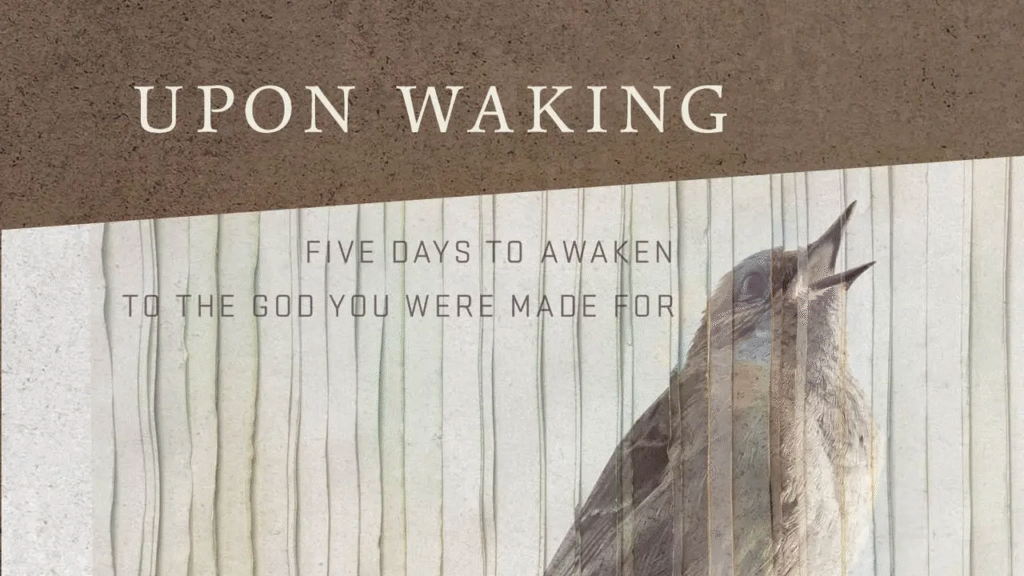
What if you could awaken each day to discover something bigger than all the chaos that typically meets you each morning? What if you could discover God? In this devotional, Jackie Hill Perry leads you to reflect on specific passages from Scripture to help you awaken to the God you were made for, the life you were made for, and the person you were made to be.
B&H Publishing
Day 1
Scripture: 1 Corinthians 11:24
Soul Food
BEFORE WORK OR WHATEVER it is that obligates our time after waking, we eat, even if we ate six to nine hours before. Before bed we eat to cease the hunger. After the risen sun and early yawn, we do the same. This is science. Biological. Human. Fuel is a perpetual need to which our bodies would break if kept from it. On those spiritual days when we fast, withholding food from the body, we taste what starvation does to us. The mind twists and turns. Our emotions sway and, if turned in the wrong direction, tempt us to burn everything to the ground. Monday through Sunday we are largely controlled by our stomachs and if anything is in it. So much so that its contents determine if we will be a Monster or a Mercy.
I don’t find it odd, then, that our Lord uses food as a metaphor for Himself. The most memorable being that of bread. The whole subject began when Jesus told Israel the Father has bread to give them that is true (John 6:32). Figuring that Jesus’s preaching about bread must mean He had access to a better manna, they heard this and contemplated a different miracle. One of constant sustenance. “Sir, give us this bread always,” they said (John 6:34). Always. They supposed Jesus was offering to fill their belly and not their soul. With a product made of wheat, planted in the soil, grown from the ground, harvested by human hands. That might’ve been bread, but that bread was not the better manna. The true bread was and is Jesus, He who said, “I am the bread of life” and “I am the living bread that came down from heaven” (John 6:35, 51).
You may be wondering where I am going by saying all of this. Wondering how my original point connects to my most recent, and it is this: in the same way our bodies need a constant diet of food, our souls need God like this always. Upon waking, we are hungry for heaven, and yet we fill it with a scroll or many. As the day moves forward and the belly still empty, we fill it again, when a person gives us a measure of love, a like, a look. Before bed, the soul, if visible, would be skeletal. Barely able to stand on its own or smile with all of its teeth. The body who holds this almost-dead thing feels alive because it depends on every other bread except the One the Father sent.
But the Lord’s Table has been set, so sit. Revive yourself in His life. Fill yourself in His love. Scrape the plate and wipe it clean. We need the Bread of heaven because truly no other food will do.
Day 2
Scripture: Colossians 4:2
Let Us Pray
NO ONE LIKES TO be bored. Especially now, in this age, with a million ways to be entertained. Things like the optionality of commercials reinforces our impatience. When only a decade or so ago, sitting through an advertisement with twiddling thumbs was an obligation. Now it’s a choice no one makes. Keep the entertainment going we say.
Then there’s the wonderfully terrible invention of social media that entertains without ceasing. Like the Colosseum in our hands. In one swipe, videos of a recipe, a twelve-second sermon, a slam dunk, a knee on a neck, an article about nothing or everything, a riot at the Capitol, and a dog singing Sinatra.
It’s no wonder that when it’s time to pray, the length and consistency of the prayer suffer under the weight of a mind that’s completely uncomfortable with boredom. In whatever quiet place you’ve chosen, in your car or in your closet, you sit or lie, kneel or stand. Closing your eyes, you begin, as usual, “Our Father” or something like it. Then you remember you forgot to get some paper towels for the kitchen. “Who art in heaven . . .” Then there’s the online meeting you have on Thursday. “Hallowed be Your name.” And why didn’t Daddy buy the bike you asked for when you were twelve? At this point, you have two options: keep sitting with God in the silence of everything, or give in to the noise in your mind, which, if you’re honest, feels more entertaining than intimacy.
“Think of boredom during silent prayer as an act of purification,” one pastor recommends. “In this uneventful moment, God purifies us of the false god of good feelings. Silent prayer is often something I want to avoid because it forces me to exorcise the demons of excitement, stimulation, and distraction.”On some level, regaining discipline over your prayer life will happen as you rediscover the beauty of boredom. As long as you need to be doing, writing, reading, laughing at, watching something to have joy, prayer will be of no interest to you. But if you pause and remember the beginning of the prayer again— “Our Father, who art in heaven, hallowed be Your name”—you will be remembering God, the aim of every prayer. Whether in a closet or a car, the One to whom you speak is holy in heaven, transcendent in nature, yet relational and therefore near to you, His child. He is most interesting. Most intriguing. Not entertaining per se, but completely worthy of your mind’s focus. And trust me, distractions will happen. It’s a part of what it means for you to be you. But every time your mind wanders, just find your way back to God again and again and again.
Day 3
Scripture: Psalms 77:10-12
Changed by the Word
GOD’S WORD AND GOD’S nature must inform your emotions. In saying this, I don’t mean feelings are unnecessary when, in fact, emotions are useful for many things. As utilitarian as they might be however, they become a danger to us and the world whenever they are detached from God’s Word.
For example, think of the ten spies who looked at the giants in Canaan, felt fear, and forgot God. Or consider David who walked his roof, observing a woman in covenant with another, feeling passion, and forgot purity of heart. Or Peter who inhabited a garden not only with his Lord but also with the men into whose hands his Lord had been delivered, and as his Lord was being taken, Peter felt a lot of things. Maybe fear, maybe zeal. Either way, after a sword was raised, an ear was removed. Feeling what he felt, he forgot the kingdom. When emotions are given underserved supremacy, they can lead us to respond to ourselves, others, and our circumstances in ways that reflect the emotion more than it does their Creator.
At this point, by singling out the negative influence emotions can have, one might see emotions as an enemy of faith. That too would be an irrational, or even emotional, way of seeing things. Emotions are good, for not only did our Lord make them, but He also has them. The issue then is not simply what or how we feel but how what we’ve inherited from Adam leads us to respond to said feelings.
To say it another way, emotions aren’t the problem; the flesh is. So then, in becoming more holy, doing away with emotions won’t serve us. What will is that God-breathed Word, both written and living—written in every narrative, epistle, prophet, and psalm, and living in the enfleshed God of heaven. Who, after ascending to that glorious right hand, together with His Father, sent their Spirit who once hovered over the waters to not just hover over but fully indwell the people for whom Christ died. These people will feel all kinds of ways all of the time, but they can and they must reflect God’s nature when they do.
Day 4
Scripture: Psalms 22:1
Asking Questions
WHILE READING THE PSALMS, I’m struck by how often God is questioned. Why He’s allowing this. Why He’s forsaken that. Suffering makes you curious, and to me, it seems, being inquisitive is in fact a healthy part of prayer. Even Jesus, in His dying hour, asked God a question.
I’m not sure who taught us to deny God our questions. If I were to guess, it must’ve come from the elders of Israel who didn’t want us to be irreverent. They knew God was a consuming fire, who descended onto mountains that couldn’t be touched. Every generation after them is just as stiff-necked as they were and therefore prone to testing God like their soul wasn’t on the line. So I won’t deny them the dignity of having good intentions.
But neither should we deny Scripture’s testimony regarding this subject. Godly people ask God questions, and why shouldn’t they? His ways are not our ways. His thoughts are not our thoughts. The way God moves doesn’t often align with our own logic since He doesn’t share our nature or essence. We run from pain; He uses it. We hate our enemies; He loves them. We try to hold onto our life with clenched fists, and He commands another way. The way of death which somehow, someway, causes us to find the life we thought we were losing.
Life with a transcendent God isn’t always going to make sense, and if that is the case, questions will be commonplace. When our aversion to prayerful curiosity has lifted, I often wonder if we will discover what we’ve withheld from God. And by what, I mean our very self. Avoiding curiosity can be a luxury in some sense. To ask anything at all, you have to acknowledge your intellectual limitations. But not only that: to ask anything at all, you have to sit inside whatever tension your body, life, and mind have brought about. Uncovering what hurts, hurts. Thinking about whatever is unclear is frustrating. If you decide not to ask God any questions regarding these things, you can go on with your life, maintain your sense of control and manufactured peace. But to do that is to deny yourself the opportunity of giving God your whole self.
What if asking God questions is one way to cultivate intimacy with God? What if your questions became a door through which you could be vulnerable with Him? What if your questions opened up your mind to read the Scriptures with Spirit-empowered expectation instead of apathetic drudgery? If, in fact, Jesus is the wisdom of God (1 Cor. 1:24), what if, by asking questions, you discover God; and by finding God, you find your answers?
Day 5
Scripture: Ephesians 6:18
Becoming Prayerful
I USED TO BELIEVE prayerlessness had everything to do with time. If I didn’t pray, it was because the day got ahead of me. The clock is a lot like my oldest daughter, an untempered leader. The calendar too. Every single day there is something to do. Much of which is good. Working from home or an office. Lunch with friends from school, or church, or wherever. Then there are the pesky duties like laundry. Somewhere in the world, there’s a pile of clothes on the cold side of the bed, abandoned and ignored for better joys. When there are life, friends, church, children, school, husbands, wives, nine-to-fives, and five-to-nines, where in the world is prayer supposed to fit? This all made sense to me. It gave me a reason and a finger to point until I opened the Gospels and saw the truth.
Truth is, Jesus was busy too. The Father had business Jesus came to handle. A woman at a well to give water to. A Lazarus to raise. Streets to straighten. Wine to turn. Bodies to heal. Even at rest, when a few waves prompted the disciples to wake Him, He got to work by speaking peace. And yet, at no point in any Gospel do you see Him neglect prayer. He made it His business to meet with the Father, sometimes in the morning and other times all the way through the night. Often before making decisions and creating miracles. Even on His dying day, He met with God about a cup, and while it was poured, He spoke with God on a cross (Matt. 26:39; 27:46).
There was no way, in heaven or on earth, that anything would ever keep Jesus from meeting with the Father. Time has never been the reason anyone doesn’t pray; the heart is. Prayerlessness is almost always a humility issue—the natural consequence of a heart that tends to believe it is good without God. Yes, you may be busy, but it’s possible that you are also proud. Pride is the true enemy of your prayer life. Pride deludes us into thinking we’re self-sufficient. That our jobs supply our needs. Our relationships provide comfort. Our intellect and ambition make us successful. But in fact, everything you are and everything you have is because God rains on the just and the unjust (Matt. 5:45).
So then, to become more prayerful, we have to be humble. To be humble, we need to be honest. Each morning, tell the truth. The truth being, you are needy even when it doesn’t feel like it. Then, turn toward God and pray.