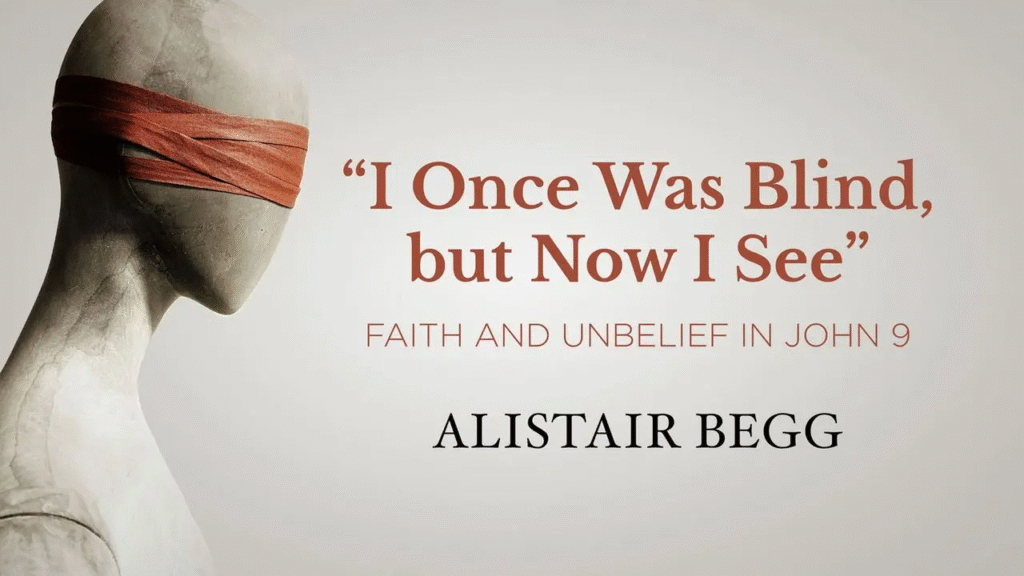
When Jesus healed a blind man in John 9, He did more than cure a physical ailment. He opened a heart’s eyes to faith. Yet as the Pharisees interrogated the man, they showed what hearts look like when they are still blinded by proud unbelief. The ministry of Jesus is to transform hearts, turning them to God, as He did for the man born blind.Devotional material is taken from ‘Truth For Life,’ a daily devotional by Alistair Begg
Day 1
Scriptures: John 9:13, Philippians 3:1-11
RELIGIOUS FORMALISM
“They brought to the Pharisees the man who had formerly been blind.” JOHN 9:13 (ESV)
The great tragedy of John 9 is not that a man had been blind for years until he met Jesus, but that a group of men were left spiritually blind despite having seen the work of Jesus.
The healing and transformation of the life of the man born blind caused a great stir in his community. Presumably he had been so much a part of people’s surroundings that it was easy to disregard him. Yet suddenly their normal daily experience was disrupted. The man who was once blind could now see perfectly well, and he was no longer asking for money (John 9:8-10).
Unable to solve this mystery, they presented the formerly blind man to the religious leaders, the Pharisees, to see if they could shed some light on what had occurred. What followed was not a conversation between the man and the Pharisees so much as an interrogation. Instead of rejoicing in his story, they challenged his testimony.
The reason for the Pharisees’ harsh reaction, at least on the surface, was that the man had been healed on the Sabbath (John 9:14-16). The religious leaders were unable to rejoice in the restoration of his sight because they were blinded by their religious formalism. The forms and structures of religion that they boasted in were the very things that proved to be a barrier to their faith in Jesus. They kept their lists of what was acceptable, and so they were unable to recognize the work of the God they claimed to worship, even when the evidence was quite literally (and miraculously) looking them in the face.
Religious formalism cannot face the dramatic impact that Jesus makes when He takes a person and turns him or her upside down—which is actually to turn them the right way up! Unwilling to acknowledge their own need for transformation—and the truth that only a radical internal transformation gives significance to the religious life—religious formalists hide behind maintaining appearances. Nothing challenges the religious formalist more than coming face-to-face with someone who has had their eyes opened to the salvation that is found in Jesus.
The Pharisees’ reaction to the blind man’s healing teaches us, then, to beware of the dangers of religious formalism. A blind commitment to religion has the potential to keep us from Jesus, just as it did with them.
Have your eyes been opened to the salvation found only in Jesus? Or has your focus on religious performance prevented you from rejoicing in the wonder of God’s amazing grace? Are you weighed down by religion’s burden or rejoicing in the awesome, often surprising work of the Lord Jesus? Look to Him alone for salvation and accept that He will not be constrained by your assumptions, for then you’ll find a joy, a transformation, and an excitement in the gospel that no amount of rule-keeping could ever provide.
- How is God calling me to think differently?
- How is God reordering my heart’s affections—what I love?
- What is God calling me to do as I go about my day today?
Day 2
Scripture: John 9:18-38
FEARLESS FAITH
“‘If this man were not from God, he could do nothing.’ They answered him, ‘You were born in utter sin, and would you teach us?’ And they cast him out.” JOHN 9:33-34 (ESV)
When the blind beggar in John 9 encountered Jesus, not only did he receive physical sight, but his spiritual eyes also were opened so that he came to believe in Him as Lord. Unfortunately, though, his troubles weren’t over. When he encountered the religious leaders, he discovered that, unwilling as they were to accept this man’s physical transformation and newfound faith, they were determined to discredit him by challenging both the miraculous sign and his personal testimony.
The Pharisees were such an intimidating presence that when questioned, the man’s parents refused to answer for fear that they would be put out of the synagogue. Instead, they redirected the Pharisees to their son, saying, “He is of age; ask him” (John 9:23). But when the man was duly summoned for his second round of questioning and intimidation at the hands of the religious leaders, he did not waver. In the face of their opposition, his newfound faith made him fearless.
The Pharisees repeatedly asked the same questions and made the same accusations because there was nothing left for them to say. They were confronted with irrefutable evidence. And what did they have by way of response? Nothing. So they began to do what people usually do when the weakness of their argument becomes evident: they resorted to insults. “You were born in utter sin,” they said to the man, “and would you teach us?” In other words, You are a miserable sinner and we are righteous people. How dare you lecture us?! Don’t you realize that we’ve gone to school for this? And you, some upstart beggar from the streets, think you can come in and confront us!The Pharisees were challenged and, because it did not fit with their own assumptions nor their own view of themselves, they couldn’t handle it. So they cast out the man who could have led them to the truth.
As fellow followers of Jesus in a world that is hostile to God and His ways, we ought not to be surprised when our friends and neighbors want to throw us out too. Frankly, we should probably get thrown out a lot more than we do! The reason many of us are under no such threat may be that we are more like the fearful parents than their faithful son, keeping quiet rather than speaking up.
Your faith in Christ does not guarantee that you will have an easy path in life. In fact, faith in Christ will almost certainly lead you to be opposed by others. Are you afraid of how others may respond to your faith? Does fear cause you to keep quiet instead of telling others, “I once was lost, but now am found, was blind, but now I see”?[1] Has your faith led you to be bold in the face of opposition like this blind man? And if not, will you pray right now that God will grant you that kind of faith so that you would speak these kinds of words?
- How is God calling me to think differently?
- How is God reordering my heart’s affections—what I love?
- What is God calling me to do as I go about my day today?
Day 3
Scriptures: John 9:35, Luke 15:1-7
SEARCHING FOR LOST SHEEP
“Jesus heard that they had cast him out, and having found him he said, ‘Do you believe in the Son of Man?’” JOHN 9:35 (ESV)
Jesus’ encounter with the blind man in John 9 is part of the great panorama of God’s redemptive purpose from all of eternity. This apparently inconsequential stop in the middle of the day was part of the fulfillment of God’s promise to Abraham that “in your offspring shall all the nations of the earth be blessed” (Genesis 22:18). It’s part of the great, ongoing, unfolding purpose of God to put together a company of people that no one can count from every tribe, nation, language, and tongue (Revelation 7:9).
The healing of this man, as well as what follows from it, is remarkable. It raises questions: How did Jesus find this man? And how did Jesus change this man? In the answers, we gain a better understanding of how Jesus finds men and women in their lostness and then changes them into sheep that have been found.
This story is not only an illustration of saving faith but also, as C.H. Spurgeon says, “an example of what you may do in endeavoring to lead [souls] to exercise faith in Jesus.” If you want to follow Christ’s example in reaching people, the first thing you must do, says Spurgeon, is “seek out the oppressed … seek out the sick, the sad, the weary, the poor, the broken-down ones, and especially such as have been put out of the synagogues.”[1]
The people that no one wants and no one will have, Jesus wants and Jesus will have. Jesus has every right to anticipate that His followers will do the same. It’s only in knowing that you were once lost that you understand what it means to be found. Jesus has sought you and found you—and if He did that for you, He can do it for anyone! Our tendency is to spend time with those who are like us. But the Son of God did not do that—otherwise He would never have been born as a man, to seek and to save sinners like us. Who are the “broken-down ones” the Lord is calling you to reach out to with the gospel of the Son of Man? With God’s help, go out and tell them that Jesus is alive and that He seeks and saves those who are lost.
- How is God calling me to think differently?
- How is God reordering my heart’s affections—what I love?
- What is God calling me to do as I go about my day today?
Day 4
Scriptures: John 9:38, Mark 10:46-52
THE SOURCE OF TRUE WORSHIP
“He said, ‘Lord, I believe,’ and he worshiped him.” JOHN 9:38 (ESV)
When he was first found by Jesus, the blind beggar in John 9 had been helpless and hopeless. Then he had become the object of God’s supernatural intervention and had had his sight restored. As a result, his life had become both better and harder; for, as a result of having his sight restored by the Lord, he was denied the support of his parents, challenged by the Pharisees, reviled for his faith, and finally cast out of the synagogue. But when Jesus found and spoke with him, those losses paled in comparison to the one whom he had gained; and so he fell down at his Savior’s feet in devoted worship.
The picture at the outset of John 9 is of a man lost in hopelessness and helplessness. Yet the chapter ends with this man as he will always and forever be: a worshiper of Christ, the Messiah, the Savior, the King.
This man is actually a fulfillment of the statement that Jesus made earlier to another person that He’d sought out—the woman at the well. Jesus had told her, “The hour is coming, and is now here, when the true worshipers will worship the Father in spirit and truth, for the Father is seeking such people to worship him” (John 4:23). The blind beggar had been sought out by Jesus, his sight had been restored, his mind had been taught, and his life had been transformed. And what did he become with what he had been given? A worshiper!
Absence of worship comes from absence of faith. The blind beggar said, “Lord, I believe,” and then he worshiped. If you are not a worshiper, you won’t make yourself one by trying extra hard. Instead, check to see whether you are a believer! If you’ve come to believe that the Father accepted the sufferings of Christ as the sin offering for all who trust in Him, then you will understand why it is that the man cast himself before Jesus. We are not talking about a style of worship or how well we sing; if you are in Christ, worship is a reflex action, and praise is a genuine reality that permeates every facet of your life.
Men and women who throw themselves down at the feet of Christ do so because they understand who Jesus is, why He came, and what He has done for them. Christ-exalting praise is not all about us and the songs we want to sing; it’s all about God and giving glory to His name.
Has your love for God grown cold? Is praise and worship a burden for you rather than a delight? When those feelings creep in, the only remedy is to fix your eyes on Christ. Remind yourself afresh of His finished work on the cross, and you, like the blind beggar, will overflow with worship for Christ.
- How is God calling me to think differently?
- How is God reordering my heart’s affections—what I love?
- What is God calling me to do as I go about my day today?
Day 5
Scriptures: John 9:40, Matthew 9:27-31
BLIND FROM BIRTH
“Some of the Pharisees near him heard these things, and said to him, ‘Are we also blind?’” JOHN 9:40 (ESV)
The great, and tragic, irony of the episode John recounts in chapter 9 of his Gospel is that while a blind man receives his sight, many of those who began with two working eyes reveal themselves to be utterly spiritually blind.
John included this event because it is one of the signs that has been “written so that you may believe that Jesus is the Christ, the Son of God, and that by believing you may have life in his name” (John 20:31). As Jesus gave the blind man sight, so Jesus can give us life. Just as surely as He opened this man’s eyes physically, so Jesus can open the spiritual eyes of men and women.
And Jesus must open men and women’s eyes spiritually because, as the Bible teaches uncompromisingly, men and women are spiritually blind from birth. We may think we see truth clearly, but in rejecting Jesus, we show ourselves to be blind in the only sense that eternally matters. Sin has robbed us of our vision, and we are unable to make ourselves see spiritually any more than the blind beggar could overcome his lack of physical sight. Unless we are made aware of the true nature of our condition from the Bible—until our blind eyes are opened to see our true state and until our deaf ears are unstopped to hear this story—the proclamation of any antidote is irrelevant.
When the Bible says we are blind, it speaks to the awful way in which sin has permeated our condition. Sin affects our emotions, will, affections, and intellect. There is no little citadel in our experience to which we may go to find refuge from our fallen state.
We must not be lulled into thinking that the Bible doesn’t really mean what it says, that people aren’t really totally blind. The friends and neighbors to whom we go and tell the gospel are not living in some middle territory between belief and unbelief, between sight and blindness. They neither see truly nor even know what it means to do so. For this, they need divine intervention, just as we once did.
By nature, the gospel story is foolishness to us. We are born deaf to its appeal and blind to its wonder. Only the God who opened the eyes of the blind man can open our eyes too. What a wonder, and a cause for gratitude, that we are able to say with the blind beggar, “Though I was blind, now I see” (John 9:25). And what an encouragement for us to share all that God can do, for there is no greater joy than to speak of Jesus and then watch Him open blind eyes to see who He is and what He has done.
- How is God calling me to think differently?
- How is God reordering my heart’s affections—what I love?
- What is God calling me to do as I go about my day today?